
Description
Lwakit Carbon Footprint Tracker (Lwakit CFT) calculates each page’s real-world environmental footprint using the Sustainable Web Design Model methodology (data transfer × energy intensity × grid carbon intensity), combining actual WordPress traffic data — not synthetic, one-off tests — with server-side metrics gathered natively in PHP.
Free version features:
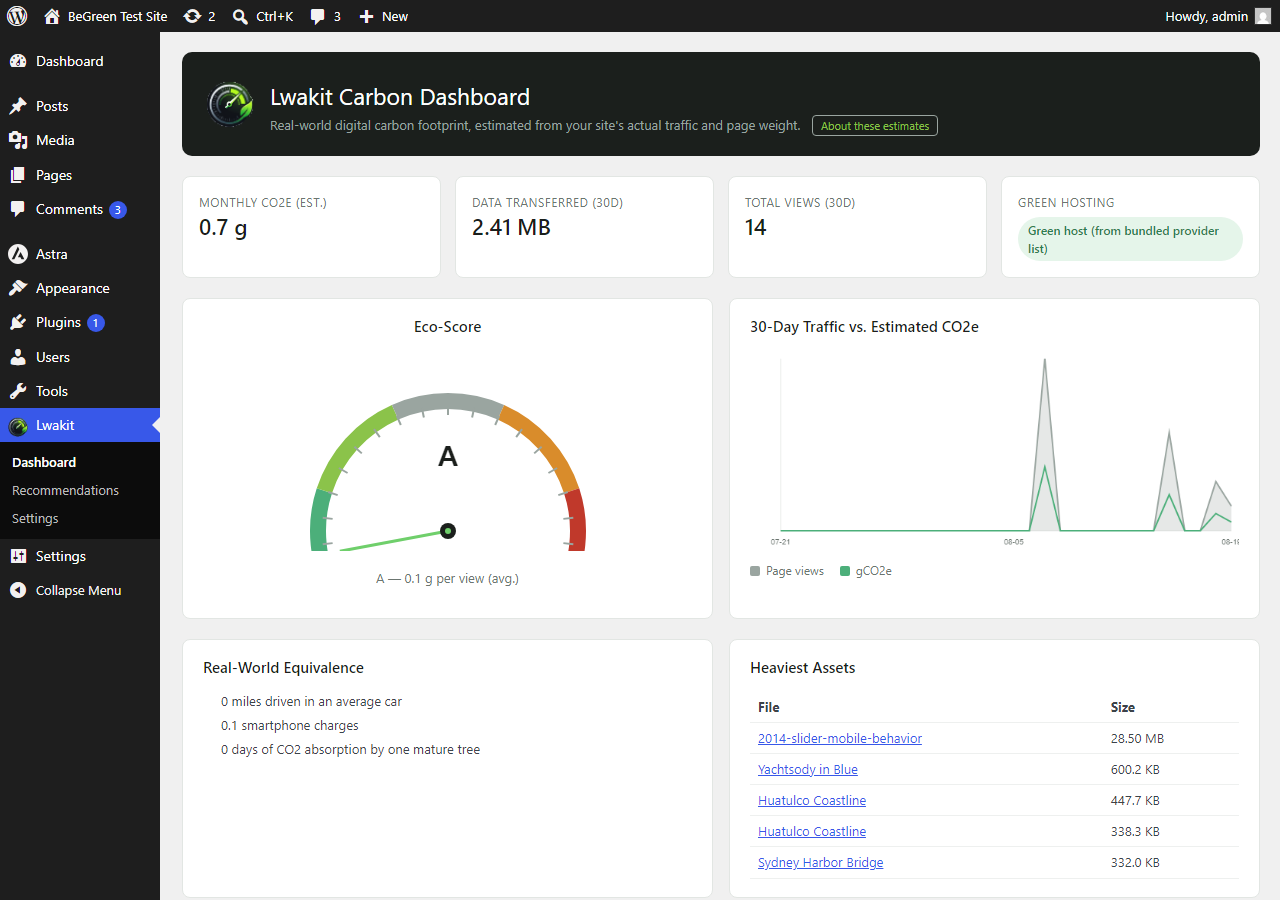
- (Free) Real-Time Carbon Dashboard — An Eco-Score gauge (A–F letter grade) rendered with plain HTML5 Canvas, a 30-day graph of page views vs. estimated daily gCO2e, summary tiles (monthly gCO2e, data transferred, green-hosting status), and a “heaviest assets” breakdown of your top 5 largest media files.
- (Free) Per-Page Traffic Mapping — Measures real page weight on the front end: actual HTML byte count, local script/style file sizes, local image sizes, and database query overhead, accumulated per page with daily granularity.
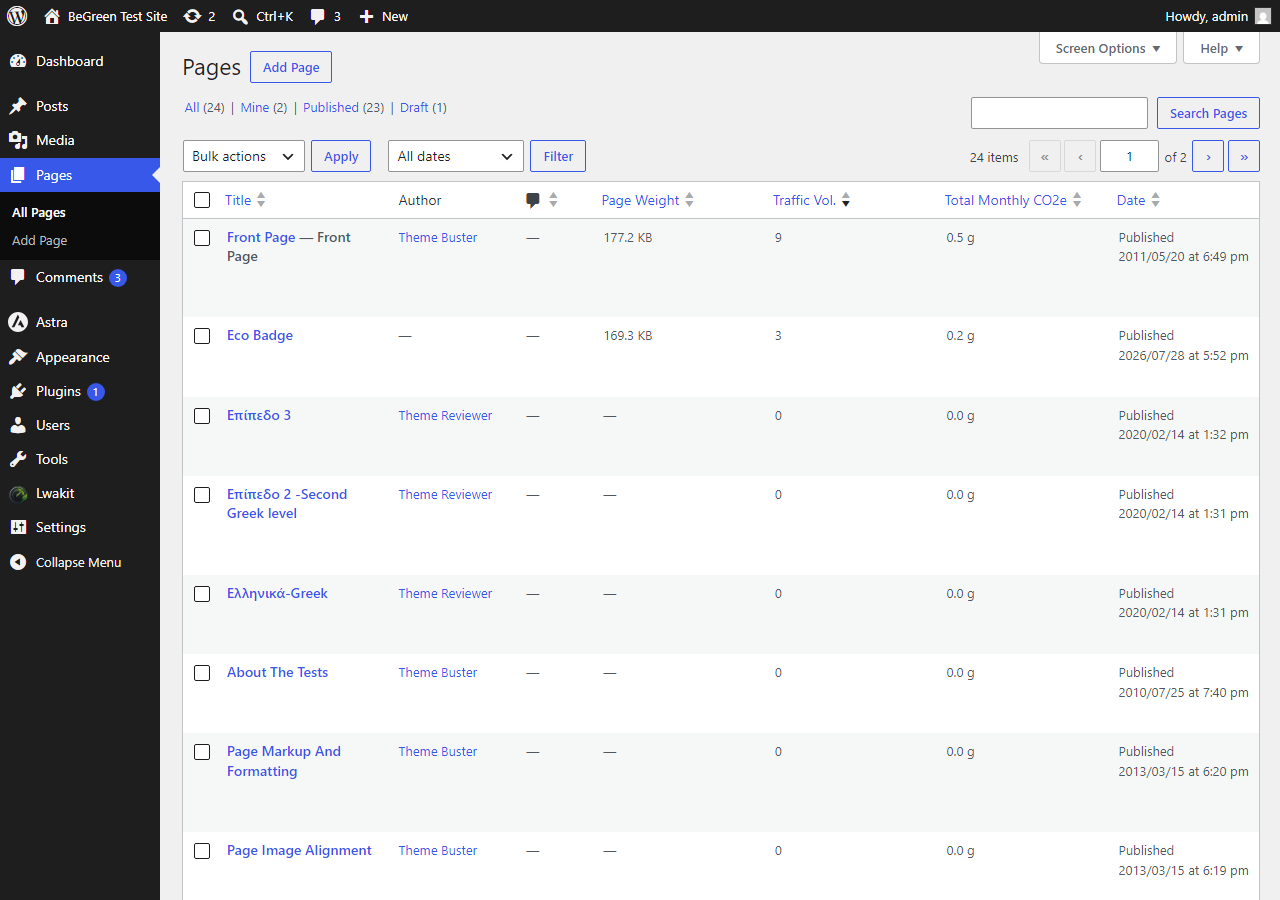
- (Free) Per-Page Impact Ledger — Adds sortable “Page Weight”, “Traffic Vol.” and “Total Monthly CO2e” columns to your Posts and Pages list tables.
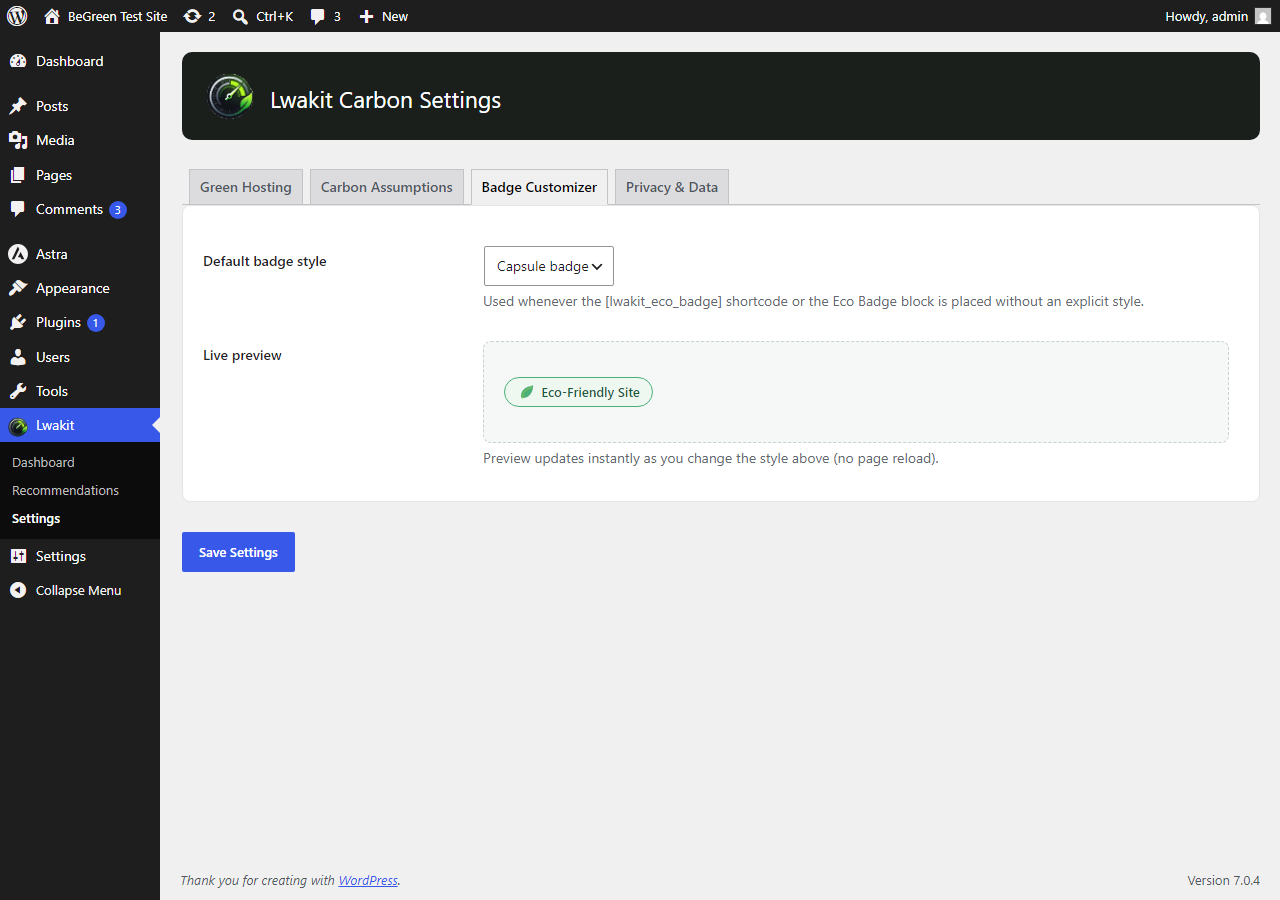
- (Free) Lightweight Frontend Trust Badge — A
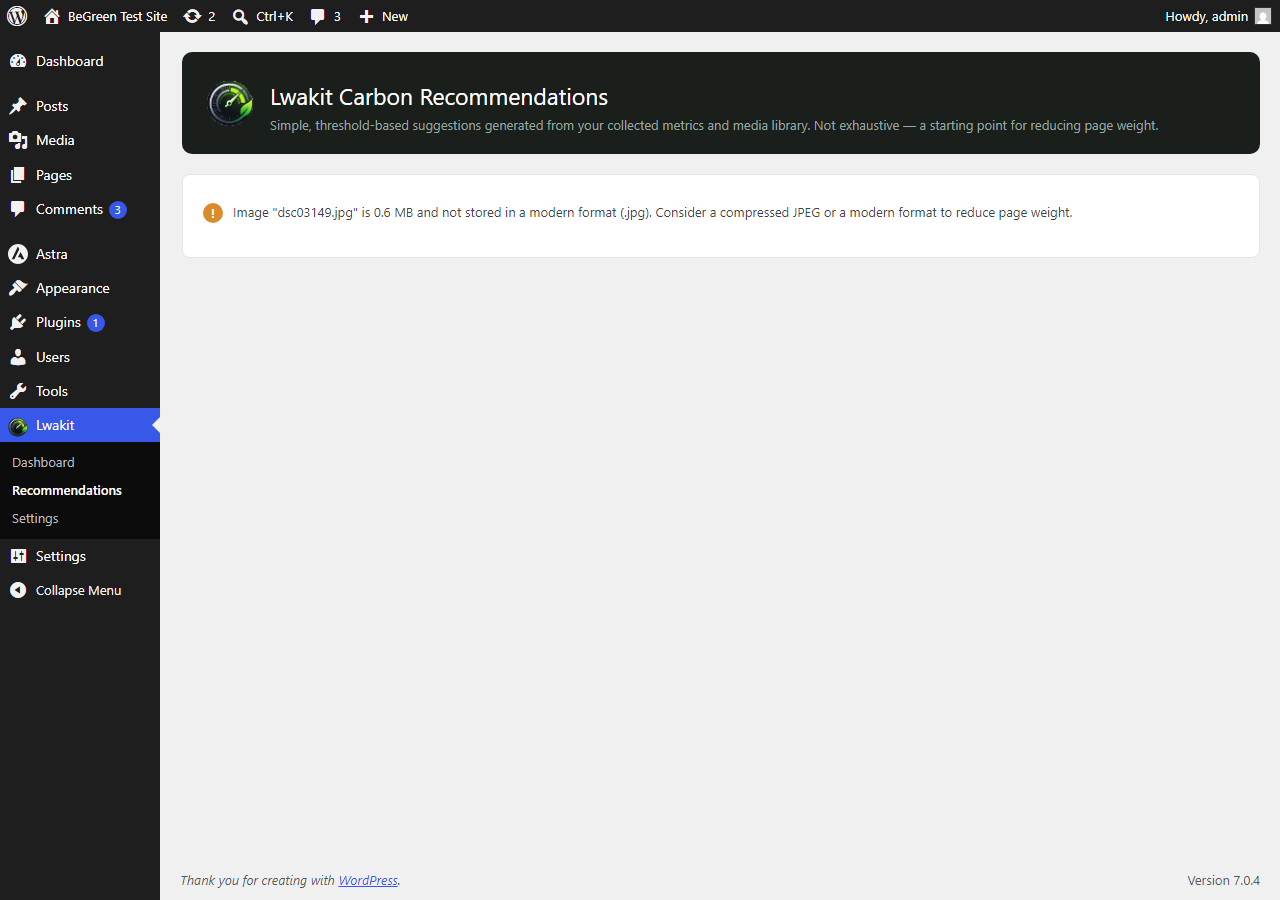
[lwakit_eco_badge]shortcode and a matching Gutenberg block render an inline-SVG “Eco-Friendly Site” badge (zero extra image requests) in 3 style variants, with a settings-based default and a live-preview customizer. - (Free) Basic Actionable Recommendations — Plain-language alerts generated from your collected metrics and media library, e.g. oversized images not in a modern format, or large non-minified scripts.
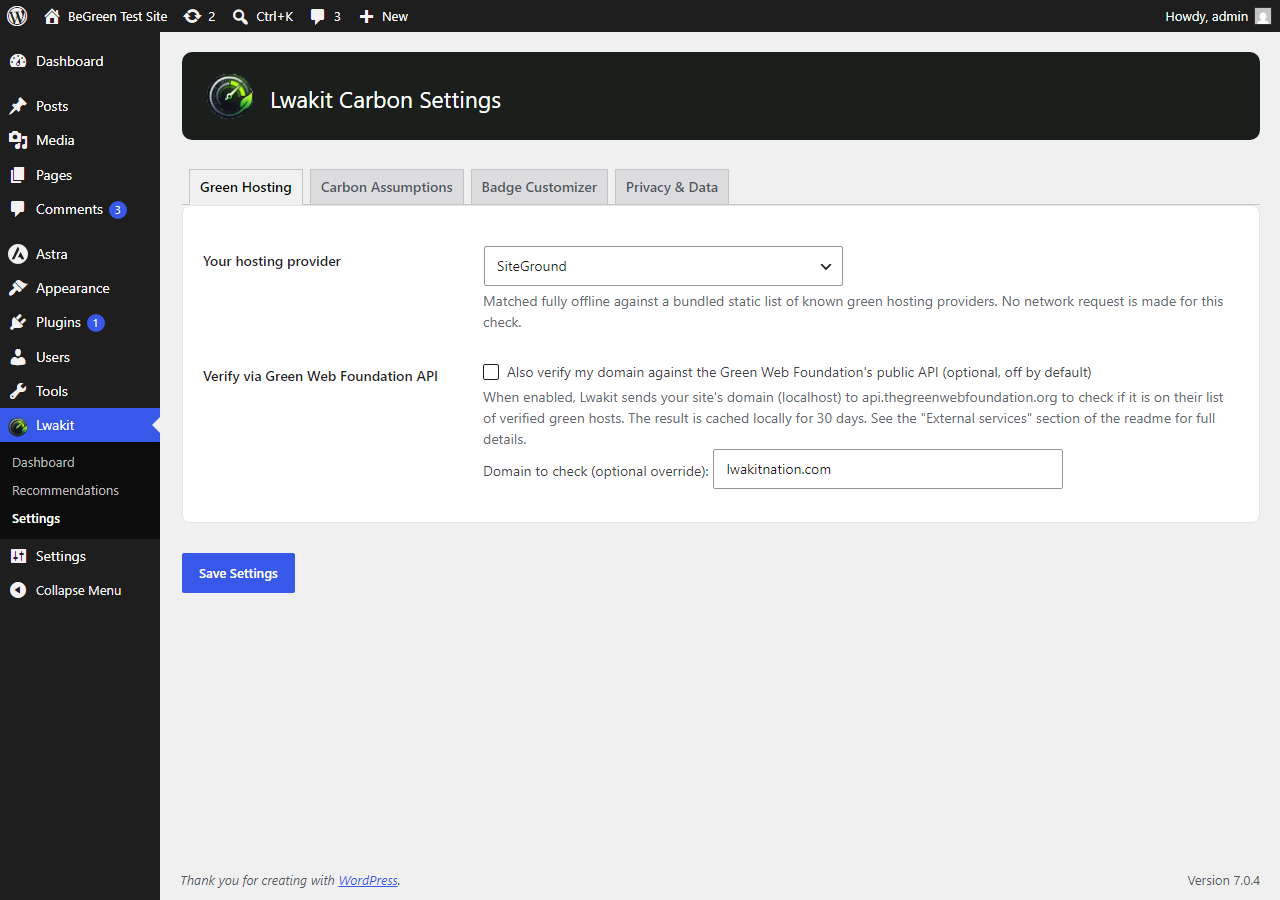
- (Free) Settings — Pick your host from a bundled offline green-hosting provider list, optionally verify via the Green Web Foundation API, edit the assumed grid carbon intensity, and control whether data is removed on uninstall.
Every number Lwakit Carbon Footprint Tracker shows is a modeled estimate, not a metered measurement — the methodology and every constant used are documented in the plugin’s source code and summarized in the dashboard’s “About these estimates” note.
A separate premium version with deeper optimization tooling is planned for the future; this free version is a complete, standalone tracking and reporting tool on its own and does not require any premium add-on to function.
External services
Lwakit Carbon Footprint Tracker’s core features (dashboard, tracking, recommendations, badge) work entirely offline and make no external network requests.
Optional: Green Web Foundation API verification. If you explicitly enable “Verify via Green Web Foundation API” on the Settings Green Hosting tab (this setting is off by default), Lwakit Carbon Footprint Tracker sends your site’s domain name (e.g. example.com, taken from your WordPress Site Address, or a domain you enter manually) to:
https://api.thegreenwebfoundation.org/greencheck/{your-domain}
This is a GET request containing only the domain name — no visitor data, page content, or personal information is included. It is used solely to check whether your hosting domain appears on the Green Web Foundation’s public registry of verified green hosts, so Lwakit Carbon Footprint Tracker can display a “Verified” badge instead of relying on the bundled offline list. The result (a true/false flag) is cached locally in a WordPress transient for 30 days to minimize repeated requests, and the request is made only when an administrator views data that needs it — never on visitor-facing front-end page loads.
This service is operated by The Green Web Foundation, a third party independent of Lwakit Carbon Footprint Tracker. See their privacy policy and terms of service for how they handle this request.
No other external service is contacted by this plugin.
Screenshots

Blocks
This plugin provides 1 block.
- Lwakit Eco Badge Displays an inline-SVG "Eco-Friendly Site" trust badge with no extra image requests.
Installation
- Upload the
lwakit-carbon-footprint-trackerfolder to/wp-content/plugins/, or install the plugin zip through Plugins Add New Upload Plugin. - Activate Lwakit Carbon Footprint Tracker through the Plugins menu in WordPress.
- Go to Lwakit CFT Settings and select your hosting provider, review the assumed grid carbon intensity, and choose your default badge style.
- Visit Lwakit CFT Dashboard after some front-end traffic has been recorded to see your Eco-Score and 30-day chart.
- Optionally add the
[lwakit_eco_badge]shortcode or the “Lwakit Eco Badge” block to any page or post.
FAQ
-
How accurate are the carbon estimates?
-
They are estimates, not precise measurements. Lwakit Carbon Footprint Tracker uses the published Sustainable Web Design Model methodology (energy per gigabyte transferred × a grid carbon-intensity assumption you can edit) combined with real, server-measured page weight from your own site’s traffic. Actual emissions vary by visitor device, network path, and local energy mix, and no software can measure true end-to-end emissions without instrumenting every device and network hop involved. Treat the numbers as a consistent, comparable trend indicator rather than an audited absolute figure.
-
Does Lwakit Carbon Footprint Tracker slow down my site?
-
Lwakit Carbon Footprint Tracker only measures pages that are already being rendered — it buffers the page output to count its size and reads file sizes already known to WordPress (enqueued scripts/styles, referenced local images), it does not add new database tables to every query, fetch additional remote resources, or block/modify your page output. Metrics are written once per page load using a single upsert query. Your own visits as a logged-in administrator are skipped automatically so testing doesn’t add overhead or skew your stats.
-
What data leaves my site?
-
By default, none. Green-hosting detection works fully offline against a static list of known providers bundled with the plugin. The only outbound network request Lwakit Carbon Footprint Tracker can make is an optional, opt-in check against the Green Web Foundation’s public API, which is off by default — see “External services” below for exactly what that sends.
-
Does Lwakit Carbon Footprint Tracker track my visitors personally?
-
No. Lwakit Carbon Footprint Tracker aggregates page weight, view counts, and database query counts per page per day. It does not store IP addresses, cookies, or any other visitor-identifying information.
-
Will this plugin block scripts, convert my images, or generate PDF reports?
-
Not in the free version. Lwakit Carbon Footprint Tracker (Free) is intentionally a pure tracking/reporting tool: it measures and reports, and gives you recommendations, but it does not modify your site’s assets or behavior. Optimization actions (image conversion, script blocking, caching, report exports) are out of scope for this version.
Reviews
There are no reviews for this plugin.
Contributors & Developers
“Lwakit Carbon Footprint Tracker” is open source software. The following people have contributed to this plugin.
Contributors
Translate “Lwakit Carbon Footprint Tracker” into your language.
Interested in development?
Browse the code, check out the SVN repository, or subscribe to the development log by RSS.
Changelog
1.0.14
- Changed: extended the “Lwakit CFT” short-form label to the readme’s Description and Installation sections, the Green Web Foundation domain-check text, the uninstall-behavior description, the JS error message, and LICENSE.txt — for consistency with the 1.0.13 admin menu label change.
1.0.13
- Changed: the top-level admin menu label is now “Lwakit CFT” (was “Lwakit”).
1.0.12
- Changed: the shortcode is now
[lwakit_eco_badge](was[begreen_badge]) to match the plugin’s new name — WordPress shortcode tags can’t contain spaces, so this is the closest valid form to “Lwakit Eco Badge”. - Changed: admin page titles/headings “Recommendations” and “Lwakit Settings” are now “Lwakit Carbon Recommendations” and “Lwakit Carbon Settings” (sidebar menu labels stay short, as “Dashboard”/”Recommendations”/”Settings”).
- Fixed: the dashboard’s “About these estimates” text still referenced “BeGreen” — missed in the 1.0.11 rename because the string spanned multiple lines. Now reads “Lwakit Carbon Footprint Tracker estimates emissions…”.
1.0.11
- Changed: renamed the plugin from “BeGreen — Carbon Footprint Tracker” to “Lwakit Carbon Footprint Tracker” (slug:
lwakit-carbon-footprint-tracker), per WordPress.org review feedback regarding potential brand confusion with the “BeGreen” name. Updated the display name, Text Domain, and all user-facing UI text accordingly. - Fixed: the admin menu icon’s sizing rule is now registered via
wp_register_style()/wp_add_inline_style()instead of a rawecho‘d<style>tag, per Plugin Check guidance to use WordPress’s enqueue APIs for all CSS/JS output.
1.0.10
- Fixed:
Text Domainheader now matches the plugin slug assigned by the WordPress.org review team (begreen-carbon-footprint-tracker), resolving atextdomain_mismatchwarning from Plugin Check. Every translation-function call across the plugin (PHP and the Eco Badge block’s JS) andblock.json‘stextdomainfield were updated to match.
1.0.9
- Changed: the dismissible “premium version” admin notice is temporarily disabled ahead of submission; its link now points to the real premium info page for when it’s re-enabled.
1.0.8
- Fixed: the remaining Plugin Check nonce-verification false positive on
class-begreen-admin.php‘scurrent_page_slug()— the$_GET['page']read happened on two separate lines, so a single-linephpcs:ignoreonly ever covered one of them. Collapsed to a single statement with one ignore comment; re-ran WP-CLI’swp plugin checkand confirmed zero remaining findings.
1.0.7
- Fixed: the “BeGreen Eco Badge” block now declares
apiVersion: 3in block.json, as required for WordPress 7.0’s iframe-based block editor. - Fixed: all custom-table SQL in
class-begreen-db.php,class-begreen-recommendations.phpanduninstall.phpnow passes the table name through$wpdb->prepare()‘s%iidentifier placeholder instead of raw string interpolation. - Fixed: a nonce-verification false-positive flagged by Plugin Check on
class-begreen-admin.php(a read-only$_GET['page']navigation check, not a state-changing action) by relocating the existingphpcs:ignorejustification onto the exact line PHPCS parses. - Updated: added scoped
phpcs:ignore/phpcs:disablecomments (with justification) for the direct-database-query and local-template-variable warnings that Plugin Check reports on every custom-table query and every included admin view — both are expected, unavoidable patterns for a plugin with its own table and plain-include view templates, not real issues.
1.0.6
- Updated: Contributors field corrected to the WordPress.org username.
1.0.5
- Fixed: menu icon and header logo now use a genuinely transparent source image, sized purely via CSS (
object-fit: contain) instead of pre-cropped image files, so the artwork displays correctly without a visible background box.
1.0.4
- Updated: refreshed menu icon and header logo artwork.
1.0.3
- Updated: author and contact information.
1.0.2
- Updated: new brand icon and logo artwork used throughout the admin UI (menu icon and page headers).
1.0.1
- Fixed: the admin menu icon was rendered at its full native image size instead of matching the other sidebar icons, since WordPress applies no CSS sizing to a custom
add_menu_page()icon. Replaced it with a properly sized 20×20 icon.
1.0.0
- Initial release: Real-Time Carbon Dashboard, Per-Page Traffic Mapping, Per-Page Impact Ledger columns, Frontend Trust Badge (shortcode + block), Basic Actionable Recommendations, and Settings (offline green-hosting list, optional Green Web Foundation verification, editable grid intensity, uninstall data control).