

Description
Build forms in your HTforms dashboard and show them anywhere on WordPress.
HTforms Builder connects WordPress to the hosted HTforms service. An HTforms
account and account API key are required; this is not a standalone local
form builder. HTforms is currently free, without merchant usage caps.
* Published field ordering and custom country/territory lists match HTforms, including cached HTML and Elementor previews.
* Gutenberg block “HTforms” and shortcode [htform id=”FORM-ID”]
* Native Elementor HTforms widget with a published-form picker; other builders work through their shortcode widget
* Submissions are proxied through your site; your API key never reaches the browser
* Spam protection (honeypot + time trap + server rate limits), file uploads, multi-step forms, conditional logic
* WordPress-native email notifications and visitor confirmations, with optional account SMTP routing
* Entry search, repeated-identifier filters, exports and a WordPress Dashboard leads widget
* Optional administrator-configured draft/pending post or consented subscriber actions
No-code builder, templates and AI
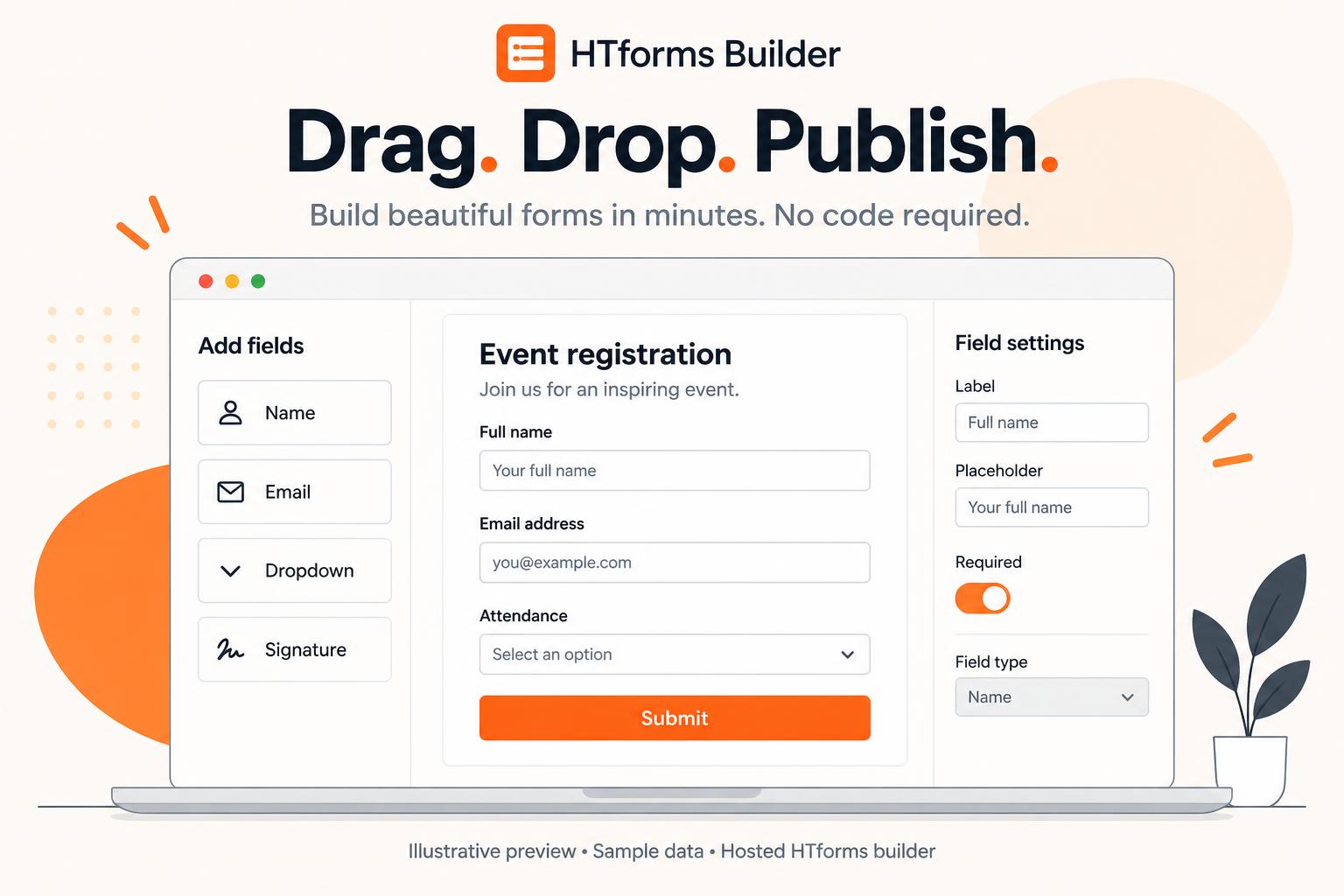
Create and edit forms in the hosted HTforms dashboard, then publish them to
WordPress. Drag and drop fields, reorder questions and choices, duplicate fields,
use undo/redo, and test the form without creating entries or sending emails.
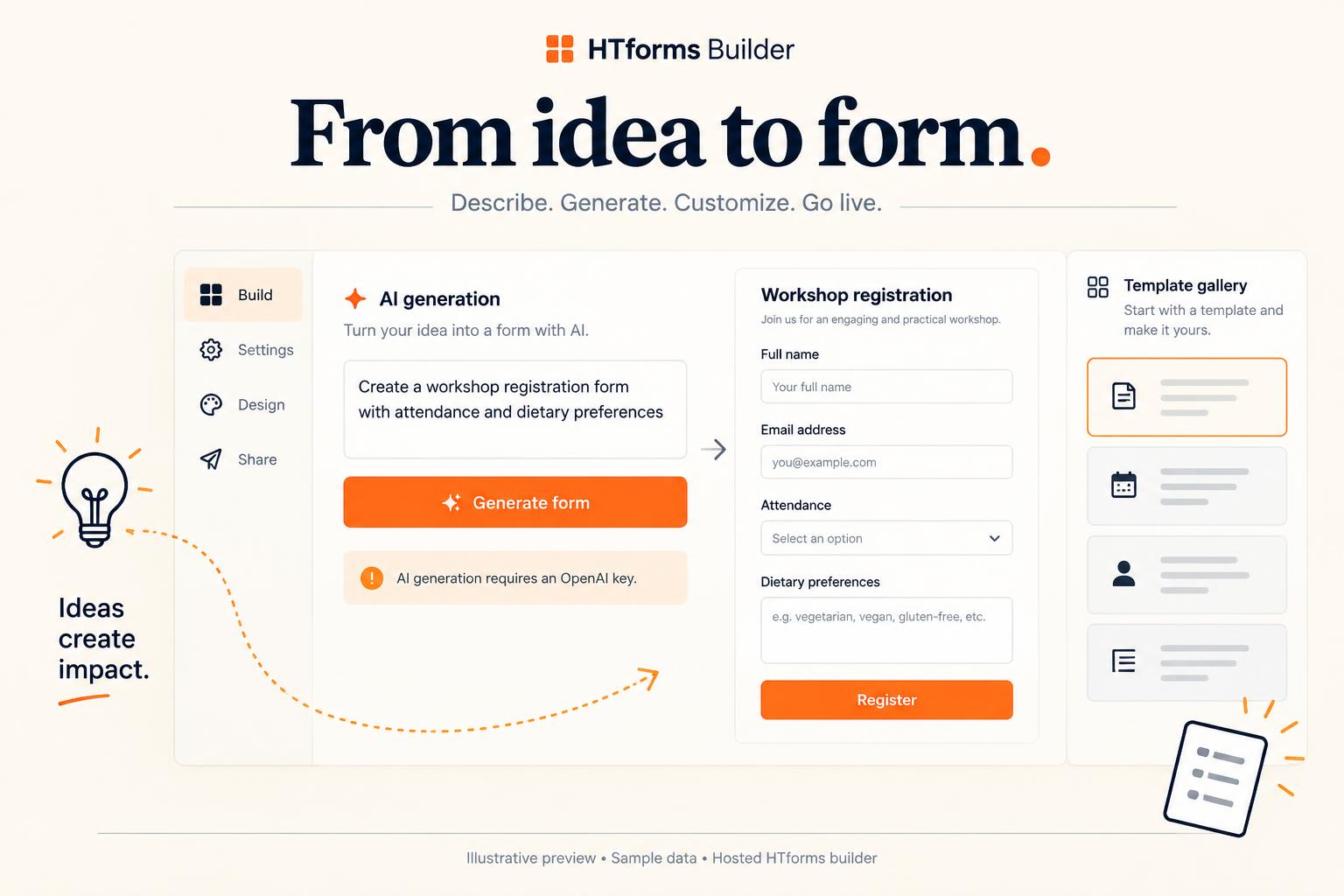
Start from the searchable template gallery or describe a form to the AI generator.
AI generation requires the service owner’s configured OpenAI key and uses
gpt-4o-mini; review generated fields and rules before publishing. AI does not run
inside WordPress and is not an independent locally installed template generator.
Set labels, help text, required fields, confirmation fields, country choices,
submit text, form colors and layout. Published updates refresh connected embeds.
Form layouts and advanced fields
- Multi-page and lead forms with page breaks and progress indicators.
- Conversational forms show one question at a time and skip hidden branches.
- Conditional visibility, conditionally required inputs and submission policy locks.
- Live calculations and repeaters with add/remove rows and calculated column totals.
- Coupon codes affect form totals only; there is no payment processing.
- Digital signature pads, uploads with validation, ratings, NPS and Likert questions.
- Scored, weighted and personality quizzes configured in the hosted builder;
accepted answers are scored by the service and results are saved with the entry. - Custom CAPTCHA challenge fields, honeypot, timing checks and submission rules.
This is not a Google reCAPTCHA or Cloudflare Turnstile integration. - Schedules, allowed domains and owner-configured per-visitor submission restrictions.
These form-level rules are not merchant account usage caps.
Entries, client replies and documents
Search answers and recorded visitor metadata, inspect entries, filter repeated
identifiers, change lead stages, add private notes in HTforms and export CSV.
Repeated email, IP or visitor identifiers are evidence, not proof of a person.
The WordPress Entries screen includes a visible Reply to client section with
recipient, subject and message. One final reply is permitted per entry and uses
WordPress wp_mail, including a configured SMTP plugin. Hosted Entries replies
require the merchant’s SMTP connection. Final client replies never use the
HTforms built-in sender. Replies from clients arrive in the configured Reply-To
or sending inbox; incoming mail is not collected in the Entries screen.
Message links can use clickable words. Images use owner-hosted HTTP/HTTPS URLs;
the reply composer does not upload or store image binaries at HTforms.
Download entry PDFs, including signatures, from hosted Entries. PDFs are generated
on the device; this is not a native WordPress PDF-generation settings screen.
Email, analytics and scheduled reports
WordPress form notifications use the site’s mail setup. An existing WordPress SMTP
plugin can deliver wp_mail messages. Alternatively, configure merchant SMTP in
HTforms and test it. HTsend is a suggested provider, not a pre-authorized mail
connection; use only host and credentials actually supplied by your provider.
HTforms analytics show recorded entries, top forms, sources and detected countries.
Coverage notes identify entries without country/source information; missing values
are not invented. Undated views and conversion are lifetime metrics, not dated
conversion comparisons. The WordPress Dashboard leads widget provides a summary.
Configure daily, weekly or monthly performance emails on the hosted Reports page.
Reports rank forms and countries, include source coverage, dashboard links and a
website/preferences/privacy footer. Stop reports at any time. Merchant reports
use saved SMTP when configured, otherwise the service report sender; this is
separate from the strict merchant-mail route for final client replies.
Hosted Email Logs expose recipient, status and recorded failure reason per attempt.
A sent status proves a mail attempt was accepted, not delivery to a client’s inbox.
Consent-based abandonment and journeys
Enable selected safe partial answers and page progress only with visitor consent.
Hosted Journeys shows completed and unfinished sessions, abandonment rates and
an email follow-up link. This link opens the merchant’s mail application; it is
not an automatic abandoned-form email campaign. Visitors can withdraw consent.
Unfinished sessions do not trigger entry emails or WordPress account/post actions.
Progress data expires after 30 days; files and signatures are excluded from capture.
Addons and connection availability
The hosted Addons Center distinguishes native tools from services requiring setup.
Native tools described above include Multi-Page Forms, Lead Forms, Form Landing
Pages, Form Abandonment, Conversational Forms, Spam Protection, VPN & Proxy
Detection, Form Locker, CAPTCHA, Calculations, Conditional Logic, Repeater Fields,
Digital Signatures, Coupons, File Uploads, Surveys and Polls, Geolocation, Quiz
Builder, WordPress Plugin, REST API, Team Members, Entry Exports, PDF Generator,
Form Analytics, User Journey and Scheduled Reports.
SMTP requires configuration and a successful connection test. Webhooks, Zapier,
Make, n8n Cloud, Slack and Notion require owner-authorized destinations and testing;
listing them does not mean they are connected. API keys and service credentials
remain server-held. HTsend Email Marketing is not a verified direct connector.
Direct HubSpot, Salesforce, Pipedrive, Zoho CRM, Google Sheets, Google Drive,
Dropbox, Airtable and Google Calendar connectors are not available natively.
Ranking Fields, Address Autocomplete, Appointment Booking, general visitor
Registration/Login/Password Reset and Customer Portal are not released addons.
Save and Resume and Offline Forms have limited hosted-only support, not full
WordPress parity. Do not rely on them as installed WordPress addons.
WordPress alone supports optional, administrator-mapped draft/pending posts and
consented subscriber creation from accepted entries; no privileged role selection
or automatic visitor login. No payment gateway integrations are included.
Related products (optional, separate services)
HTsend is an email service; SMTP use still requires documented
provider settings and testing. HTchat is a separate chat
product. Jamesinvoicing is a separate Bitcoin
invoicing product, not a payment gateway in HTforms. These products are optional:
none is installed, connected or contacted automatically by this WordPress plugin.
External services and privacy
The administrator explicitly connects the site to HTforms at https://htforms.app
(or their configured HTforms endpoint). After connection, PHP sends the server-held
API key and site URL when fetching published forms, connection status, entries,
reports or performing administrator-requested entry changes.
When a visitor submits a connected form, submitted answers, permitted file uploads,
visitor IP address, user agent, available referring/campaign information and a
browser-stored visitor identifier are sent to HTforms for published-schema
validation, entry storage, spam checks and reporting. Entry search and reporting
return account-scoped data to authorized WordPress administrators.
Optional unfinished-answer and journey capture requires explicit visitor consent;
only owner-selected safe fields and page progress are sent, and withdrawal is
supported. Optional post/subscriber actions use accepted entries locally;
subscriber creation requires explicit consent. Mail uses WordPress wp_mail or
the owner’s configured HTforms SMTP route. No service API key reaches visitors.
HTforms may send an IP address to proxycheck.io, ip-api.com and ipapi.is to check
location and VPN/proxy evidence. Optional owner-authorized automations forward
selected entry data to the connected services. AI builder prompts are processed
by OpenAI in the HTforms dashboard, not by the WordPress plugin.
No remote connection is made before account configuration. Form images selected
by the owner may load from their chosen HTTPS image URL. Site owners must provide
their own privacy notices and obtain any legally required consent.
HTforms privacy notice: https://htforms.app/privacy
HTforms service terms: https://htforms.app/terms
IP provider policies: https://proxycheck.io/privacy/ ; https://ip-api.com/docs/legal ; https://ipapi.is/privacy.html
OpenAI privacy policy: https://openai.com/policies/privacy-policy/
Source and licensing
Plugin code and HTforms artwork: GPL-2.0-or-later (LICENSE.txt).
Signature Pad 5.1.4: MIT, license in licenses/signature-pad-MIT.txt;
readable browser build and original TypeScript source included.
See THIRD-PARTY.md for provenance and upstream build instructions.
Contributors & Developers
HTforms Builder is maintained by the HTforms team. The approved WordPress.org
repository committer is htsend. The Contributors header retains the existing
htsend and htforms accounts; credits do not grant repository access.
The hosted HTforms service provides the builder, published-schema validation,
entry storage and account reports. The WordPress plugin provides local embedding,
private server-to-server API access, WordPress mail and administrator tools.
Plugin code and HTforms artwork are GPL-2.0-or-later. Signature Pad is credited
under its MIT license with readable source and license bundled in the plugin.
Use the WordPress.org support forum for reproducible plugin issues. Include
WordPress/PHP/plugin versions and redacted error details; never publish keys,
SMTP passwords, entry answers or customer data. Integration developers should
use the account-scoped v1 API documented at https://htforms.app/docs.
The shortcode name, stored settings and API identifiers remain compatible with
earlier HTform releases. The directory name/text domain is htforms-builder;
the cloud product name remains HTforms. Contributions should preserve these
identifiers, administrator permissions, consent and merchant email routing.
Screenshots


Blocks
This plugin provides 1 block.
- HTforms
Installation
- Confirm WordPress 6.0 or later, PHP 7.4 or later and outbound HTTPS access to HTforms. Back up an existing site before replacing a plugin version.
- Upload the standalone htforms-wordpress-1.11.16.zip through Plugins Add New Upload Plugin, install and activate. Do not upload the listing/SVN assets kit. For manual installation, extract its htform folder into wp-content/plugins.
- Create or sign in to your HTforms account. Build a form in the hosted dashboard, review its fields and settings, test it, then publish it. Draft-only forms cannot be selected as published embeds.
- In HTforms open WordPress & API and create an account API key. Keep it private: do not paste it into page content, screenshots or browser JavaScript.
- In WordPress open HTforms Connection, enter https://htforms.app and your key, then choose Save & test connection. Resolve any connection error before embedding.
- In the block editor add the HTforms block and select your published form. In Elementor select the native HTforms widget and choose a published form. Other builders can use their shortcode widget with [htform id=”YOUR-FORM-ID”].
- Configure WordPress email settings and send a test using your site’s mail setup. For hosted SMTP delivery, save and test the provider’s real SMTP details in HTforms. A successful account connection alone does not verify email delivery.
- Open the published page, submit a deliberate test entry and verify it under HTforms Entries and in your intended inbox. Editor previews never submit.
- For daily/weekly/monthly digests open the hosted Reports page, choose recipients and frequency, save and use Send now for a real inbox test. Use Stop reports whenever you no longer want scheduled email.
- For consent-based journeys or WordPress post/subscriber actions, configure them explicitly and update your privacy notice. They are not enabled by installation.
- If a published change is missing, use Troubleshooting Clear form cache, clear your page/CDN cache and reopen the page. Uninstall removes local settings and caches, not hosted entries. Reconnecting requires your account key.
WordPress.org maintainers: this approved plugin is published through SVN at https://plugins.svn.wordpress.org/htforms-builder. Upload plugin contents to trunk and the matching release tag; directory screenshots/icons/banners go in the repository’s separate top-level assets directory, not inside the install ZIP.
FAQ
-
My form does not show
-
Make sure it is published, then use HTforms Troubleshooting Clear form cache.
-
Where are entries?
-
In WordPress under HTforms Builder Entries and in HTforms under Forms Entries.
-
Does uninstall delete hosted entries?
-
No. Uninstall removes the plugin’s local settings, form caches and action history.
Manage hosted entries in your HTforms account. -
Is email delivery guaranteed?
-
No. WordPress mail depends on your host and mail configuration. An SMTP plugin
can be used with native WordPress mail, or configure your own SMTP in HTforms.
Reviews
There are no reviews for this plugin.
Contributors & Developers
“HTforms Builder” is open source software. The following people have contributed to this plugin.
Contributors
Translate “HTforms Builder” into your language.
Interested in development?
Browse the code, check out the SVN repository, or subscribe to the development log by RSS.
Changelog
1.11.16
- Expand feature, addon-availability, installation, privacy and developer documentation.
- Document hosted AI generation, SMTP, client replies, scheduled reports and optional related products without claiming unconnected integrations.
- Add captions for eight clearly labelled illustrative previews; plugin behavior and existing mail routes are unchanged.
1.11.15
- WordPress.org review fixes: enqueued admin/print assets, default-off administrator attribution consent, complete submission buffer cleanup, matching htforms-builder translations and contributor credits.
1.11.14
- Conversational forms skip hidden questions and preserve supporting content.
1.11.13
- Quiz results (score and outcome) now appear on separate lines after submitting.
1.11.12
- Use HTforms account terminology in connection screens, messages and documentation; existing API keys and settings are unchanged.
1.11.11
- Client replies: Add link and Add image buttons; images are linked from your own site, never uploaded.
1.11.10
- Entries: visible “Reply to client” box under client details showing where client answers go.
1.11.9
- Click a client email in Entries to send one final reply (subject and message) through your own site mail or SMTP plugin; never sent from HTforms.
1.11.6
- WordPress directory name: HTforms Builder. Existing shortcode and settings remain compatible.
- Include GPL and MIT licenses and readable Signature Pad source.
- Complete local option, transient and entry-column cleanup on uninstall.
- Expand hosted-service data-flow disclosure and document directory screenshots.
1.11.5
- Merchant-ordered country lists and territories; field reordering and matching WordPress rendering.
1.11.4
- Search saved answers, files and visitor metadata using literal phrases, all keywords or exact values.
- Filter repeated email/IP/user IDs with complete-history per-form counts; date filters and exports match the search.
1.11.3
- HTTPS-safe submission URLs, signed refresh of expired cached-page sessions, and resilient JSON replies without automatic submission retries.
- Reports rank recorded sources and detected countries only, with coverage counts for older entries lacking metadata. Totals stay unchanged.
1.11.2
- Fix: visitors no longer see “Network error” after a successful submission when other plugins print notices or email sending is slow. The reply is sent first, then emails run.
1.11.1
- Entries show only VPN or NO VPN once checked; unfinished checks finish automatically. Technical errors are no longer shown.
1.11.0
- Lead stages (New, Contacted, Qualified, Proposal sent, Won, Lost) with estimated value in Entries, exports and bulk actions; every stage change is recorded in the lead timeline in HTforms.
1.10.0
- New “HTforms Leads” widget on the WordPress Dashboard: 7/30-day lead chart, totals, unread leads, top lead sources and countries.
- Every entry now records where the lead came from (search engine, social site, campaign tags, referring page) and shows it in Entries and exports.
1.9.0
- Optional visitor-consented unfinished-answer capture and form-page journey reporting.
- Only merchant-selected safe field types are shared; files, signatures and security fields are excluded.
- Progress never triggers notifications or WordPress post/account actions; accepted submissions mark the session complete.
- Existing mail routing and immediate form rendering remain unchanged.
1.8.0
- Per-form WordPress actions: map accepted entries to draft/pending posts and subscriber accounts.
- Required single-option account-consent checkbox, WordPress password-setup notifications, no automatic login or privileged role selection.
- Spam/ambiguous responses never create posts or users; unique accepted-entry action claims prevent reprocessing the same entry.
- Administrator-only settings and actual action history; existing form display and email routing unchanged.
1.7.1
- Accepted WordPress entries use HTforms account automations: configure services and test delivery in HTforms WordPress & API.
- No service credentials are added to WordPress. Native WordPress and SMTP email routing remain unchanged.
1.7.0
- Calculations (live totals), repeater sections, custom CAPTCHA questions and coupon codes — all checked by HTforms on submit.
1.6.0
- Signature drawing and download, star ratings, Likert scales, NPS and polls.
- Server-printed fields match live rendering; survey reports use saved entries in HTforms.
- Existing WordPress and SMTP email routing is unchanged.
1.5.1
- Admin: HTforms logo shown clearly and aligned on every HTforms screen.
- Forms published on htforms.app now replace the saved WordPress copy automatically within minutes, even with page caching.
1.5.0
- Entries: VPN, PROXY, TOR and DATACENTER (red), NO VPN (green, only after a successful provider check) and CHECK FAILED (grey) badges, with the provider, check time and failure reason shown on each entry. Same rules as htforms.app.
- Real visitor IP behind Cloudflare: CF-Connecting-IP is trusted only when the request comes from Cloudflare’s network; other proxies can be trusted with the htform_trusted_proxies filter. Spoofed forwarding headers are ignored.
1.4.9
- Elementor: choosing a form in the HTforms widget now saves and shows the live form preview instantly on every Elementor page.
1.4.8
- The form is now printed as real HTML in the page, so it shows even when Cloudflare Rocket Loader, LiteSpeed, WP Rocket or other speed tools delay scripts. Anything typed before the script starts is kept.
- HTforms script is automatically excluded from delayed/combined JavaScript in common speed plugins, and saved pages are cleared once after updating.
- Elementor no longer caches an old copy of the HTforms widget.
- Troubleshooting: new Speed check and a button that clears form cache and saved pages.
1.4.7
- Forms now appear instantly: the last published copy is stored on the site and printed straight into the page, with no “Loading form” wait. Updates still refresh in the background.
1.4.6
- Elementor: the form picker is now a searchable popup listing every published form.
- Elementor: the selected form renders instantly in the editor preview — no more blank/white area; preview submissions stay disabled.
1.4.5
- Entries start with Client Name, Email, IP Address (NO VPN green / VPN red) and Unique User ID; answers use the form’s real field names.
1.4.4
- Refresh published forms on each page opening, window focus, and every 15 seconds while untouched; never erase answers being entered.
- Render cached forms immediately and move freshness checks off the page-rendering path.
- Add email confirmation, full country list, split names, images, boundary lines and custom submit styling.
- Forward confirmation emails for server validation; keep existing WordPress mail routing unchanged.
1.4.3
- Fixed blank Gutenberg previews: load and initialize the actual form renderer in the editor.
- Added a native Elementor widget with a published-form picker.
- Initialize forms inserted after page load; display loading and error states instead of silent blanks.
- Editor previews cannot send submissions; existing WordPress email settings are unchanged.
1.4.2
- All entry emails now go out from the WordPress admin email; HTforms’ own sender is no longer used for WordPress forms.
1.4.1
- After activation, opens the Connection screen automatically.
- Connection fix: only the HTforms website address is kept, so pasted dashboard links no longer cause HTTP 404.
1.4.0
- Entries screen with chart, search, bulk actions and export.
1.3.0
- Emails through WordPress (wp_mail): merchant alerts to the site admin email and visitor confirmations, no SMTP needed. Works with any WordPress SMTP plugin.
- Elementor: use the Shortcode widget with [htform id=”…”].
1.2.0
- Applies each form’s design: colors, font, spacing, corner roundness, button style, logo, 2-column layout.
- Lead and conversational (one question at a time) layouts.
- Shows the form’s closed message when outside its schedule.
1.1.0
- New field types: Name, Address, Multi-select and Section divider.
- Settings from 1.0.0 are kept on upgrade.
1.0.0
- First release.