

Description
Designed2Use Events is a self-contained events calendar for WordPress. Events
and venues are custom post types — not products — so the calendar works fully
on its own. When WooCommerce is active, an opt-in ticketing module turns
events into purchasable tickets with attendee capture, capacity tracking,
sale windows and refund-aware capacity release.
Calendar without WooCommerce
- Events and venues as custom post types, with categories and tags
- Frontend Pages for the calendar (
/events/) and the venues archive
(/venues/) — created on activation and rendered through your active
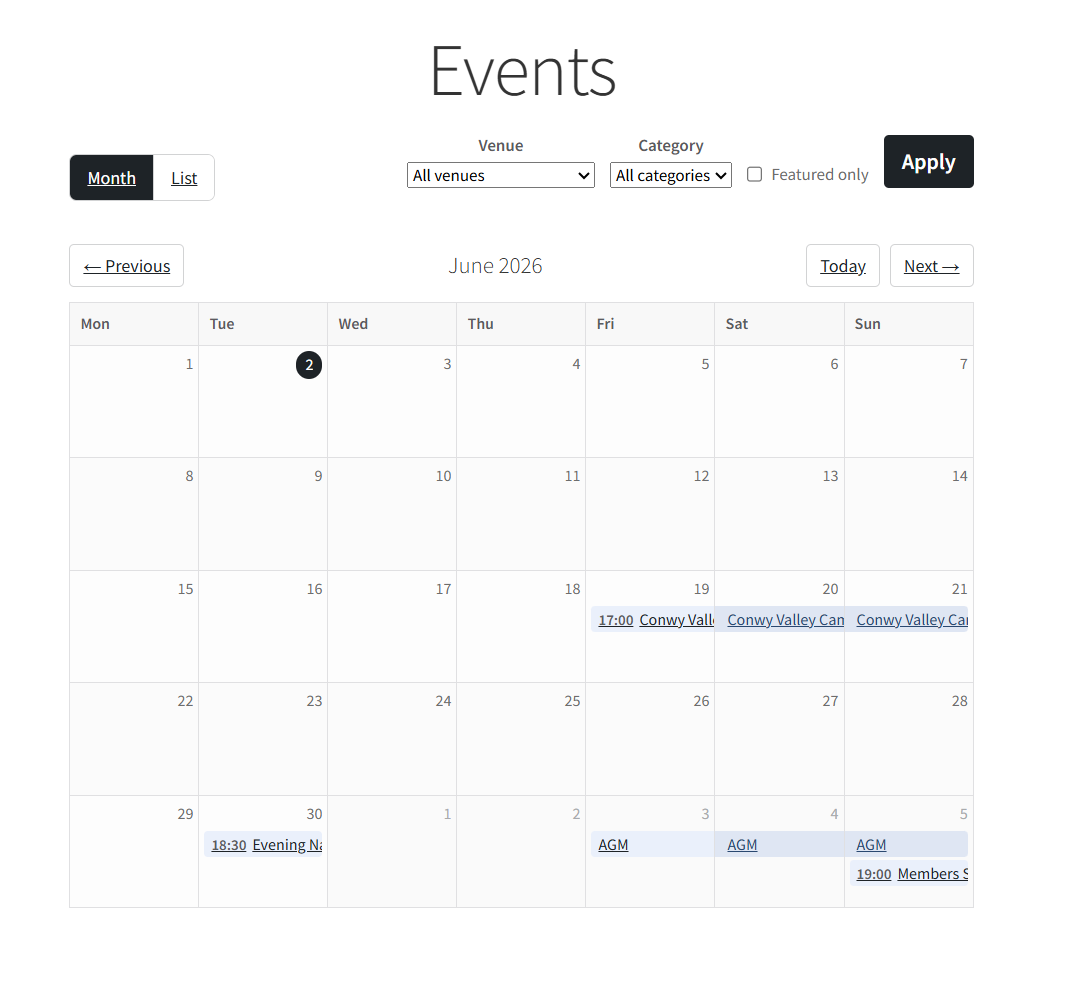
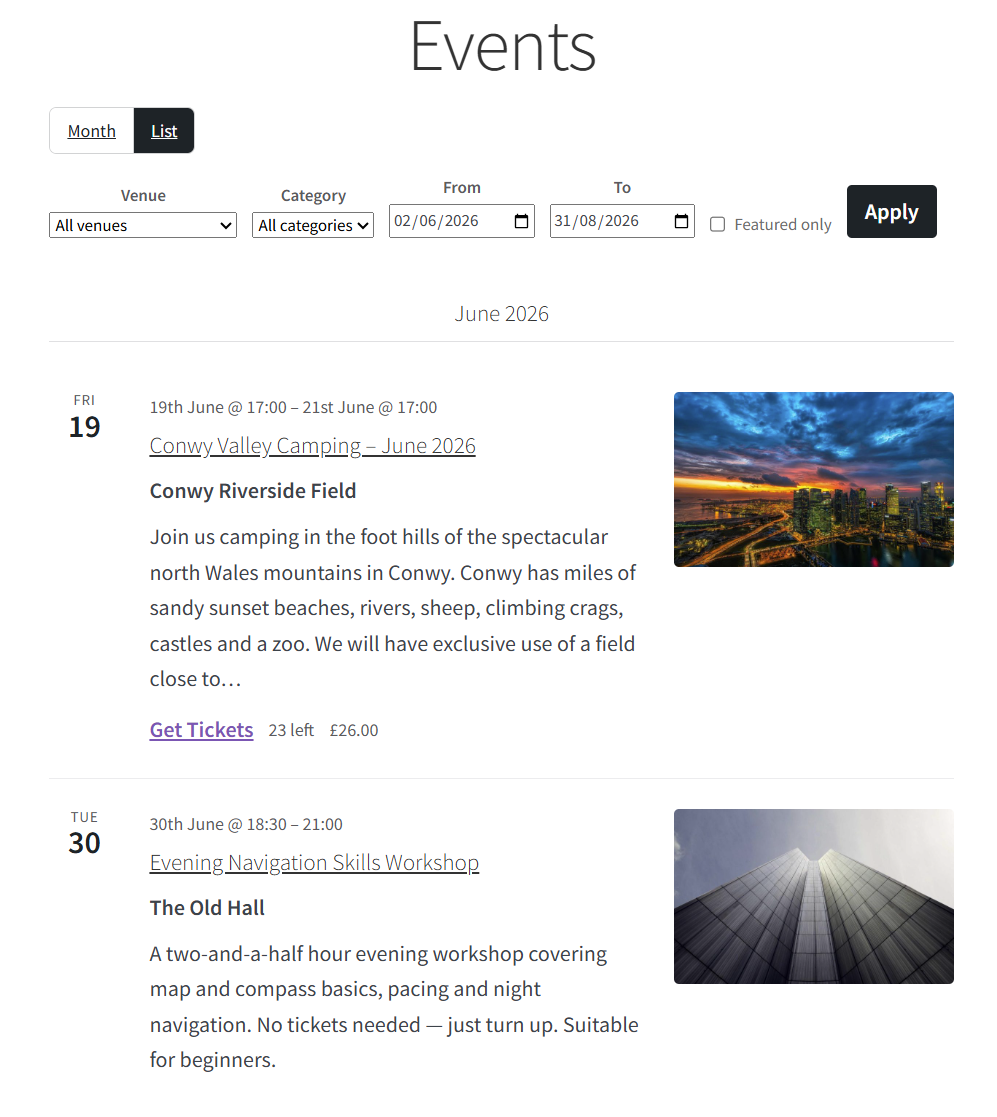
theme, no template takeover - Month + List calendar views with venue / category / featured filters,
prev / next month navigation, and a shareable URL for every state - Server-rendered first paint plus a vanilla-JS REST-driven view swap —
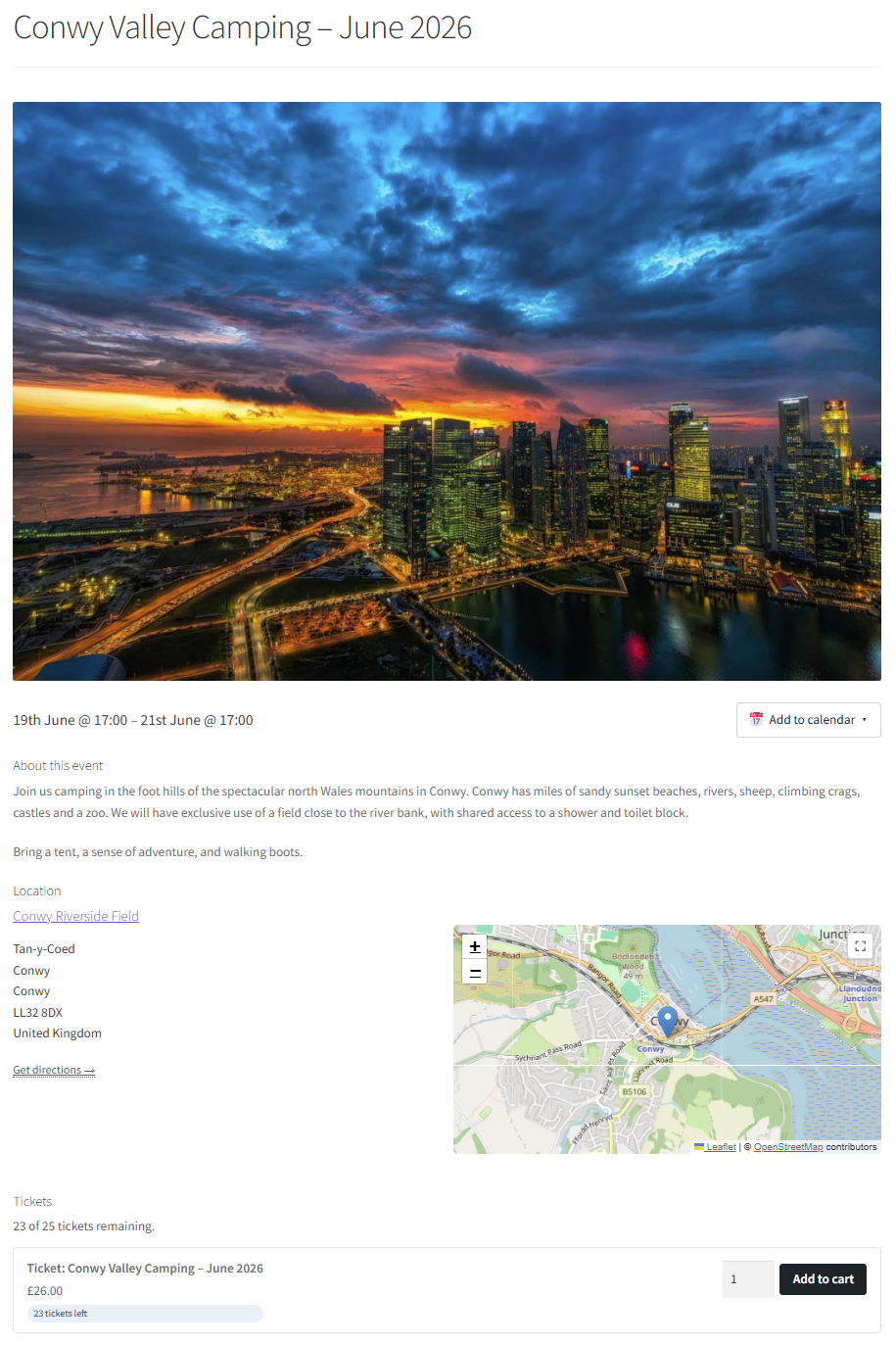
no JS framework, no build step - Single-event pages with schedule, venue, address and an embedded
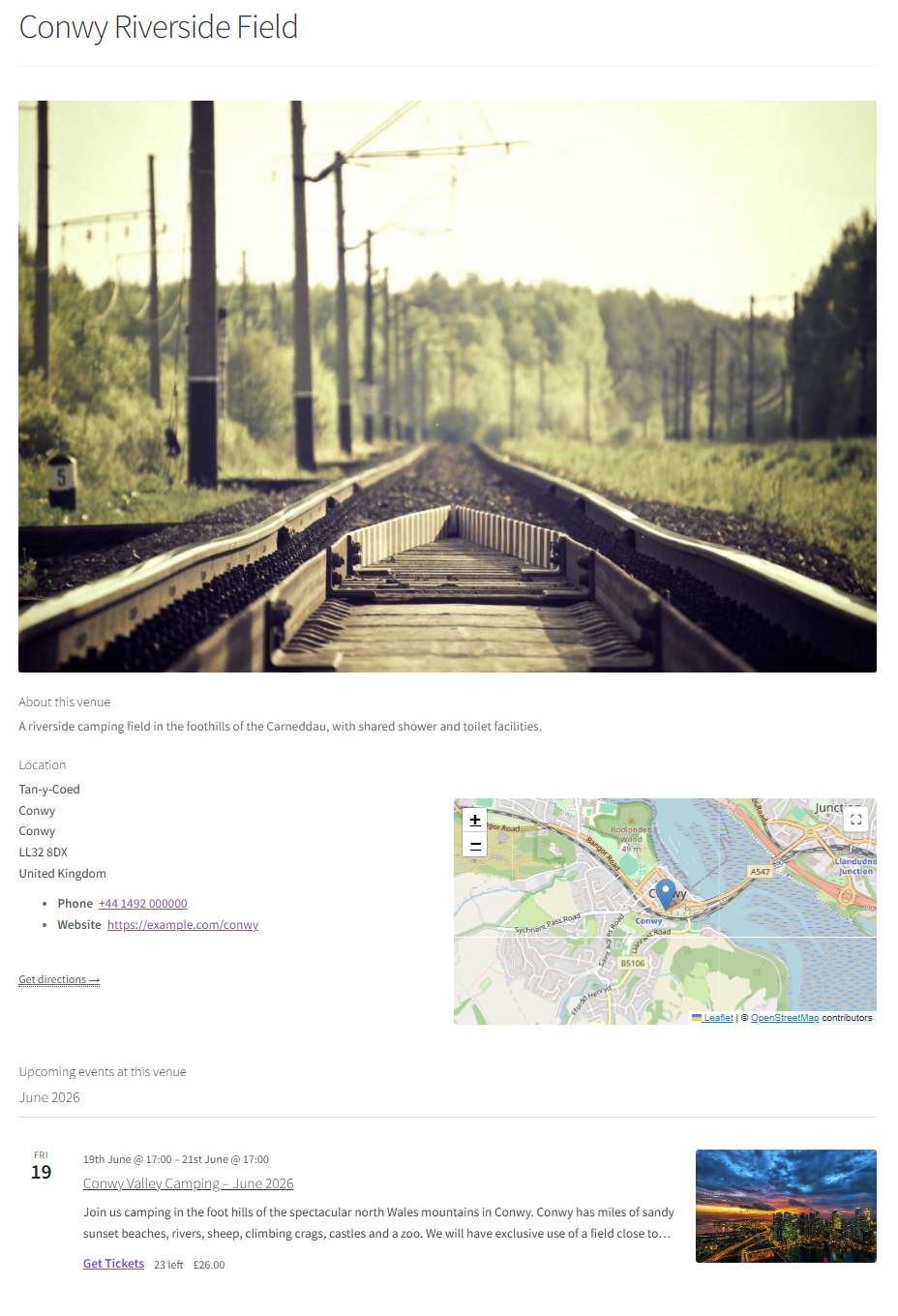
OpenStreetMap (Leaflet) map - Single-venue pages with address, map and upcoming events
- Multi-day events span every day they cover in the month view, with a
“Through {date}” hint in the list view - JSON-LD
Eventschema in the document<head>for Rich Results - Per-event
.icsdownload and a subscribable iCal feed
(/event/{slug}/feed/ics/) - Theme overrides — copy any template part to
your-theme/designed2use-events/{name}.php - Five free shortcodes (
[d2uevents_calendar],[d2uevents_list],
[d2uevents_event],[d2uevents_venues]) and matching server-rendered blocks
under an “Events shortcodes” inserter category - REST endpoint
/wp-json/d2uevents/v1/occurrencesfor headless use
Optional WooCommerce ticketing
When WooCommerce is active, the Tickets meta box on the event editor
appears and the rest of the integration switches on:
- Create a ticket product directly from the event, or link an existing
product - Inline editor on the event admin for name / description / price /
per-ticket capacity / sale window — no round-trip to the product
editor for the common fields - Single-cap cascade: per-ticket event venue settings (first
set value wins) so an admin can choose where to track capacity - Sale window with event-end fallback — the form is replaced with a
“Tickets go on sale on X” or “Ticket sales have ended” notice as
appropriate - Atomic capacity decrement at order completion — concurrent oversells
collapse to exactly one winner; the rejected order is recorded as an
order note and a debug-log entry - Refund-aware capacity release — the same counter the booking
incremented is released - Per-ticket attendee capture (name + email) on the event page — block
cart / block checkout / classic cart all show the data, no React
build step required - Cart-aware quantity input — the visitor cannot purchase more tickets
than remain - Block cart / mini-cart quantity is locked at the Store API schema
level so attendee mappings cannot be quietly broken from the cart - HPOS (High-Performance Order Storage) compatible
- Per-event Attendees admin screen with a CSV export of every booking
- WooCommerce privacy-export and erasure integration — attendee
personal data flows through the standard “export / erase personal
data” tools - My-account view-order page lets the customer edit attendee details
until a configurable cutoff before the event
Developer friendly
- Public
d2uevents_action / filter API — a documented contract for
third-party developers, not just the free Pro boundary
(docs/hooks.md) - Five shortcodes that mirror every server-rendered block
(docs/shortcodes.md) - Filterable template loader — every part is overridable from the
active theme (docs/templates.md) - PSR-4 autoloader, namespaced
D2UEvents\ - WooCommerce ticketing module is fully isolated — nothing outside it
references a WooCommerce symbol, so the plugin works without
WooCommerce installed at all
Designed2Use Events Pro — Coming Soon!
The free plugin is the real product, not a teaser — every feature above
stays free, forever. Pro adds power alongside it, never gating what you
already have. Here’s what’s on the way:
- Recurring events — daily, weekly, monthly and custom patterns, with
proper series editing. - Multi-tier tickets — early-bird, standard and VIP pricing tiers, with
per-occurrence inventory. - Registration form builder — collect exactly the attendee information
you need. - QR check-in — scan attendees in at the door from your phone.
- Organizers — give each event an organizer profile with their own
details and listings. - Week, Day and Map views — more ways for visitors to browse what’s on.
- Importer — bring your events across from The Events Calendar.
- Automatic updates — licensed, with one-click updates straight from
your dashboard.
Pro hooks into exactly the same public d2uevents_ API a third-party
add-on would — no privileged access, no patching of free internals. See
designed2use.co.uk/plugins/designed2use-events/.
External services
This plugin relies on two OpenStreetMap services to provide venue geocoding and
maps. Both are optional to how you use the plugin and can be disabled or replaced
(see below).
1. OpenStreetMap Nominatim (address geocoding)
When you create or edit a venue and enter an address but leave the latitude and
longitude blank, the plugin sends that address to the OpenStreetMap Nominatim
service to look up its coordinates. The request includes the address you entered
and a User-Agent identifying this plugin and your site’s URL (required by
Nominatim’s usage policy). This happens only in the admin when a venue is saved,
is throttled to one request per second, and results are cached for seven days. No
request is sent if you fill in the latitude/longitude yourself, or if you replace
the provider via the d2uevents_geocode_provider filter.
- Service: OpenStreetMap Nominatim — https://nominatim.org/
- Usage policy: https://operations.osmfoundation.org/policies/nominatim/
- Privacy policy: https://wiki.osmfoundation.org/wiki/Privacy_Policy
2. OpenStreetMap map tiles (Leaflet maps)
Single venue pages, the venues archive and the venue map display an interactive map
rendered with the bundled Leaflet library. The map image tiles are loaded in the
visitor’s browser from the OpenStreetMap tile servers, which receive the visitor’s
IP address and the map area being viewed. The tile source is configurable under
Events Settings (the “Map tile URL”), so you may point it at your own or a
third-party tile provider, and maps are only shown on pages that display one.
- Service: OpenStreetMap tile servers — https://www.openstreetmap.org/
- Tile usage policy: https://operations.osmfoundation.org/policies/tiles/
- Privacy policy: https://wiki.osmfoundation.org/wiki/Privacy_Policy
Screenshots
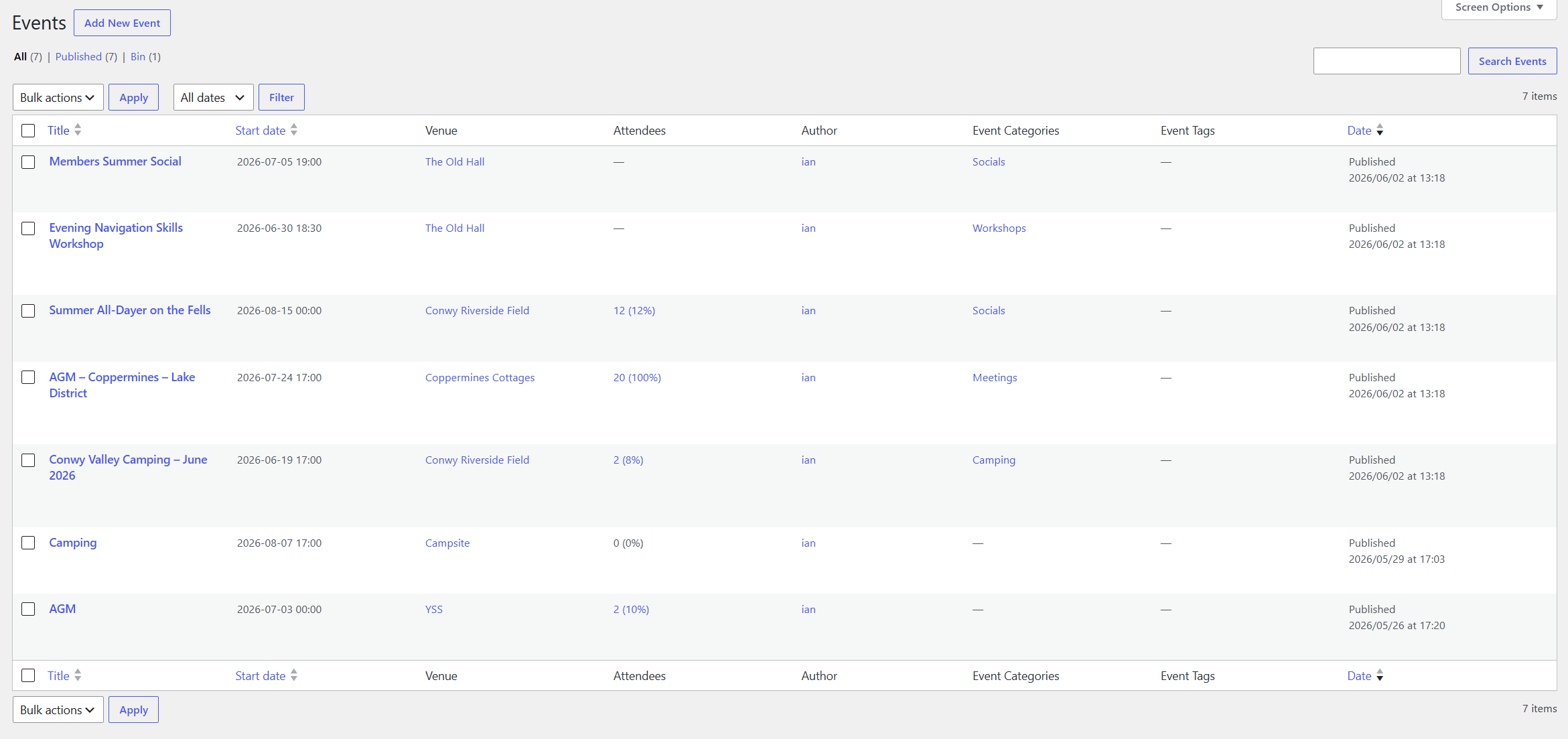
Blocks
This plugin provides 4 blocks.
- Venues map + list The venues archive — Leaflet map + list. Equivalent to the [d2uevents_venues] shortcode.
- Events list A chronological list of upcoming events. Equivalent to the [d2uevents_list] shortcode.
- Events calendar Embed the Designed2Use Events calendar (Month or List view) on any page.
- Event card A compact card for a single event. Equivalent to the [d2uevents_event id=…] shortcode.
Installation
- Upload the
designed2use-eventsfolder to/wp-content/plugins/, or install through Plugins Add New in the dashboard. - Activate the plugin through the Plugins screen.
- The Events calendar Page (
/events/) and the Venues Page (/venues/) are created automatically the first time the plugin activates. If a Page already exists at one of those slugs the plugin adopts it rather than creating a duplicate. - Go to Events Add New to create your first event. Add venues under Venues Add New.
- (Optional) Activate WooCommerce to unlock ticketing — the Tickets meta box appears on the event editor.
- Adjust defaults under Events Settings: page slugs, default capacity, default timezone, map tile URL, attendee edit cutoff and data deletion on uninstall.
FAQ
-
Does this require WooCommerce?
-
No. The calendar, venues, single-event / single-venue pages, iCal
feeds, blocks, shortcodes and REST endpoint all work without
WooCommerce. Activating WooCommerce just switches on the optional
ticketing module. -
Where does the calendar live?
-
On a real WordPress Page at the configured calendar slug (default
/events/). The plugin renders its markup through thethe_content
filter so the active theme’s header, sidebar and footer surround the
calendar — no template takeover, works the same on block and classic
themes. -
How do I override a template?
-
Copy any file from
wp-content/plugins/designed2use-events/templates/
towp-content/themes/your-theme/designed2use-events/at the same
relative path. The plugin picks up your version automatically. See
docs/templates.md for the full lookup order and the variables each
part receives. -
Where do I find the public hook API?
-
docs/hooks.md in the plugin folder. Every public action and filter
is documented with parameters, since-version and example usage. The
machine-readable source is
src/Extension/HooksRegistry.php. -
Can I sell tickets without WooCommerce?
-
Not in 1.0 — ticketing routes through WooCommerce only.
-
How is capacity tracked?
-
When a ticket has its own capacity, that capacity tracks its own
counter. Otherwise the event’s capacity (which itself cascades from
event venue settings unlimited) is what every ticket on that
event shares. The cascade picks the first level that has a set value;
booked totals decrement that same level so refunds release back to
where the booking came from. -
What happens at uninstall?
-
Nothing destructive by default. Events Settings Privacy &
uninstall has a “delete data on uninstall” opt-in — only when it’s
on does uninstall remove events, venues, the occurrence table, the
ticket-stock table and the settings. Deactivating the plugin never
deletes data. -
How do I subscribe to an event in a calendar app?
-
Each event has an “Add to calendar” button that downloads an
.ics
file. Subscribers can paste the iCal feed URL
(/event/{slug}/feed/ics/) into Google Calendar or any other
RFC 5545 calendar client — updates flow through automatically. -
Does it work with multisite?
-
The CPT capability mapping follows the WordPress meta-cap rule (plural
primitive caps only, mapped toedit_pages) so super admins keep
access. The plugin has not yet been functionally regression-tested on
multisite — please report any issues.
Reviews
There are no reviews for this plugin.
Contributors & Developers
“Designed2Use Events” is open source software. The following people have contributed to this plugin.
Contributors

“Designed2Use Events” has been translated into 1 locale. Thank you to the translators for their contributions.
Translate “Designed2Use Events” into your language.
Interested in development?
Browse the code, check out the SVN repository, or subscribe to the development log by RSS.
Changelog
1.0.5
- Fixed: the block placeholder cards (Event, Events Calendar, Events List,
Venues) now load their styles and icons inside the block editor iframe,
which WordPress 7.1 always uses. - Tested up to WordPress 7.1.
1.0.4
- Changed: refreshed the “Designed2Use Events Pro” section of the plugin
description to a “Coming Soon” overview of the planned Pro features
(recurring events, multi-tier tickets, registration form builder, QR
check-in, organizers, week / day / map views, importer, automatic
updates). No code or behaviour changes — the free plugin is unchanged
and every free feature stays free.
1.0.3
- Changed: every global symbol now uses the longer, more distinct
d2uevents prefix (functions, hooks, options, post types, meta keys,
theD2UEventsnamespace, REST route and blocks) to avoid collisions,
per the WordPress.org plugin guidelines. - Removed: the optional one-instance limit on the Events Calendar block —
any number of calendar blocks can now be placed on a page. The free
plugin has no feature gating of any kind.
1.0.2
- Fixed: a ticket saved without an explicit sale window stored a
0000-00-00 00:00:00 zero-date instead of an empty window, which made
the event report “Ticket sales for this event have ended” even though
the event was in the future. Blank sale windows are now stored as NULL,
and any existing zero-date rows are treated as “no window” on read.
1.0.1
- Added:
d2uevents_pre_sync_occurrencesfilter, letting an add-on
(e.g. Designed2Use Events Pro) take over occurrence-row management for
an event — the foundation for the Pro recurrence engine. - Added:
d2uevents_single_occurrence_limitfilter to control how many
upcoming occurrences a single event’s date picker offers. - Added: occurrence-table repository helpers for in-place row updates and
re-parenting rows between events (so bookings survive a series split).
1.0.0
- Initial release.
- Events, Venues and event categories / tags as custom post types
with sortable admin lists. - Frontend Pages for the calendar and venues archive, created on
activation, rendered throughthe_contentso the active theme owns
the chrome. - Month + List calendar views with prev / next navigation, venue /
category / featured filters and a URL for every state. - REST endpoint
/wp-json/d2uevents/v1/occurrencesand a
server-rendered + client-driven viewport swap. - Four blocks under the “Events shortcodes” inserter category and
five shortcodes that mirror them. - Per-event
.icsdownload and subscribable iCal feed. - JSON-LD
Eventschema in<head>. - Multi-day events span every covered day in month view; “Through”
hint in list view. - Single event and single venue pages with embedded OpenStreetMap
(Leaflet) maps. - “Add to calendar” dropdown on the single event page — Google
Calendar, Outlook.com, Yahoo Calendar and Apple Calendar (.ics).
Outside-click and Esc both close the menu; Esc returns focus to
the trigger. - Optional WooCommerce ticketing module — Tickets meta box with
inline editor, deductive event-cap model (per-ticket capacities
reserve from the event pool), sale window with event-end fallback,
atomic capacity decrement, refund-aware release, per-ticket
attendee capture, HPOS compatibility. - Per-event “Maximum tickets per user” limit for logged-in customers
— enforced on the event page, at add-to-cart and at order
completion. - Per-event Attendees admin screen with CSV export (RFC-4180 +
UTF-8 BOM, opens cleanly in Excel). - WooCommerce privacy export / erasure integration.
- Customer my-account attendee editor with configurable cutoff.
- Email customisations — appended “Your attendees” section on
customer order confirmation emails (HTML + plain-text,
theme-overridable). Events Settings Emails exposes a
per-WC-email toggle, custom section heading, optional intro
paragraph and column-visibility toggles. - Full settings page under Events Settings.
- Calendar grid is keyboard-navigable — arrow keys move focus by
±1 day / ±1 week, Home / End jump to row edges,
PageUp / PageDown paginate months, Enter on a focused cell opens
the first event.role="grid"+aria-labelon each cell + a
screen-reader live region announce view swaps. - Calendar query cached in the object cache (group
d2uevents_calendar) with namespace-version invalidation on
every event save, trash, settings save or category change. Two
filters (d2uevents_calendar_query_cacheable,
d2uevents_calendar_query_cache_ttl) and one action
(d2uevents_calendar_query_invalidated) let downstream caches
hook the same lifecycle. - CSS custom properties (
--d2u-events-*) for theming — accent,
surface, border, state and spacing tokens declared on a:where()
selector list so theme overrides win without specificity wars.
Documented indocs/templates.mdwith three worked
template-override examples. - Toast feedback on the Tickets meta box for every AJAX round-trip
(create / link / unlink / delete / save) so success messages
survive the list-item DOM swap. - Friendly empty states — calendar Page with active filters shows
“Clear filters” CTA; site-wide empty shows admins a “Create your
first event ” prompt; REST-failure path on view-swap offers an
inline Try again + “Open server-rendered view” link instead
of an auto-redirect. - Plugin Check clean (zero errors, zero warnings under the wp.org
preset).