
Description
When an editor pastes a YouTube URL, WordPress turns it into an iframe — and on every page view, before the visitor has been offered any choice, their browser contacts the provider. Measured on a plain GET to www.youtube.com/embed/… with no playback and no scripts run: five cookies, two of them ~18-month identifiers. The same request on www.youtube-nocookie.com sets zero.
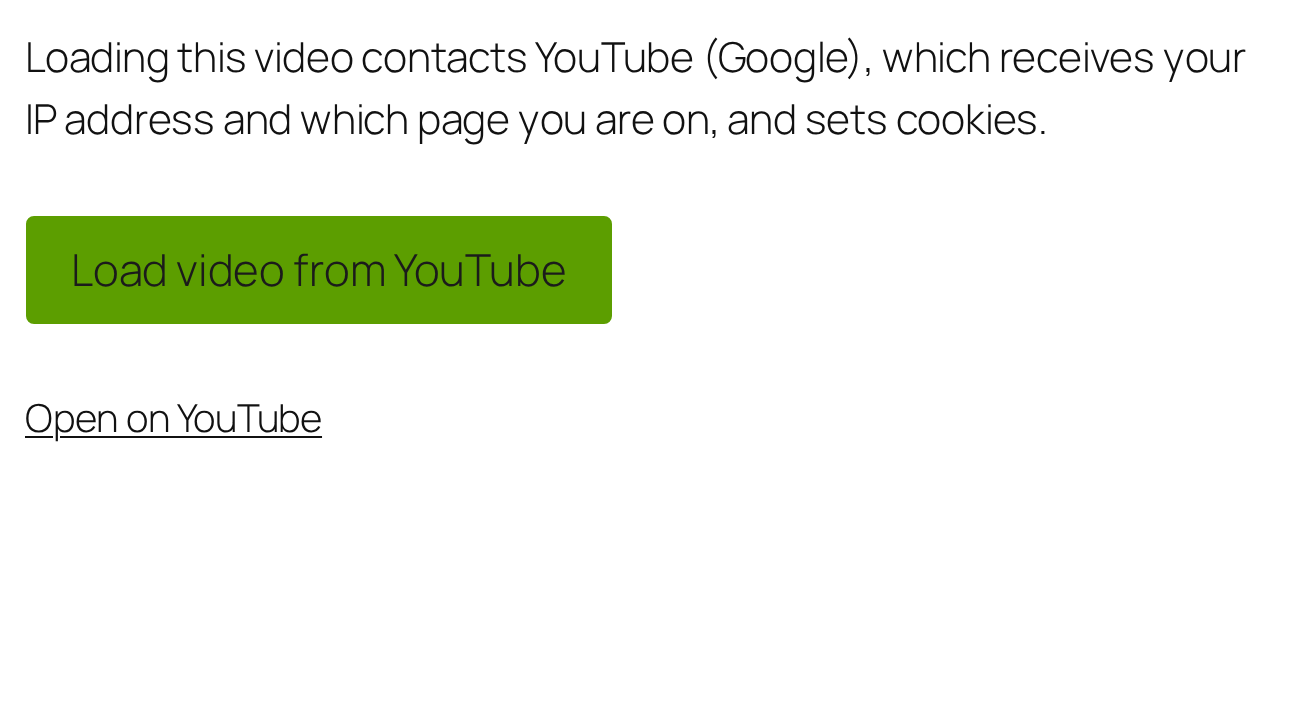
Calucon Third-Party Embed Gate replaces third-party embeds with a server-rendered placeholder until the visitor clicks to load them — the two-click pattern (Zwei-Klick-Lösung). Nothing third-party is contacted before that click: no script, no iframe, no thumbnail, no preconnect. Nothing is stored on the visitor’s device before that click either — including by this plugin.
See it in action on the live demo, or read the details on the plugin page.
What it does
- Gates third-party iframes, embed SDK scripts and legacy
<embed>/<object>markup in post content, blocks, widgets, comments and archive descriptions — including HTML that has been minified by caching plugins, where most implementations silently fail, and lazy-loaded markup that parks the real URL in adata-srcattribute. - Gates content delivered over AJAX and the REST API to visitors (“load more”, infinite scroll), while editors always see the original markup.
- Gates by host, not by a provider allowlist: an unknown third-party iframe is gated by default.
- Loads from privacy-preserving endpoints after the click where they exist:
youtube-nocookie.com(measured: 0 cookies instead of 5), Vimeo withdnt=1. - Renders the placeholder server-side, so a visitor without JavaScript still gets a real, working link to the content.
- Rebuilds embeds from an attribute safelist —
sandboxis preserved,autoplaynever survives, inline styles and event handlers are never copied. - Strips
preconnect/dns-prefetch/preload/prefetchresource hints pointing at gated providers and their CDN hosts (i.ytimg.com,pbs.twimg.com, …). - Removes embeds from feeds and excerpts instead of showing a meaningless placeholder; a plain fallback link to the content stays for feed readers.
- Per-block override in the editor: gate a specific embed always, never, or per the site default.
- Optional poster image behind the consent panel, chosen per embed from your media library — served from your own site, never fetched from the provider.
- Optional, off by default: remember consent in the visitor’s browser (per embed, per provider, or for all embeds; session or with an expiry), with a withdrawal control via the
[calucon_embed_gate_withdraw]shortcode. - Optional, off by default: a bridge to your consent platform. When a tested platform (WP Consent API, Complianz, Cookiebot, CookieYes, Borlabs Cookie 3, Real Cookie Banner) reports consent for the embeds’ category, gated embeds load without a second click — and a withdrawal there re-gates them. The bridge only reads the platform’s state; with an untested platform, or when the platform gives no answer, gating stands unchanged.
- Accessible placeholder: named group, a real button, visible focus, sufficient contrast, focus kept after activation. Zero axe-core violations in CI.
- Never phones home. The plugin makes no outbound request from your server or your visitors’ browsers, on any path, for any reason.
What it is not
Calucon Third-Party Embed Gate is a technical measure. It is not a consent management platform, it does not produce consent records for accountability purposes, it does not scan your site, and it does not make legal claims about your site. What it technically does: it prevents the embed providers’ requests until the visitor acts, and the click is scoped to the embed (or, if you enable memory, the scope you configure). You remain responsible for your privacy policy, which still has to name the providers you embed from, and for your legal bases. If you need a documented consent record, you need a consent management platform.
Customisation
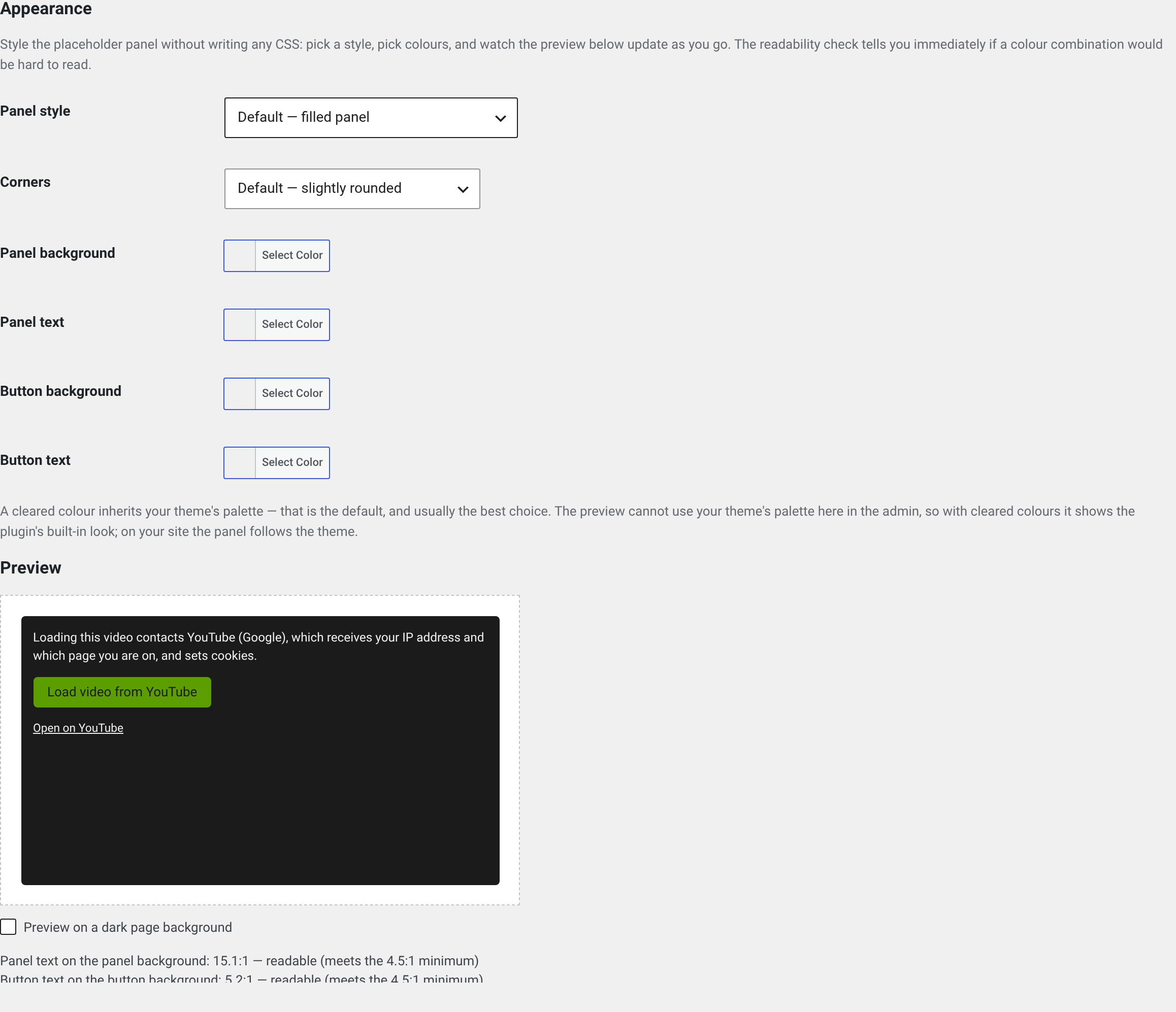
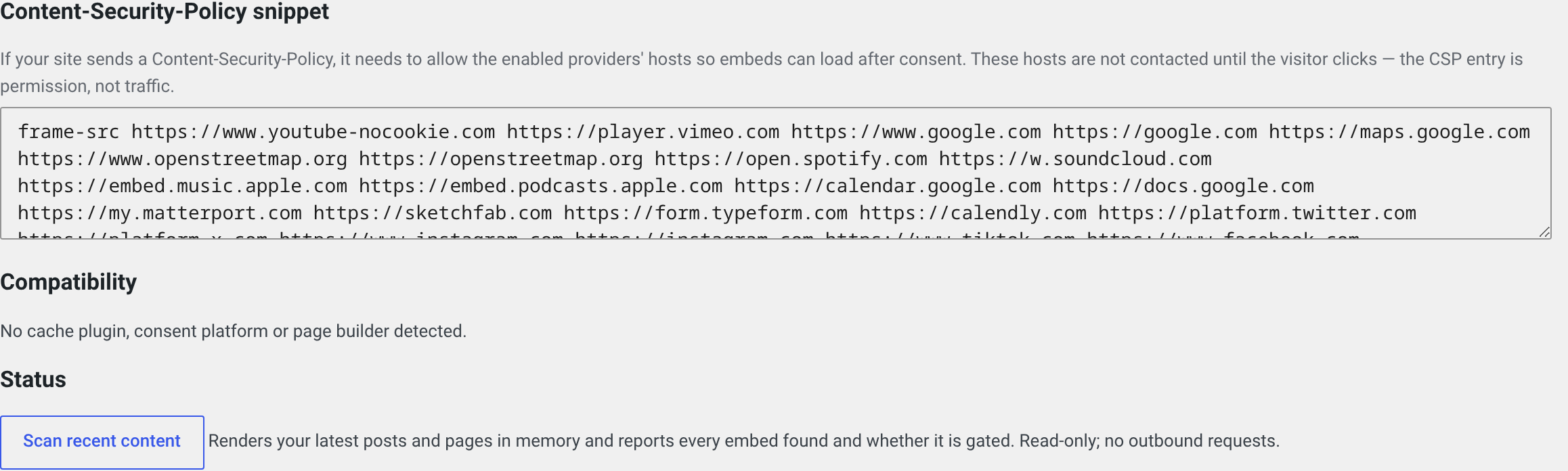
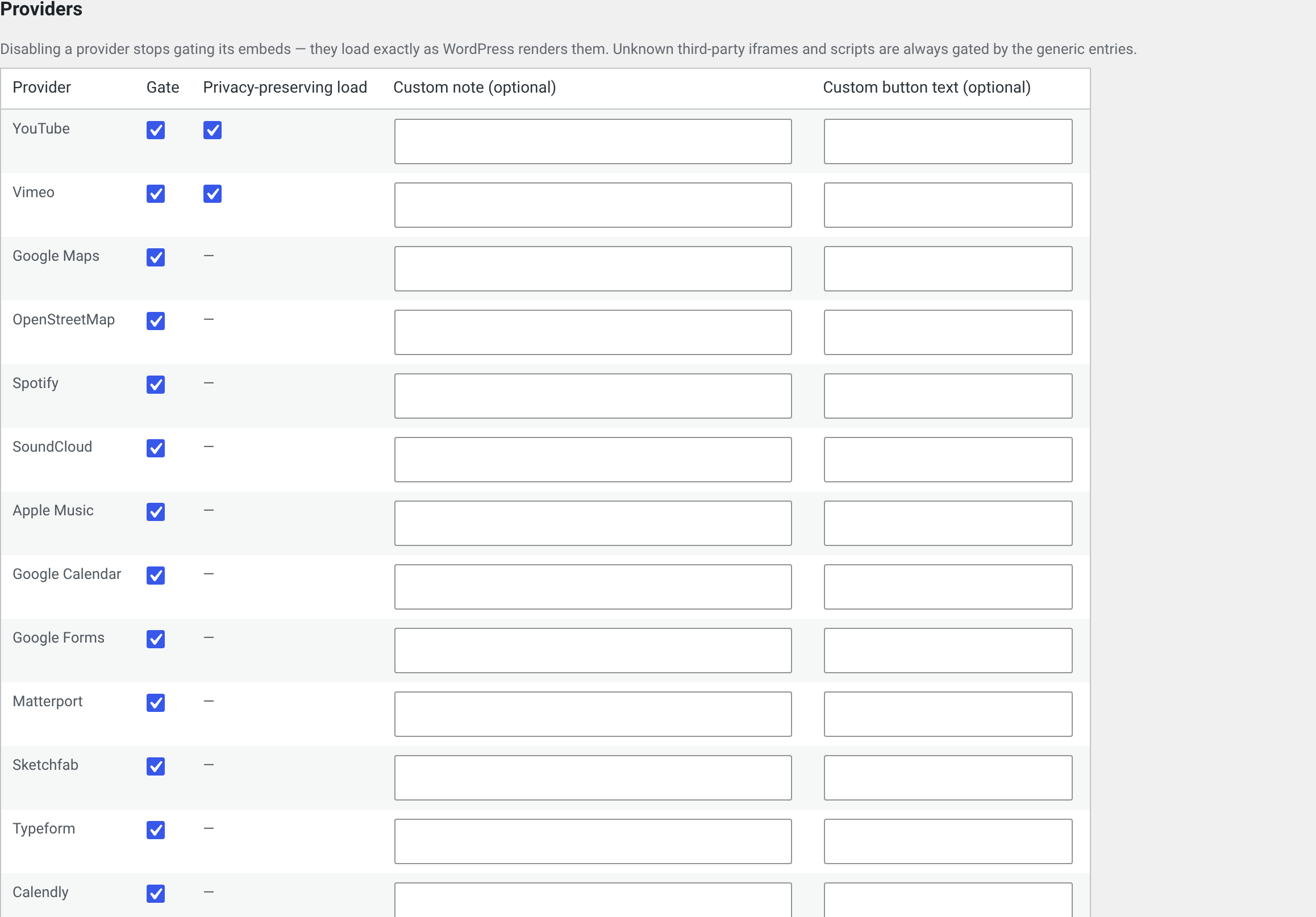
- Tabbed settings screen (Providers / Detection / Appearance / Consent memory / Status & tools): per-provider on/off, privacy-variant on/off, custom note and button text; own-host, never-gate and always-gate lists; rule toggles including opt-in third-party image gating; appearance presets, corner styles and colour pickers with a live preview and an automatic readability check — no CSS needed; opt-in whole-page buffering for page builders; consent memory; a generated Content-Security-Policy snippet; a Compatibility overview (detected cache plugin, consent platform, page builder — and what the plugin does about each); a read-only Status scan of recent content.
- Theme override: copy
templates/placeholder.phpto{your-theme}/calucon-embed-gate/placeholder.php. - CSS custom properties on
.cg-embed(--cg-bg,--cg-fg,--cg-accent, …) for restyling without specificity wars. - WP-CLI:
wp calucon-embed-gate scan(is every embed gated?--format=jsonfor CI and automation) andwp calucon-embed-gate providers; the shippeddocs/customizing.mdis a self-contained customization reference for developers and AI agents. - Documented filters:
calucon_embed_gate_providers,calucon_embed_gate_provider_for_url,calucon_embed_gate_should_gate,calucon_embed_gate_is_own_host,calucon_embed_gate_own_hosts,calucon_embed_gate_placeholder_html,calucon_embed_gate_payload,calucon_embed_gate_note_text,calucon_embed_gate_action_text,calucon_embed_gate_fallback_url, plus thecalucon_embed_gate_before_renderandcalucon_embed_gate_embed_gatedactions. Adding a provider is a ten-line filter infunctions.php.
External services
This plugin makes no request to any external service, on any page, at any time. It contacts no API, loads no remote script, font, image or update check, and sends no telemetry. Its entire purpose is the opposite direction: it prevents your pages from contacting embed providers.
Third-party content enters the picture only after a visitor explicitly clicks the “Load” button on an embed placeholder. At that moment the visitor’s browser loads that one embed from its provider (for example YouTube, Vimeo, or Google Maps) — exactly as it would have without this plugin, except that it now happens on the visitor’s request instead of automatically. Each placeholder names the provider and links its privacy policy before the click, and the provider hostnames in the plugin’s source code exist solely so it can recognise and gate that content. No data is sent anywhere by the plugin itself.
Screenshots
Blocks
This plugin provides 1 block.
- Calucon Embed Gate Withdraw
Installation
Calucon Third-Party Embed Gate works the moment it is activated — it gates third-party embeds by default, with no configuration, no account and no external service.
- In your WordPress admin, go to Plugins Add New, search for “Calucon Third-Party Embed Gate”, and click Install Now, then Activate. To install from a downloaded zip instead, go to Plugins Add New Upload Plugin, choose the file, install and activate.
- That is all that is required. Your existing embeds are now replaced with a click-to-load placeholder on the front end, and nothing third-party is contacted before the visitor clicks. Editors keep seeing the normal embed in the block editor, so nothing changes about how you write posts.
- Optional: open Settings Calucon Third-Party Embed Gate to adjust appearance, per-provider behaviour, detection rules, consent memory and the optional consent-platform bridge. None of it is needed to be protected — the defaults gate everything third-party.
If you turn on consent memory and want to offer visitors a way to take it back, add the “Withdraw embed consents” block, or place the [calucon_embed_gate_withdraw] shortcode on your privacy-policy page.
Requirements: WordPress 5.9 or newer and PHP 7.4 or newer. No build step, no runtime dependencies, and no outbound request from your site on any path.
FAQ
-
Does this make my site GDPR compliant?
-
No plugin can claim that, and this one does not. Calucon Third-Party Embed Gate implements a technical measure: it prevents third-party embed requests (and the storage they trigger on the visitor’s device) until the visitor explicitly asks for the content. Whether your site’s overall processing is lawful depends on things a plugin cannot know. The relevant background — § 25 TDDDG / ePrivacy Art. 5(3) for terminal-equipment storage, GDPR Art. 6(1)(a) for the processing after the click — is described in the documentation, and your privacy policy still has to name the providers you use.
-
Because there is nothing to announce at page load. If nothing third-party loads until the visitor asks for it, there is no third-party storage to consent to on page load. The consent is the click, given for the one embed it belongs to.
-
No. Out of the box Calucon Third-Party Embed Gate ignores the banner and keeps gating — visitors see your banner for its categories and the embed placeholder for embeds, and nothing double-blocks (the placeholder contains no iframe or script for a banner’s blocker to catch). If you prefer one decision instead of two, enable the consent platform bridge under Settings Calucon Third-Party Embed Gate Consent: a consent your visitor gives in the platform then loads the embeds automatically, and a withdrawal there re-gates them. The bridge works only with the platforms listed on that screen — with any other platform it stays out of the way and gating stands. If you would rather have your platform’s own blocker handle a specific provider, disable that provider under Providers and Calucon Third-Party Embed Gate steps aside for it.
-
Is Google Consent Mode v2 supported?
-
Consent Mode is deliberately not read or written directly. It is a signal that consent platforms send to Google’s tags; Google publishes no API for other scripts to read it, and no Consent Mode signal governs iframes such as YouTube embeds. The bridge instead connects to the consent platform itself — the same place Consent Mode gets its state from — which is the reliable way to honour the same visitor choice. Calucon Third-Party Embed Gate also never sends
gtag('consent', …)updates: a click on one embed is consent for that embed, not a site-wide marketing consent, and misreporting that would be wrong. -
An embed from my page builder is not being gated
-
Page builders render outside WordPress’s content filters. Enable “Gate the whole page output” under Settings Calucon Third-Party Embed Gate Detection. It is off by default because whole-page buffering can conflict with other buffering plugins.
-
The placeholder looks unstyled after an update
-
If your minification setup serves CSS from a long-cached URL that does not change with the file contents, browsers can keep the old stylesheet for a long time. A hard reload fixes it; the plugin cannot.
-
Does `loading=”lazy”` on an iframe count as consent?
-
No. Lazy loading defers the request to scroll time — it is still made without consent. Calucon Third-Party Embed Gate gates lazy iframes like any other.
-
How do I report a security issue?
-
Privately, please — through GitHub’s private vulnerability reporting on the plugin repository (https://github.com/Calucon/consent-gate/security/advisories/new), not in a public issue or support topic. The repository’s SECURITY.md describes what counts: besides the usual classes, any way to make a page contact a third party before the click is a vulnerability.
Reviews
There are no reviews for this plugin.
Contributors & Developers
“Calucon Third-Party Embed Gate” is open source software. The following people have contributed to this plugin.
Contributors
Translate “Calucon Third-Party Embed Gate” into your language.
Interested in development?
Browse the code, check out the SVN repository, or subscribe to the development log by RSS.
Changelog
0.9.2
- The Status screen’s scan query parameter now carries the full plugin prefix (
calucon-embed-gate-scan). No functional change.
0.9.1
- When “Gate the whole page output” is enabled, the plugin’s stylesheet and script are now delivered through the standard enqueue API on every front-end page instead of being written into the buffered document at shutdown. Direct tag injection is gone entirely.
- The translation bridge for the WordPress-free layers now resolves through a generated map of literal gettext calls (
languages/strings.php), so no translation function in the plugin ever receives a variable argument. - The provider descriptor key
hint_hostsis nowscrub_hint_hosts— a clearer name for what it always was: hostnames whosepreconnect/dns-prefetchresource hints the plugin removes. Nothing is ever requested from them. - Fixed the Cloudflare cache-purge integration: it now registers with the official Cloudflare plugin’s
cloudflare_purge_everything_actionsfilter and fires the plugin’s owncalucon_embed_gate_flush_cachesaction (the previous direct hook call never reached the Cloudflare plugin). The LiteSpeed purge hook now fires only when LiteSpeed Cache is installed.
0.9.0
- Before the WordPress.org listing goes live — while no installed sites exist to break — the plugin’s internal identifiers were aligned with its new name, with no legacy aliases: filters and actions are
calucon_embed_gate_*, the shortcode is[calucon_embed_gate_withdraw], the block iscalucon-embed-gate/withdraw, the WP-CLI namespace iswp calucon-embed-gate, the theme template override directory is{theme}/calucon-embed-gate/, and the settings option was renamed. If you somehow installed a pre-release build, update those references and re-save the settings. - The
.cg-embedCSS classes,--cg-*custom properties anddata-cg-*attributes are unchanged.
0.8.1
- Renamed the plugin’s constants to match the plugin: CALUCON_EMBED_GATE_VERSION, FILE and _DIR. The previous CONSENT_GATE* names remain defined as aliases and will be removed no earlier than 0.9.0, in a release of their own.
- Updated the plugin page and demo links to their new addresses.
- Everything a site can depend on is unchanged: the calucon_embed_gate_* filters, the [calucon_embed_gate_withdraw] shortcode, the wp calucon-embed-gate CLI commands, the .cg-embed CSS classes and the theme template override path all keep their existing names. Nothing you have already set up needs changing.
0.8.0
- Renamed from “Consent Gate” to “Calucon Third-Party Embed Gate” (new slug
calucon-third-party-embed-gate) during WordPress.org review, to make clear the plugin gates third-party embeds and is not a consent management platform. No functional change. - Translations: the strings defined in the WordPress-free layers are now mirrored in
languages/strings.phpas literal gettext calls, so translate.wordpress.org can extract them. Removed the redundantload_plugin_textdomain()call (WordPress loads language packs automatically since 4.6). - readme: added the “External services” section stating what the plugin does (and does not) contact.
0.7.5
- Compliance: documented the WordPress-free layer’s
parse_url()usage and replaced a WordPress 6.5-only function with a version-agnostic equivalent, so the plugin passes WordPress Plugin Check cleanly on the 5.9 minimum. No functional change.
0.7.4
- Documentation: added Installation and Screenshots sections to the readme for the WordPress.org listing, and linked the plugin page and live demo. Plugin URI now points to the plugin’s home page. No functional change.
0.7.3
- Repository renamed to match the plugin (github.com/Calucon/consent-gate). Updated the Plugin URI and the issue/security-report links. No functional change.
0.7.2
- Added an optional way to support development: a Donate link, a support link in the plugin’s own settings footer, and a GitHub Sponsor button. Plain links only — no third-party widget or remote image loads, so the plugin still makes no outbound request from wp-admin.
0.7.1
- Security hardening (pre-submission audit). Closed a host-classification gap where a crafted embed URL using a backslash or irregular slashes in its authority (e.g.
https://evil.example\@yoursite/) parsed to your own host in PHP but connects to the third party in every browser — such URLs are now gated, matching how browsers resolve them. The fallback link now rejects non-navigable schemes (javascript:,data:), the inline settings JSON is emitted with the same tag-escaping as the embed payload, and provider note/button overrides are length-capped. - Robustness: when a script-strategy SDK (X/Twitter, Instagram, …) is blocked by the browser, the other embeds of that provider keep their panels and fallback links instead of disappearing until reload.
- Every plugin PHP file now carries a direct-access guard, and the plugin declares its Domain Path — housekeeping for the WordPress.org directory.
0.7.0
- Consent platform bridge (off by default): when an installed, tested consent platform — WP Consent API, Complianz, Cookiebot, CookieYes, Borlabs Cookie 3, or Real Cookie Banner — reports consent for the embeds’ category, gated embeds load without a second click, and a withdrawal in the platform re-gates what the bridge loaded (an embed the visitor clicked personally stays). Client-side and read-only: the bridge stores nothing, sends nothing, and with an untested platform or no answer gating stands unchanged.
- IAB TCF v2.2 signals can additionally be honoured behind their own experimental flag; only providers with a Global Vendor List entry can ever be granted that way.
- The Compatibility screen now distinguishes tested platforms (bridge available or active) from untested ones (fail-closed, as before).
0.6.1
- Legacy Google Maps embeds (
maps.google.com/maps?q=…&output=embed, the older share form that is still widespread) are now recognised as Google Maps instead of falling back to the generic gate. They were already gated either way; they now get the Google Maps label, note and resource-hint scrubbing.
0.6.0
- Poster images: every embed block gains a “Set poster image” control (Calucon Third-Party Embed Gate panel in the block inspector). The chosen media-library image is shown behind the consent panel until the visitor loads the embed — served from your own site, never fetched from the provider, so the zero-third-party-requests guarantee is untouched. The panel keeps its solid background on top of the image, so text contrast is preserved.
- Theme placeholder templates receive the poster as a
$postervariable; see docs/customizing.md.
0.5.0
- WP-CLI:
wp calucon-embed-gate scanreports every embed in recent content and whether it is gated (--format=jsonfor CI and automation);wp calucon-embed-gate providerslists providers as the gate resolves them. Both read-only, no outbound requests. - Ships
docs/customizing.md: a self-contained reference for customizing the plugin from functions.php or WP-CLI — descriptor keys, filter examples, the template contract, and the invariants a customization must keep. Written to serve developers and AI coding agents alike.
0.4.0
- The settings screen is now tabbed: Providers, Detection, Appearance, Consent memory, and a read-only Status & tools tab (Status scan, Compatibility, CSP snippet). One page, one Save button — saving returns you to the tab you were on.
- Tabs follow the ARIA tabs pattern (arrow keys, Home/End) and are an enhancement: without JavaScript the page renders as before, every section visible.
0.3.0
- Appearance made novice-friendly: the colour fields are now WordPress colour pickers (no hex typing), a corner-style choice (square, rounded, pill button) joins the panel-style presets, and the settings screen shows a live preview of the placeholder that updates as you change anything.
- The preview includes an automatic readability check: every colour pair (panel text, button text, fallback link) is measured against the WCAG 4.5:1 contrast minimum, in plain language, as you pick colours.
- The preview is rendered through the same pipeline as the front end — template overrides and text filters included — and is inert: the settings screen still makes no third-party request.
0.2.0
- Detection hardening: exclusion ranges are scanned sequentially, so a stray
<!--inside a script (JSON-LD, legacy script-hiding) or an unclosed<pre>can no longer disable gating for the rest of the page. - Gates attribute-swapped lazy loading (
data-src,data-lazy-src,data-original), legacy<embed>/<object>markup, andsrcdocembeds that reference third parties; invisible tracking iframes (zero-sized,display:none) are removed instead of becoming a visible dead panel. - Gates content delivered to visitors over AJAX and REST (“load more”, infinite scroll); editors keep seeing original markup. New surfaces: Text-widget visual mode, comments and term/archive/author descriptions on classic themes.
- Whole-page gating repaired for page-builder sites: styles and scripts are injected into the buffered page (buttons work now), scanning is scoped to the body, and hint tags printed by performance plugins are scrubbed.
- Activation fixes: unknown widgets no longer share one consent/removal group (scoped per host);
id,name,classanddata-secretsurvive the rebuild, so the YouTube JS API,<form target>and WordPress-to-WordPress embed resizing work after consent; loading and error states are announced to assistive technology, with a link to the provider as the error fallback. - Resource hints:
preload/prefetch/prerendercovered, thewp_preload_resourcesfilter hooked, and providers’ sibling CDN hosts scrubbed. - Feeds carry a plain fallback link where an embed was removed.
- New: per-block “Gate this embed” override and a withdrawal block in the editor; Appearance presets and colours; Compatibility and Status screens; always-gate host list; opt-in third-party image gating.
- Providers registered from a theme’s
functions.phpnow appear in the settings table, the CSP snippet and hint scrubbing; five new documented hooks. - Multisite-aware uninstall; page caches are flushed on deactivation.
- The full E2E, accessibility (axe) and real-WordPress integration suites now run in CI on every change.
0.1.0
- Initial release: core gate (minification-tolerant scanner, host matcher, iframe and script rules), built-in provider set with privacy-preserving load targets, server-rendered accessible placeholder, settings screen, template override, feeds/excerpts/widgets/resource-hint handling, opt-in consent memory with withdrawal shortcode, CSP snippet generator.