
Description
AI-generated imagery is becoming normal on news sites, magazines, blogs, company websites, educational projects, product content, and public-interest publications. The practical question for publishers is increasingly not just whether an image can be used, but whether readers can clearly understand when it was generated or substantially created with artificial intelligence.
Aiviso gives WordPress publishers a simple AI image disclosure workflow. Mark an image once in the Media Library and Aiviso remembers that editorial declaration wherever the same attachment is used as a Featured Image. If one attachment appears on twenty posts, it does not need to be declared twenty times.
The declaration belongs to the WordPress attachment, not to one individual post. Aiviso can then render a clear, configurable AI disclosure badge alongside standard Featured Image output. The original image file remains untouched.
What Aiviso does
An editor or administrator opens an image in the Media Library and checks AI-generated image. Aiviso stores that decision as WordPress attachment metadata. When the attachment is later used as a Featured Image, Aiviso can show a non-destructive HTML/CSS disclosure badge.
The badge is not burned into JPEG, PNG, WebP, or any other media file. Aiviso does not modify original files, regenerate media, or embed metadata into the physical image. It renders a separate overlay in the page output, so the image remains reusable and the badge can be changed, disabled, or removed without altering the source media.
Available controls include:
- Display AI badge on featured images
- Custom Badge text
- Badge position and Badge size
- Built-in Aiviso logo or a WordPress Media Library custom logo
- Live Badge preview
- Optional removal of declarations when the plugin is deleted
Editors also see the declared AI status while working with Featured Images in the Block Editor and Classic Editor.
Why disclose AI-generated images?
Disclosure is a practical part of responsible AI publishing. It can help readers distinguish documentary photography from synthetic imagery, reduce ambiguity about image origin, and give editorial teams a consistent workflow for recording decisions that have already been made.
There is no single rule that makes every AI-generated image in every context subject to the same visible label. Still, readers, platforms, regulators, standards bodies, and publishers are giving more attention to synthetic media, deepfakes, provenance, and consumer transparency. Clear AI image disclosure is increasingly useful publishing hygiene: it supports reader trust without requiring a site to redesign its entire editorial process.
EU AI Act and AI transparency
Regulation (EU) 2024/1689, commonly called the EU AI Act, contains transparency obligations for certain AI systems and AI-generated or manipulated content in Article 50. The relevant Article 50 transparency obligations began applying on 2 August 2026. The scope, exceptions, and responsibilities depend on the AI system, the organization’s role, and the use case.
Article 50 addresses, among other things, transparency for certain AI interactions, machine-readable marking and detectability of AI-generated or manipulated content by providers of certain generative AI systems, disclosure of deepfakes, and disclosure of certain AI-generated or manipulated text published to inform the public on matters of public interest. The framework distinguishes provider and deployer responsibilities.
The European Commission has published the Article 50 transparency guidelines and a Code of Practice on Transparency of AI-generated Content. The Code is a voluntary compliance-support instrument for marking and labelling practices; it supports, but does not replace, the AI Act or the Commission’s guidelines. The legislation itself is available on EUR-Lex.
Aiviso can support a publisher’s AI transparency practices by recording editor-declared AI imagery and showing a visible WordPress disclosure. It is not a general Article 50 implementation. In particular, Aiviso does not determine whether Article 50 applies to an organization or image, verify provenance, detect AI imagery, create C2PA credentials, add cryptographic provenance, or automatically satisfy provider-side machine-readable marking requirements.
Aiviso does not guarantee compliance with the EU AI Act or any other law. Administrators and editors remain responsible for deciding which images should be declared, which obligations apply, what wording is appropriate, and whether other technical or legal measures are required.
AI transparency beyond the European Union
AI-content transparency is not limited to the European Union. Governments, regulators, platforms, publishers, standards bodies, and technology companies in many jurisdictions are developing rules and practices around synthetic media, deepfakes, provenance, disclosure, and consumer transparency.
For a global WordPress site, an explicit editorial disclosure process can therefore be useful even when a particular image is not subject to a specific statutory labelling requirement. Aiviso is designed as a practical publishing tool, not a legal decision engine.
Disclosure, not AI detection
Aiviso deliberately does not attempt to decide whether an image was generated by AI. AI-image detection can be probabilistic and uncertain. Instead, Aiviso uses an editorial declaration workflow: an authorized editor or administrator decides that an attachment should be marked, and Aiviso records that decision.
This keeps the behavior predictable. Aiviso does not silently label a real photograph as AI-generated, and it does not silently treat an AI-generated image as authentic photography. It records and presents the editorial declaration you make.
Multilingual Badge text
When WPML, Polylang, or TranslatePress is active and reports multiple configured site languages, Aiviso shows a separate Badge text field for each language in Settings > Aiviso. This is manual editorial translation, not machine translation.
For example, an editor may enter different text for English, Serbian, and German. These are administrator-defined values, not bundled translations. If a configured language field is deliberately saved empty, Aiviso uses logo-only disclosure for that language rather than silently falling back to another language’s text.
Features
- Attachment-level AI-generated image declaration
- Media Library integration
- Featured Image disclosure badge for standard WordPress Featured Image output
- Block Editor and Classic Editor status support
- Public custom post types that support Featured Images
- Built-in Aiviso AI logo and custom raster logo support
- Configurable Badge text, position, and size
- Badge display scope for singular content only or every qualifying Featured Image context
- Live settings preview
- Manual multilingual Badge text fields for WPML, Polylang, and TranslatePress
- REST-aware attachment declaration state for editor integration
- No original image-file modification
- Local, privacy-focused operation
- Developer helper and filters
Themes using WordPress’s standard Featured Image APIs receive the intended automatic frontend integration. Highly customized theme output that bypasses those APIs may need theme-level integration.
How it works
- Upload or open an image in the Media Library.
- Check
AI-generated image. - Use that attachment as a Featured Image.
- Aiviso shows the configured AI disclosure badge on supported frontend output.
There is no need to mark the same attachment again for each post that uses it.
Who is Aiviso for?
Aiviso is useful for publishers, news and magazine websites, bloggers, editorial teams, agencies, businesses publishing AI-assisted visual content, educational organizations, public-interest websites, and organizations building internal AI transparency practices. It is globally usable and is not limited to EU websites.
Settings
Open Settings > Aiviso to configure the plugin.
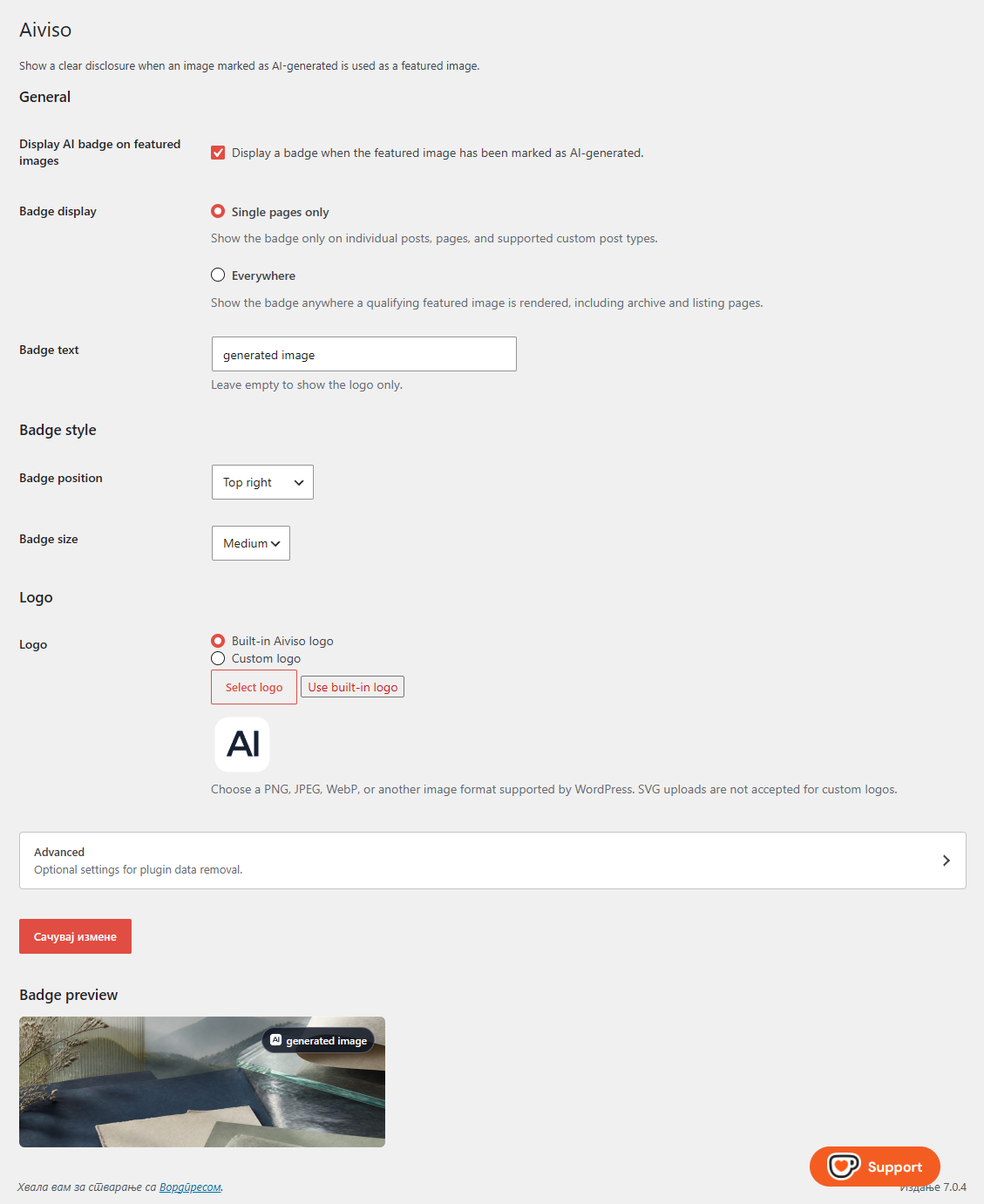
Display AI badge on featured imagesenables or disables frontend badges without deleting attachment declarations.Badge displaychooses between individual posts, pages, and supported custom post types only, or everywhere a qualifying Featured Image is rendered through the supported WordPress path.Badge textcontrols the visible disclosure text. With a supported multilingual plugin, separate fields are shown for configured site languages.Badge positionandBadge sizecontrol placement and scale.Built-in Aiviso logouses the included mark.Custom logolets you choose a supported raster image from the Media Library.Badge previewshows the selected visual treatment while editing settings.AdvancedcontainsRemove data when plugin is deleted.
Leaving Badge text empty displays the logo only. Changing the text or logo never changes the original media file.
Privacy
Aiviso operates locally inside WordPress. It has no telemetry, analytics, tracking, remote API calls, AI provider integration, OpenAI API use, external image analysis, CDN assets, remote fonts, account registration, or Aiviso cloud account.
Images are not sent to an external Aiviso server. The plugin stores an editor-declared state as WordPress attachment metadata and reads the site’s own settings when rendering a badge.
Developer hooks
aiviso_is_ai_generated() is a public helper function that returns whether an attachment is declared AI-generated.
The aiviso_is_ai_generated filter adjusts the resolved attachment declaration. aiviso_should_display_badge controls whether a qualifying Featured Image receives a badge. aiviso_badge_text, aiviso_badge_position, aiviso_badge_logo, aiviso_badge_classes, and aiviso_badge_markup adjust badge output.
aiviso_multilingual_provider optionally lets developers replace the active normalized multilingual provider. These APIs are intended for controlled integrations; the plugin’s existing options, metadata keys, and attachment workflow remain the primary public behavior.<h3>Legal notice</h3>
Aiviso is a technical publishing and disclosure tool. It does not provide legal advice, make legal determinations, or guarantee compliance with the EU AI Act or any other law. Laws, regulatory guidance, and platform requirements can change. You are responsible for determining which disclosure, labelling, provenance, accessibility, consumer-protection, or other requirements apply to your content and organization.
Screenshots


Installation
Install from a ZIP file
- In your WordPress admin area, go to Plugins > Add New Plugin.
- Select Upload Plugin and choose the Aiviso ZIP file.
- Install and activate Aiviso.
- Open an image in Media Library, check
AI-generated image, then use that image as a Featured Image.
Install manually
- Upload the
aiviso-ai-image-disclosurefolder to/wp-content/plugins/using FTP or your hosting file manager. - Activate Aiviso from the Plugins screen.
- Configure the badge in Settings > Aiviso.
FAQ
-
Does Aiviso automatically detect AI-generated images?
-
No. Aiviso records an editor or administrator declaration.
-
Does Aiviso verify that an image was generated by AI?
-
No. It does not verify provenance, inspect image files, or make authenticity decisions.
-
Does Aiviso modify my image files?
-
No. It stores WordPress attachment metadata and renders a separate HTML/CSS overlay. Original media files remain unchanged.
-
Does Aiviso guarantee EU AI Act compliance?
-
No. Aiviso is a technical disclosure tool, not legal advice or a compliance guarantee. It does not determine whether Article 50 or another rule applies to your organization or content.
-
Why use Aiviso if it does not detect AI images?
-
It provides a predictable editorial workflow. Authorized people decide when an attachment should be disclosed, and that declaration follows the attachment wherever it is used as a Featured Image.
-
Do I need to mark the same image on every post?
-
No. The declaration is stored on the WordPress attachment, so it can be reused across posts.
-
Can I use my own AI disclosure logo?
-
Yes. Choose a supported raster image from the WordPress Media Library in Settings > Aiviso. Custom SVG logos are not accepted.
-
Can I change the disclosure text?
-
Yes. Use the
Badge textsetting. -
Can the badge be translated?
-
Yes. When WPML, Polylang, or TranslatePress is active with multiple configured languages, Aiviso provides separate manual Badge text fields for those languages.
-
What happens if I leave Badge text empty?
-
The badge displays the selected logo without visible text. This also works per language when multilingual Badge text is configured.
-
Does Aiviso work with custom post types?
-
Yes, for public post types that support the standard WordPress Featured Image (thumbnail) feature.
-
Does it work with Gutenberg / Block Editor?
-
Yes. Aiviso provides Featured Image AI-status feedback in the Block Editor.
-
Does it work with Classic Editor?
-
Yes. The Classic Editor retains the Featured Image status interface.
-
Will it work with every WordPress theme?
-
Automatic frontend output relies on the theme using WordPress’s standard Featured Image APIs. Highly customized image output can bypass that integration.
-
Does Aiviso send my images anywhere?
-
No. Images are not uploaded to an external Aiviso server.
-
Does Aiviso use an AI API?
-
No. It does not use OpenAI, another AI provider, or external image analysis.
-
What happens when I deactivate Aiviso?
-
Settings and attachment declarations remain in WordPress. The frontend badge is no longer rendered while the plugin is inactive.
-
What happens when I delete Aiviso?
-
The Aiviso settings option is removed. Attachment declarations remain by default. Enable
Remove data when plugin is deletedbefore uninstalling if you also want Aiviso’s attachment declarations removed.
Reviews
There are no reviews for this plugin.
Contributors & Developers
“Aiviso – AI Image Disclosure” is open source software. The following people have contributed to this plugin.
Contributors

Translate “Aiviso – AI Image Disclosure” into your language.
Interested in development?
Browse the code, check out the SVN repository, or subscribe to the development log by RSS.
Changelog
1.0.0
- Initial release with attachment-level AI image declarations, configurable Featured Image disclosure badges, editor status, multilingual Badge text support, and local operation.