

Description
Clearyvo SEO is an SEO plugin for WordPress built around an SEO audit of every page and real image alt text. It handles the everyday SEO work – SEO titles and meta descriptions with a live search preview, schema markup, an XML sitemap, redirects and a 404 log – and then checks every published page the way a search engine sees it: missing alt text, broken heading structure, duplicate titles, keyword cannibalization and orphan pages. It is for site owners, bloggers, shops and agencies who want clear SEO fixes instead of a wall of green and red lights.
The difference starts with images. Many tools fill a missing alt attribute with the file name (“IMG 4521”). Clearyvo SEO drafts each alt text from what the page says about the image – its caption, the heading it stands under, a meaningful image title or the page title. You approve the drafts, and they are saved into the page and the Media Library: real content that stays, even if you switch the plugin off. Good alt text helps image SEO and accessibility at the same time.
And no keyword stuffing: one optional focus phrase, used naturally. Stuffing is flagged as a problem, never rewarded with a green light, and the plugin never writes keywords into your text.
Features
- Better titles in search results: SEO title and meta description for posts, pages, products, categories and tags, with title templates and variables.
- See the result before you publish: live search result preview with pixel-based title width.
- Fix problems while you write: SEO panel in the block editor with live checks for title and description, focus phrase, content, images, links and indexing – a green tick when it is good, a clear tip when it is not. The classic editor gets an SEO box under the editor.
- No empty descriptions: an automatic meta description from the excerpt when you have not written one.
- Clean indexing: canonical URLs and robots meta (noindex / nofollow), with sensible defaults for search results, date archives and attachment pages.
- Rich results and better shares: JSON-LD schema graph with WebSite, Organization or Person, WebPage, Article and BreadcrumbList; Open Graph and X (Twitter) cards with a fallback share image.
- Breadcrumbs with the
[clearyvo_breadcrumbs]shortcode orcvseo_breadcrumbs()in your theme. - Search engines find every page: XML sitemap on the fast WordPress core sitemap engine; noindexed pages and pages with a canonical elsewhere are left out, lastmod is added. Old Yoast SEO and Rank Math sitemap addresses redirect to it, so Google Search Console keeps working.
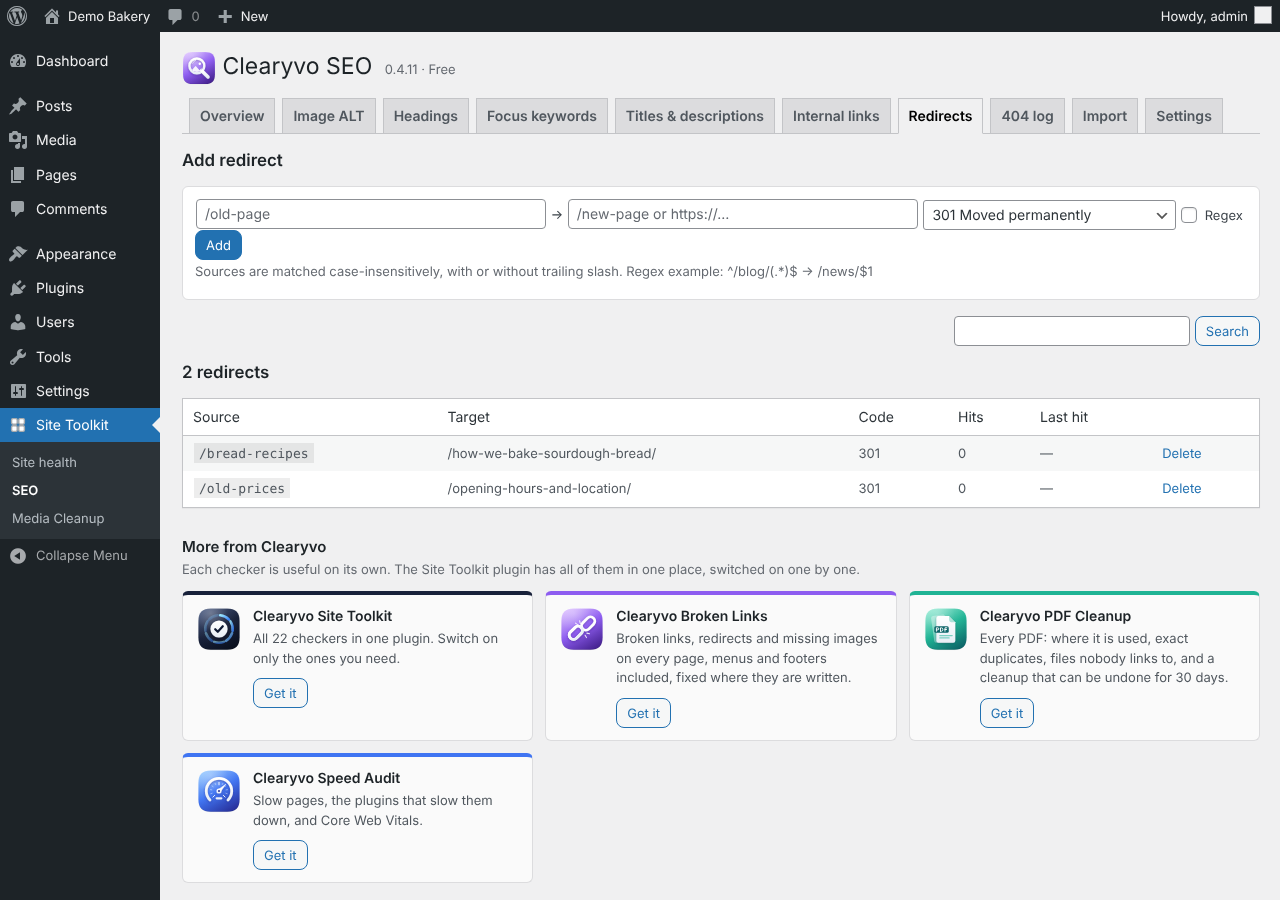
- No lost visitors: 301, 302, 307, 410 and 451 redirects, exact or regex, with a hit counter and loop protection; a 404 error log with one-click “create redirect”.
- robots.txt lines of your own, and attachment pages that redirect to their parent post.
The SEO audit: every page as a search engine sees it
The audit loads each published page like a visitor, so it sees what page builders, themes and other plugins really output. It changes nothing by itself.
- Image alt text: every image on every page, with a ready alt text draft for each missing one. Approve them one by one or all at once; mark decorative images.
- Headings: missing or repeated H1, an H1 in the header or footer of every page, skipped heading levels – fixed with one click.
- Focus keywords: the same keyword on several pages (keyword cannibalization), and whether it is in the title, H1, URL, first paragraph, meta description and an image alt text.
- Titles and meta descriptions: what search results show, with length and duplicate checks, editable right in the list.
- Internal links: orphan pages that no other page links to, and pages linked only from the menu or footer.
- One findings list with Critical, Warning and Notice severities, filters and CSV export.
Switch from Yoast SEO or Rank Math
Import titles, meta descriptions, focus keywords, canonical URLs, robots settings, social fields, primary categories, category and tag SEO, title templates, knowledge graph and redirects. Nothing is deleted from the old plugin. While another SEO plugin is still active, Clearyvo SEO prints no tags, so you never get duplicate meta tags.
Why Clearyvo SEO?
- Alt text from the page, not the file name – drafts you approve, saved as your own content.
- An audit of the real output – pages are checked as visitors receive them, page builders included.
- No keyword stuffing, no upsell nags – one optional focus phrase, plain-language tips.
- No account and no external service – everything runs on your own site.
Free and Pro
Everything above is free. The separate Clearyvo SEO Pro add-on adds AI image descriptions with your own Claude or OpenAI key, internal link ideas for pages nobody links to, LocalBusiness and Service structured data, a Search Console import for keyword conflicts and ideas, image loading fixes (lazy-loaded hero image, missing width and height), and scheduled audits by email with a white-label report. Clearyvo Pro, the all-in-one plugin of the family, contains Clearyvo SEO too; the SEO Pro features above stay in the Clearyvo SEO Pro add-on.
Part of the Clearyvo family
Focused plugins that each check one part of your site and share one Site Toolkit menu with a Site health score: media cleanup, broken links, indexing, schema, content, PDFs, database cleanup, backups, speed and more. The free Site Toolkit plugin is the dashboard: one Site health score and one-click install of every checker. The Clearyvo Site Inspector Mac app can read and edit the SEO of all your sites through the REST API (clearyvo-seo/v1, Application Password authentication). More at wp-sitechecker.com.
External services
The free plugin connects to no external service. The SEO audit loads your own pages from your own site. The Site Inspector REST API only answers requests that you make with an Application Password; it sends nothing by itself.
Screenshots




Installation
- Install and activate the plugin.
- Moving from Yoast SEO or Rank Math? Open SEO Import, run the import, then deactivate the old plugin.
- Check SEO Settings (site name, logo, title templates).
- Click “Scan site” on the Overview, then work through Image ALT.
- Submit /wp-sitemap.xml in Google Search Console.
FAQ
-
How do I add alt text to images in WordPress?
-
Click “Scan site” on the Overview and open Image ALT. Every image without alt text gets a draft written from its caption, the heading above it or the page title. Read it, edit it if needed and approve it, or approve all at once. The alt text is saved into the page and, optionally, into the Media Library.
-
Does it write alt texts by itself?
-
No. Drafts are shown for you to read and approve. The plugin cannot see the picture, so check that the draft describes it. AI image descriptions (which do look at the picture, with your own API key) are part of Clearyvo SEO Pro.
-
Is the alt text saved, or added on the fly?
-
Saved. In the block and classic editor it is written into the page (every place the image appears, as a new revision you can undo), and optionally into the Media Library for featured images, logos and page builders. It stays when you deactivate the plugin.
-
How do I run an SEO audit of my whole WordPress site?
-
Click “Scan site” on the Overview. The audit loads every published page (up to 5,000) like a visitor and lists missing alt text, heading problems, duplicate or too long titles and meta descriptions, keyword cannibalization and orphan pages, each with its severity and a fix. Export the list as CSV for a client or a to-do list.
-
How do I add a meta description in WordPress?
-
Open the post or page and use the Clearyvo SEO panel in the editor sidebar: type the description and watch the search preview and the length bar. If you leave it empty, the excerpt is used. Titles and descriptions can also be edited in bulk in the audit’s “Titles and descriptions” list.
-
Does it create an XML sitemap?
-
Yes, at /wp-sitemap.xml, built on the WordPress core sitemap. Noindexed pages are left out and lastmod dates are added. Old Yoast SEO and Rank Math sitemap addresses redirect to it, so you do not need to resubmit anything in Search Console.
-
How do I set up a 301 redirect or fix 404 errors?
-
Open SEO Redirects and add the old address and the new one; 301, 302, 307, 410 and 451 are available, as exact matches or regex. The 404 log lists every “not found” address visitors hit, and one click turns it into a redirect.
-
How do I switch from Yoast SEO or Rank Math?
-
Open SEO Import and run it: titles, meta descriptions, focus keywords, canonical URLs, robots, social fields, redirects and settings are copied over. Nothing is deleted from the old plugin, so you can check everything before you deactivate it. Until then Clearyvo SEO prints no tags, so there are no duplicates.
-
Does it work with WooCommerce and page builders?
-
Yes. Products, product categories and tags get SEO titles and descriptions, and the audit checks what page builders really output on the page.
-
Will I lose data if I deactivate it?
-
No. SEO data is only deleted on uninstall if you tick “Delete all data” in the settings. Alt texts, headings, titles and descriptions you saved are your content and always stay. If you used the separate “Clearyvo Image Alt & SEO Audit” plugin: Clearyvo SEO includes it, switches it off and keeps its settings and results. The /wp-json/clearyvo/v1/app/ address is a read-only route for the Site Inspector Mac app that changes nothing.
Reviews
There are no reviews for this plugin.
Contributors & Developers
“Clearyvo SEO – Image Alt Text, SEO Audit, XML Sitemap & Redirects” is open source software. The following people have contributed to this plugin.
Contributors
Translate “Clearyvo SEO – Image Alt Text, SEO Audit, XML Sitemap & Redirects” into your language.
Interested in development?
Browse the code, check out the SVN repository, or subscribe to the development log by RSS.
Changelog
0.5.3
- Fix: classic themes (e.g. Twenty Twenty-One) – the post title and featured image inside the article header are no longer reported as site-wide header items in the audit.
- Fix: the sitemap link and the old sitemap address redirect use the real sitemap URL (also with plain permalinks).
- Fix: no contradicting “follow” robots value when WordPress already says nofollow (Discourage search engines).
- Shared Clearyvo framework 3.6: knows the Clearyvo store checkers for WooCommerce.
0.5.2
- Fix: uninstalling no longer fails on PHP builds without GLOB_BRACE (Alpine/musl, WordPress Playground).
- Security: the Rank Math import no longer unserializes stored strings; the redirects table is read without allowing objects.
0.5.1
- Security: the request address is sanitized before it is matched or written to the 404 log; image lookups send plain arrays that are sanitized on arrival, and the audit data is sanitized value by value right after decoding.
- The shared Clearyvo framework loads admin include files only when their functions are missing.
0.5.0
- Unified Clearyvo interface: the same page layout as every Clearyvo checker. The views (Overview, Image ALT, Headings, Focus keywords, Titles and descriptions, Internal links, Redirects, 404 log, Import, Settings) are a sub-navigation with counts; Settings is last.
- Overview: Score and five summary cards, a “Scan site” bar with a progress bar, and one findings table with Critical / Warning / Notice / OK severities, filters and Export CSV. Headings, Focus keywords, Titles and descriptions and Internal links are filterable tables with Export CSV.
- Redirects: search, pagination, Export CSV and a confirmation before deleting. 404 log: Export CSV and a confirmation before clearing it.
- Settings: one form with “Save settings” (identity, behaviour, titles and indexing, sitemap and robots.txt, 404 log, CSV separator), every default stated, a notice when a value was adjusted. The 404 log settings moved here from the 404 log view.
- Site health: the SEO findings now appear in “Fix these first”. The Plugins screen shows one “Open” link.
- Settings, meta, redirects and scan results are unchanged.
- Shared Clearyvo framework 3.3.0: number columns line up, code names such as hooks and file names no longer break letter by letter on phones, long filter choices stay compact, and the “KEEP” label of the Pro previews is easier to read.
- Image ALT: “Show only pages with problems” sits in the filter bar; Settings: the logo and share-image address fields open the address keyboard on phones.
0.4.13
- Shared Clearyvo framework 3.2.0: when several installed Clearyvo plugins contain this checker (this plugin, Site Toolkit), only the newest copy runs; an older plugin that keeps its own copy is named in an “Update” notice.
- Site Toolkit menu: one entry per topic, the checkers of a topic as tabs. Site health shows a “Fix these first” list.
- Uninstall keeps the data while another installed plugin still uses it, and cleans every site of a multisite network.
- The interface stays English with every combination of Clearyvo plugins.
0.4.12
- Plugin name in the header matches the readme. Translator notes for the %sep% and %category% variables.
0.4.11
- Readme: clearer description, FAQ and screenshots.
0.4.10
- Redirect source and target fields: tags are stripped before saving (no change for valid addresses).
0.4.9
- Shared Clearyvo framework 2.3.2: SEO and content come first in Site Toolkit, the menu and Site health, then Media and the rest.
0.4.8
- Shared Clearyvo framework 2.3.1: the SEO checker is listed as Clearyvo SEO (formerly Image Alt & SEO) everywhere, whichever Clearyvo plugin loads the framework.
0.4.7
- Clearyvo SEO now starts the same way as the other Clearyvo checkers, so the Site Toolkit plugin can include it as its SEO module. With both installed, one copy runs and settings and data are shared.
- Uninstalling with “Delete all data” keeps the SEO data while Site Toolkit (which uses it) is installed.
0.4.6
- Security: text and images of a password-protected post never reach the description, social tags or structured data (also not through %excerpt%).
- Fix: %category%, %date% and %description% survive saving (WordPress’s text cleaning removed “%ca”, “%da” and “%de” as if they were URL codes). Redirect addresses with encoded accents (/%C3%A1rak) are kept too.
- Security: a regex redirect with $1 can no longer send visitors to another site (“//evil.example”).
- Fix: redirect loops are refused when saving: same address (also as a full URL), chains like A B C A, and regex rules whose target matches their own pattern. A target such as “new-page” means /new-page, not a host name. Yoast regex rules without a leading slash now match.
- Security: running the site audit (which replaces the stored results) needs an editor or administrator. Attachment details in the ALT tools follow the same read rules as the media library.
- Fix: canonical and og:url ignore tracking and other unknown parameters (?utm_source=…, ?replytocom=…).
- Fix: the robots tag never says “index” where WordPress itself says noindex (embeds, comment reply links).
- Fix: private or draft parent pages are left out of breadcrumbs; the breadcrumb HTML is valid (separators inside the list items).
- Fix: the audit covers up to 5,000 pages (filter: wpsc_audit_max_pages) and says how many were left out.
- Fix: no PHP errors from array input in the classic meta box, term fields, settings or REST; no database error when the same 404 is hit in parallel; a source over 255 characters gives a clear error.
- Fix: a very long focus phrase no longer breaks the analysis; the field takes up to 150 characters.
- Fix: og:locale is always language_TERRITORY (de_DE_formal de_DE); a separator containing “$” stays as typed; a 404 never gets “Page 2” in its title; an attachment whose parent is in the trash redirects to the file.
- Fix: network uninstall on multisite removes the data of every site (when “Delete all data” is on).
- Editor: sidebar controls use the new WordPress component styles (no deprecation warnings).
- Admin: a notice when JavaScript is off.
0.4.5
- Fix: search phrases or content with broken UTF-8 bytes no longer trigger PHP deprecation notices in title, excerpt and analysis code.
- New: classic themes that print their own
<title>through wp_title() now get the SEO title too, without a duplicated site name on the front page. - New: a short notice on the General tab when the active theme does not declare title-tag support.
0.4.4
- Security: the page title is escaped like WordPress escapes its own (a search phrase or a post title with HTML could reach the
<title>tag unescaped). - Import: damaged or unexpected Yoast SEO / Rank Math data no longer stops the import; values that are not text are skipped.
- REST API: fields sent as lists or objects are refused with a clear error instead of being stored.
- Redirects: a target that is not a valid URL (for example javascript:) is refused; a redirect that would bounce back and forth with an existing one is refused.
- Paginated archives and the home page get the page number in their title (no duplicate titles on page 2, 3…).
- Password-protected and private pages: no “Protected:” / “Private:” prefix in the SEO title, social title and breadcrumbs.
- Structured data: the site name and titles are plain text (no & or other HTML entities in the JSON-LD).
- If the separate Image Alt & SEO Audit plugin is activated next to Clearyvo SEO, it is switched off automatically (Clearyvo SEO includes it).
0.4.3
- Editor panel: add-ons can add actions to a section (JavaScript filter “clearyvo-seo.sidebar.section”). Clearyvo SEO Pro uses it for AI ALT texts in the Images section.
- Editor panel: a section stays open or closed until you click it; it no longer closes by itself when its last problem is fixed.
0.4.2
- Security: the schema (JSON-LD) block escapes < and >, so no title or text can close its script tag. It is printed with wp_print_inline_script_tag().
- Database: every query goes through $wpdb->prepare(), with %i placeholders for table names.
0.4.1
- An “i” button next to the focus phrase explains in one line why one focus phrase is enough: Google does not read the field.
- Analysis: image captions and all other block content are counted in the server-side checks (REST API, Site Inspector), the same as in the editor panel.
0.3.4
- Editor toolbar: the Clearyvo SEO button grows to fit the logo and the score in every WordPress version.
0.3.3
- Editor panel: the length bars of the SEO title and description sit right under their boxes, with the character counts below them (the bar covered the numbers in some WordPress versions).
0.3.2
- Editor toolbar: with the panel open, the Clearyvo SEO button now frames both the logo and the score (it was cut off in newer WordPress versions).
0.3.1
- The editor toolbar shows the Clearyvo SEO logo with the score (SEO 0–100) in a coloured pill; the panel starts with a score ring. A red problem such as keyword stuffing keeps the score under 50.
- One H1 in the text is no longer reported as a problem: many themes and page builders do not show the page title as a heading. Several H1 headings still are.
0.3.0
- New: Clearyvo SEO panel in the block editor (icon at the top right, its colour shows the state of the page). Live checks on the text you are writing, before saving, grouped by topic: what is good is ticked, what is not good enough has a warning. Includes the Google preview, focus phrase, SEO title, description, social and advanced fields.
- New checks: focus phrase in a subheading and in an image ALT, other pages with the same focus phrase, skipped heading levels, long paragraphs and sentences, links without text, internal and external links.
- The classic editor keeps the Clearyvo SEO box under the editor.
0.2.0
- Clearyvo SEO now includes the Image Alt & SEO Audit (formerly a separate plugin): image ALT drafts from page context, headings, focus keywords, titles and descriptions, internal links.
- Titles, descriptions and focus keywords edited in the audit are saved into Clearyvo SEO (or into Rank Math / Yoast while one of them is still active).
- One menu: the SEO settings, redirects, 404 log and import are tabs of the audit page.
0.1.0
- First release: titles, meta, canonical, robots, Open Graph, schema, sitemap, breadcrumbs, redirects, 404 log, Yoast / Rank Math import, REST API for Site Inspector.