

Description
LMS-Advisor AI Powered Cache stores a static HTML copy of each page so that repeat visitors are served straight from disk, skipping PHP and the database entirely.
What makes it different is that it does not ask you to guess at the numbers. It watches how your own site behaves — how often each URL is requested, how long each page takes to render, and how frequently its content changes — and uses that to work out how long each individual page should stay cached and which pages are worth warming first.
Working from the moment you activate it
Activation does the setup rather than asking you to. Page caching is switched on, the cache directories are created, the drop-in is installed if your wp-content allows it, the rewrite rules are written if your server supports them, and a preload run is queued so the first real visitor lands on a cached page. The safe optimizations — HTML minification, native lazy loading, LCP prioritisation, image dimension injection, font display-swap — are on as well.
The optimizations that can break a theme are not. CSS and JavaScript minification and combining, deferred JavaScript and delay-until-interaction all start switched off, and the setup wizard offers them one at a time with a plain description of what each one risks.
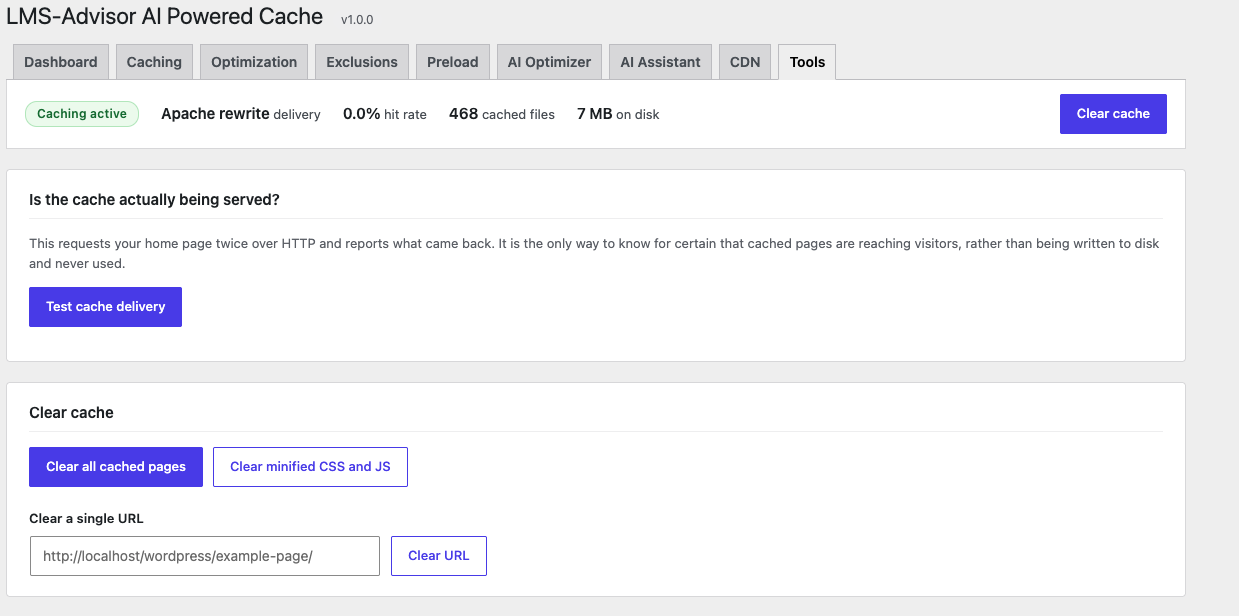
The wizard still opens after activation. It checks your server, tells you plainly what it found, and lets you change any of it — but if you close it and never come back, the plugin is already doing its job. There is also a Test cache delivery button on the Tools tab that requests your home page over HTTP and tells you whether cached pages are genuinely reaching visitors, rather than being written to disk and never used.
Changed your mind later? Every settings tab has a reset link that restores just that tab, and Tools has a full reset that returns everything to how it shipped. Both ask for confirmation first, and both tell you how many settings actually differ from the defaults before you commit.
Two kinds of intelligence, and an honest line between them
The optimizer runs entirely on your server. It needs no API key, no account, and makes no external request of any kind. It is a small set of well understood statistics — exponential moving averages, z-scores and logistic scoring — trained on counters stored in your own database. It records URL paths and counters only: no IP addresses, no cookie values, no visitor identifiers, and it transmits nothing anywhere. This is on by default and always will be.
The optional AI assistant does leave your server. It sends a technical profile of your site to an AI model and gets back a genuine diagnosis of what is slowing it down, with specific settings changes you can apply in one click.
That request goes through the AI Client built into WordPress 7.0, not through any integration of our own. The provider, the model and the credentials are whatever you configured once for your site; this plugin stores no API key, is tied to no particular vendor, and sends nothing to us. On WordPress versions without the AI Client this tab is simply inert — every caching and optimization feature works regardless.
The assistant is off until you switch it on, and will not run until you have separately confirmed consent. The settings screen shows you the exact payload — the complete text, not a summary — before anything is sent. See the Privacy section for what is and is not included.
Page caching
- Static HTML page cache with pre-compressed gzip copies
- Three delivery methods, auto-detected: Apache/LiteSpeed rewrite rules, Nginx rules, and a universal PHP drop-in
- Separate variants for mobile and HTTPS where your theme needs them
- Conditional request support, so returning browsers get a 304 instead of a full page
- Targeted invalidation: editing a post clears that post plus its archives, author page, date archives and adjacent posts — not your entire site
Adaptive optimization
- Per-URL cache lifetimes derived from measured traffic and measured rate of change
- Pages with a detectable rhythm of change expire just before they typically go stale
- Expensive pages are kept longer, because regenerating them costs the most
- Preload queue ordered by expected value, so high-traffic and slow-rendering pages are warm first
- A recommendations panel that explains what to change and shows the evidence behind each suggestion
Core Web Vitals, addressed directly
- LCP — the likely hero image is identified server-side at cache time, stripped of any lazy loading and given fetchpriority=”high”, so the browser starts fetching it while it is still parsing the HTML instead of after layout.
- CLS — local images missing width and height get their real dimensions measured on disk and written into the markup, so space is reserved and nothing jumps.
- INP — JavaScript can be delayed until the first real interaction, with an order-preserving sequential restore and a timeout so idle visitors still get full functionality. Or simply deferred, so parsing never stops for a download.
- Fonts — display=swap keeps text visible while webfonts load, and preconnect hints are contributed through WordPress’s own resource-hints API.
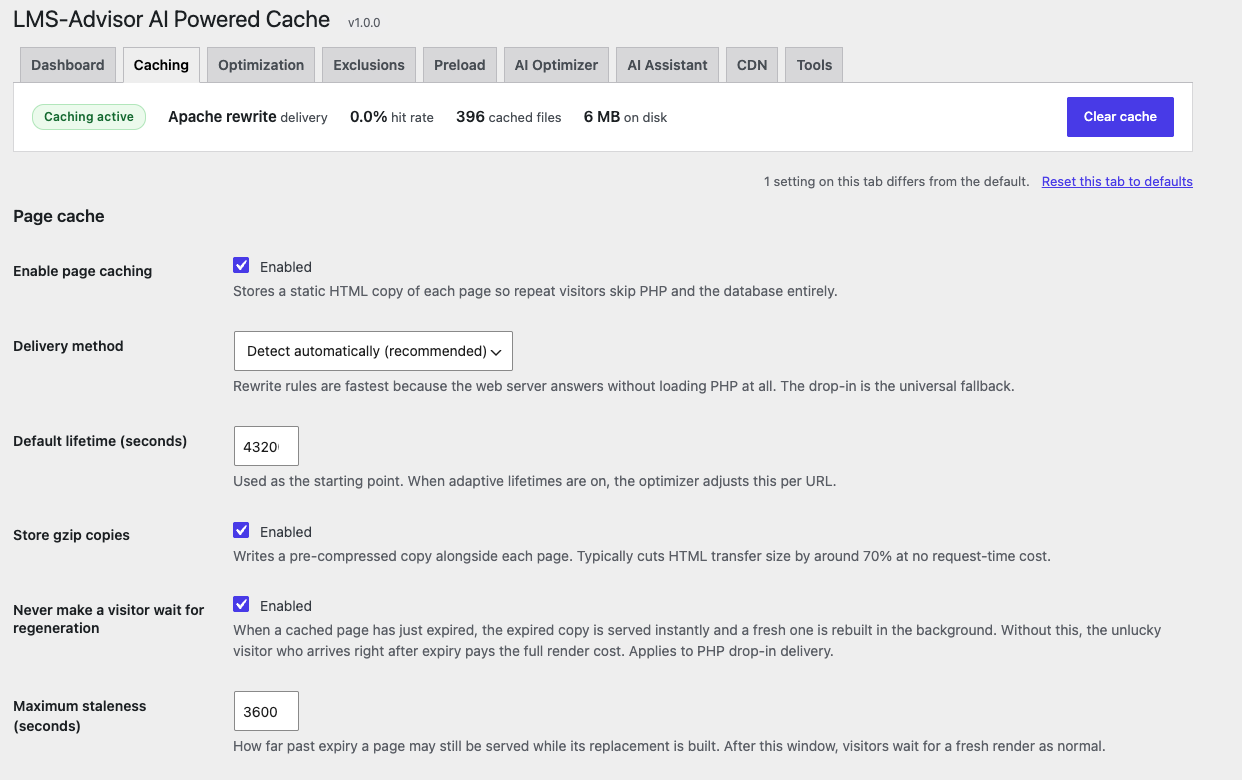
- Stale-while-revalidate — when a page has just expired, the expired copy is served instantly and the path is queued for a background rebuild, so a visitor arriving in the grace window gets an immediate response instead of waiting for a full render.
All of this analysis happens once, when the page is cached. Visitors are served the finished result.
Page builders are first-class citizens
Elementor, Divi, Beaver Builder, Oxygen, Bricks, Brizy, WPBakery, Visual Composer, Thrive, Cornerstone, Flatsome and SiteOrigin editing sessions are detected and never cached — the guard runs before any user setting, so no configuration can accidentally cache an editor screen. When a builder saves a layout or regenerates its CSS, the page cache is purged in step. Builder runtime scripts are shielded from JavaScript delay by default, so above-the-fold sliders and animations keep working.
Asset optimization
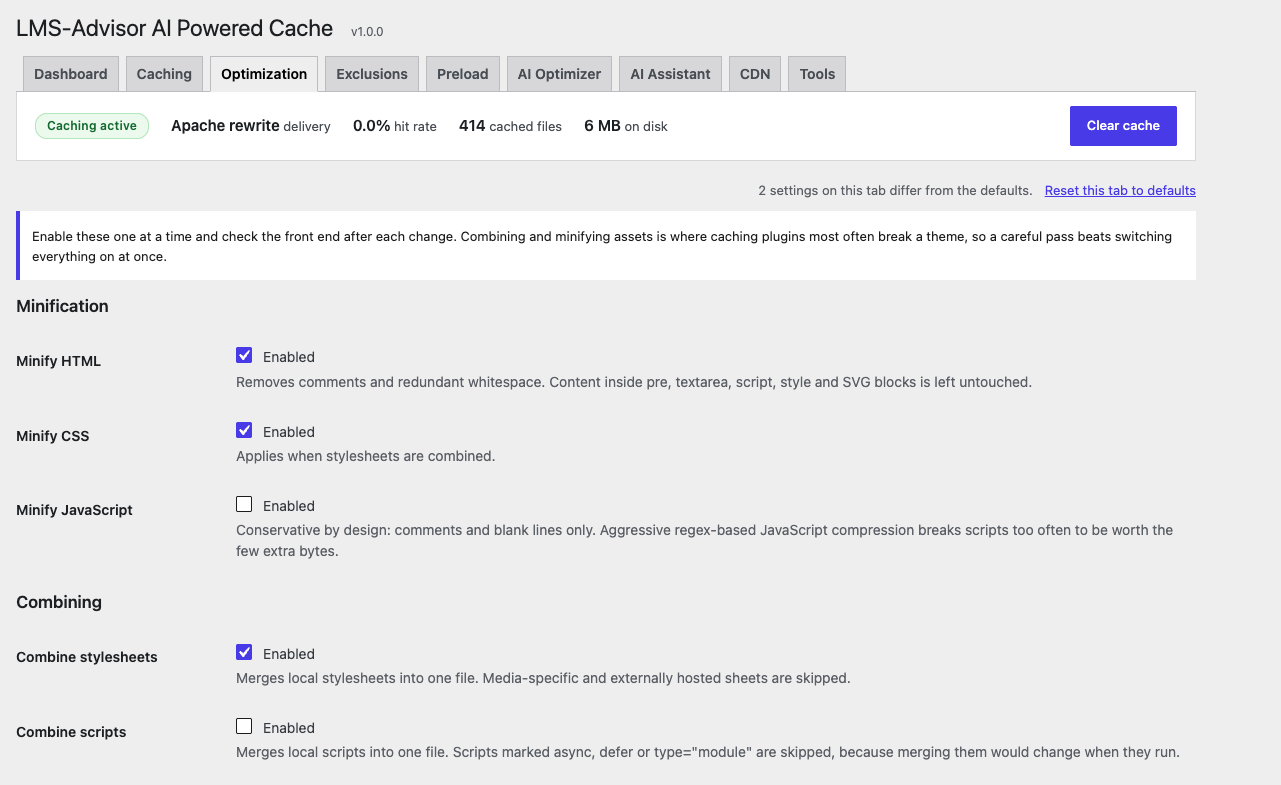
- HTML minification that leaves pre, textarea, script, style and SVG blocks untouched
- CSS minification and combining through the WordPress dependency API, with url() references rebased correctly
- Conservative JavaScript minification and combining that never merges a handle carrying inline code, localized data, a loading strategy or a conditional comment
- Native lazy loading for images and iframes, with no JavaScript added
- CDN URL rewriting, including srcset
- Browser caching headers for static assets
- Optional removal of the emoji script and version query strings
Preloading
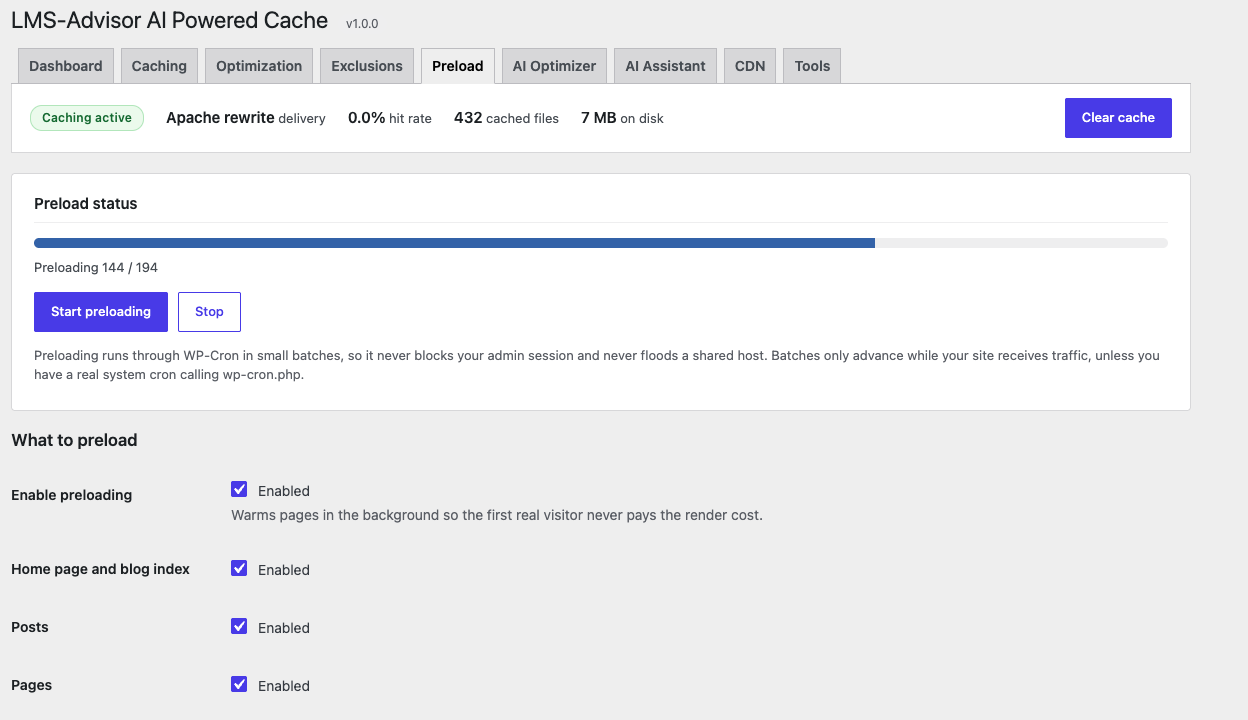
Preloading runs through WP-Cron in small batches with a configurable pace, so it never blocks your admin session and never floods a shared host.
Automation
WP-CLI:
wp lmsa-cache clear
wp lmsa-cache clear --url=https://example.com/hello-world/
wp lmsa-cache clear --post=42
wp lmsa-cache preload
wp lmsa-cache status --format=json
REST API (authenticated, requires the manage_options capability):
POST /wp-json/lmsa-cache/v1/purge
GET  /wp-json/lmsa-cache/v1/status
For developers
Filters: lmsa_cache_is_cacheable, lmsa_cache_ttl, lmsa_cache_variant_parts, lmsa_cache_related_urls, lmsa_cache_preload_urls, lmsa_cache_allowed_hosts, lmsa_cache_pre_optimize, lmsa_cache_post_optimize, lmsa_cache_recommendations
Actions: lmsa_cache_loaded, lmsa_cache_page_stored, lmsa_cache_purged_all, lmsa_cache_purged_post, lmsa_cache_model_trained, lmsa_cache_settings_saved
To skip caching for a request from your own code, define DONOTCACHEPAGE, return false from lmsa_cache_is_cacheable, or emit <!--lmsa-cache-skip--> anywhere in the page.
Privacy
Default behaviour: nothing leaves your server
With the AI assistant switched off — which is how the plugin ships — this plugin contacts no external service and transmits no data anywhere.
Optional AI analysis
The AI assistant is an opt-in feature that requires you to switch it on, tick a separate consent box, and have an AI provider configured for your site in WordPress. Until all three are true, no request is made.
Requests are made by the WordPress core AI Client, not by this plugin. Which company receives them, and under what terms, is determined entirely by the provider you configured in WordPress — this plugin has no provider of its own and no way to send your data anywhere else.
When you press Analyse, the following is handed to the AI Client:
- server software, PHP version, WordPress version, memory limit, and which optional PHP extensions are present
- the names and version numbers of your active plugins and theme
- this plugin’s own settings
- cache statistics this plugin collected locally: hit and miss counts, bypass reasons, and per-path request counts and average generation times
- for one page you nominate: its HTML size, and an inventory of its stylesheets, scripts and images described by path, file size and loading attributes
- the hostnames of any third-party resources that page references
The following is never sent: post or page content, user accounts, usernames, email addresses, comments, orders, form submissions, IP addresses, cookies or cookie values, and any data belonging to another plugin. The profiler collects a fixed list of named facts and does not read anything else.
You can display the complete payload for your own site, verbatim, on the AI Assistant tab before enabling anything.
How that data is then handled is governed by the terms and privacy policy of the AI provider you configured in WordPress.
Switching the assistant off stops all external communication immediately. Uninstalling the plugin deletes the stored report, the change log and the usage counters.
Data stored locally
When statistics collection is enabled (on by default, and switchable off under Tools), the plugin records the following in wp-content/cache/lmsa-cache/ai/statistics.json, which is protected from direct web access:
- URL paths that were requested
- Counts of cache hits, misses and bypasses per path
- Average page generation time and response size per path
- How often each path was invalidated
It does not record IP addresses, user agents, cookie values, usernames, user IDs, referrers, or any request or response body. Cookie names are compared against your exclusion list to decide whether a request may be cached; cookie values are never read.
Enabling the optional diagnostic log adds a plain-text log under wp-content/cache/lmsa-cache/logs/, also protected from direct web access. It records cache decisions and purge events only, and is off by default.
All of this data is deleted when the plugin is uninstalled.
Can I undo my settings?
Yes, at two levels. Each settings tab shows a reset link when at least one of its settings differs from the shipped default, and that link restores only that tab. Tools has a full reset that restores everything. Neither touches your collected statistics or the trained model — those have their own reset button.
After a full reset, page caching returns to being switched off, exactly as on a fresh install, so nothing continues to be served from a configuration you have just discarded.
Can I run the setup wizard again?
Yes, from AI Powered Cache Tools. It starts from your current settings rather than from defaults, so walking through it changes nothing unless you actually change an answer.
Screenshots
Installation
- Upload the
lmsadvisor-ai-powered-cachefolder to/wp-content/plugins/, or install it through the Plugins screen. - Activate the plugin. Caching is switched on and configured for your server automatically, and the setup wizard opens so you can review what was done.
- If rewrite rules could not be used, add
define( 'WP_CACHE', true );towp-config.php, just below the opening<?phptag. WordPress will not load any caching drop-in without it, and this plugin does not edit that file for you. The admin screen tells you when this is needed and shows the exact line. - Open AI Powered Cache Tools and press Test cache delivery. It requests your home page twice and reports whether the cache is actually being served. Do this before measuring anything with PageSpeed Insights or GTmetrix.
- You can re-run the wizard at any time from AI Powered Cache Tools, and every settings tab has a reset link.
Do not run two page caching plugins at once. Deactivate WP Rocket, W3 Total Cache, WP Super Cache, LiteSpeed Cache, WP Fastest Cache or any similar plugin before enabling this one.
FAQ
-
Does this send my data anywhere?
-
Not unless you deliberately turn on the AI assistant. Everything else — page caching, adaptive lifetimes, preloading, all the Core Web Vitals work — runs entirely on your own server and makes no external request.
If you do enable the assistant, pressing Analyse sends a technical profile of your site to whichever AI provider you configured in WordPress, through the WordPress AI Client. You can read the exact payload on screen before consenting. Nothing is sent on a schedule, in the background, or without a click.
-
What exactly does the assistant send?
-
Server and PHP capabilities, your active plugin and theme names and versions, this plugin’s own settings, the cache statistics it collected locally, and an inventory of the CSS, JS and images on one page you choose — described by path, size and loading attributes.
It does not send post content, pages, users, comments, orders, form submissions, email addresses, IP addresses, or any data belonging to another plugin. The profiler is an allow-list of named facts, not a scrape.
-
Do I need an API key to use this plugin?
-
No, and this plugin never asks you for one. Every caching and optimization feature works without any AI at all. The assistant is an optional extra that reuses the AI provider you have already set up for your site in WordPress.
-
What does “AI” mean in this plugin?
-
Two distinct things, and the plugin is careful not to blur them.
The built-in optimizer is applied statistics running locally: moving averages to track how fast each page changes, z-scores to find unusually popular pages, logistic scoring to rank preload priority. A real model trained on your traffic — but not a language model, and it does not pretend to be one.
The assistant is a large language model, reached through the WordPress AI Client using the provider configured for your site. It reads the profile of your site and reasons about it the way an experienced performance engineer would.
-
Can the AI change my settings without asking?
-
No. It returns recommendations; each one shows exactly which setting would change, from what value to what value, with an Apply button you press. Only settings on an internal allow-list can be applied at all, and a proposed value is re-validated against the same schema that guards the settings form before it is written.
Some settings are deliberately excluded from that list — caching for logged-in visitors, the server delivery method, and every exclusion rule — because getting them wrong breaks a site in ways an automated suggestion should not risk. Every applied change is logged with its previous value and can be undone in one click.
-
Where is my API key stored?
-
Nowhere in this plugin. Credentials for AI providers are handled by WordPress itself through the core AI Client, so there is no key for this plugin to store, encrypt, leak or export. You configure a provider once for the whole site and every plugin that uses the AI Client shares it.
-
Do I have to edit wp-config.php?
-
Only if you choose the PHP drop-in delivery method, and only to add one line. WordPress will not load any caching drop-in unless
WP_CACHEis defined, and this plugin does not edit wp-config.php for you — it is your configuration file, it is read-only on many hosts, and a plugin rewriting it is a good way to break a site. The Caching tab shows the exact line and tells you whether the constant is already set. The Apache and Nginx delivery methods do not need it. -
I installed it and my PageSpeed score did not change. Why?
-
Work through these in order.
First, press Test cache delivery on the Tools tab. It tells you whether cached pages are reaching visitors at all. The most common cause of “no change” is that pages are being cached correctly and nothing is serving them — usually because
WP_CACHEis missing fromwp-config.phpand rewrite rules were not available.Second, remember what a page cache does. It removes PHP and database work from the response, which improves your server response time and, through it, part of LCP. It does not change how large your images are, how much CSS blocks rendering, or how much JavaScript runs on the main thread — and those are what dominate a Lighthouse score. A cache is necessary for a fast site; on its own it is rarely worth thirty points.
Third, make sure the URL you are testing is warm. A cold URL is measured on the slow path, where the plugin is doing extra work rather than saving it. Preloading is on by default for this reason; give it a few minutes after activation, or run it manually from the Preload tab.
Finally, look at the Dashboard’s recommendations panel. It names the specific things your site is doing that cost you points, with the evidence, and several of them are settings this plugin ships switched off on purpose.
-
GTmetrix gives me an F on “Add Expires headers” or “Compress components with gzip”.
-
Those two are the plugin’s job and it should fix them, so if they are still failing, check in this order.
Open AI Powered Cache Tools and look at Server capabilities. Expires headers need
mod_expiresand compression needsmod_deflateormod_brotli. If a module is not loaded, no plugin can supply it — only your host can enable it. On a default XAMPP installmod_expiresandmod_headersare frequently commented out inhttpd.conf.If the modules are present, confirm the rules were written. The plugin writes them on activation and whenever you save settings, but only when
.htaccessis writable. The Caching tab reports whether it is, and offers a Write rules button. On Nginx nothing can be written automatically — the Caching tab shows the block to paste into your server configuration. -
Not on its own, and it would be dishonest to imply otherwise.
Cookie-free domains means serving static files from a hostname that your cookies are not scoped to. That requires a second hostname, which means a CDN or a subdomain you control — there is nothing a plugin can do from inside one domain. Configure the CDN tab with a CDN hostname and this grade resolves itself.
Reduce DNS lookups counts the distinct domains a page contacts. Every one comes from your theme, your other plugins, or an embed — Google Fonts, an analytics script, a chat widget, an embedded video. The plugin already removes one (the emoji script’s
s.w.orglookup) and adds preconnect hints so the remaining lookups start earlier, but the only real fix is to use fewer third-party services or self-host the ones you keep.Both of these are YSlow rules from an era of HTTP/1.1 and domain sharding. They are worth knowing about, but a modern Lighthouse or Core Web Vitals score — which is what search ranking actually uses — weighs neither of them.
-
Why is my hit rate low?
-
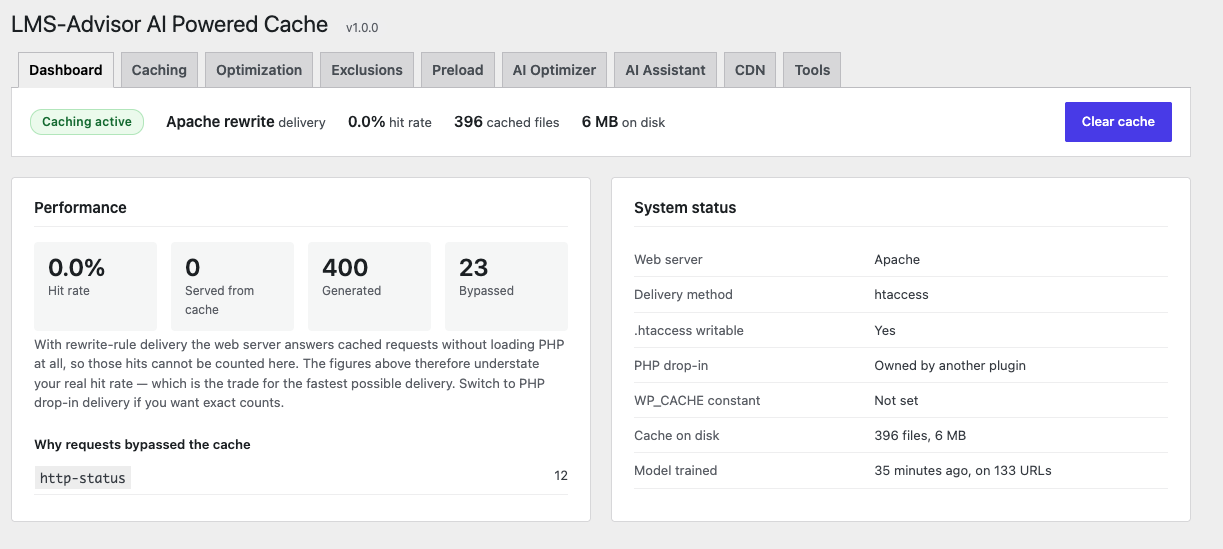
Check the “Why requests bypassed the cache” panel on the Dashboard. The most common causes are logged-in traffic, query strings on inbound links, and exclusion rules that are broader than intended. The Dashboard names the exact reason and how many times it occurred.
-
Can I cache pages for logged-in users?
-
Yes, but leave it off unless every logged-in visitor sees identical markup. On a membership site, a shop, or anything with a personalised header, enabling it will show one member’s page to another.
-
Which delivery method should I use?
-
Leave it on automatic. Rewrite rules are fastest because the web server answers without loading PHP at all; the PHP drop-in is the universal fallback and still skips your theme and plugins.
-
Does it work with Elementor and Divi?
-
Yes, by design. Editing sessions for all major builders are detected by their URL signatures and never cached — this guard runs before every user setting, so it cannot be misconfigured away. Saving a layout or regenerating builder CSS purges the affected pages automatically. If you enable JavaScript delay, the builders’ front-end runtime scripts are protected by default so sliders, animations and responsive behaviour work immediately, before any interaction.
-
Will this actually improve my Core Web Vitals?
-
The features map one-to-one onto the field metrics: hero-image preloading and lazy-load correction target LCP, dimension injection targets CLS, and JavaScript delay targets INP and blocking time. What you gain depends on what your site currently does wrong — a theme that lazy-loads its hero image will see a large LCP gain from the fix; a site that already does everything right will see less. The Dashboard’s recommendations panel tells you which of these apply to your site, with the evidence.
-
Does it work with WooCommerce?
-
Cart, checkout and account pages are excluded by default through their cookies, and product pages are invalidated automatically when stock or stock status changes.
-
Does it work on multisite?
-
Yes. Settings, statistics and cache entries are per-site, and network activation initialises each site.
-
What happens if I deactivate it?
-
The rewrite rules and the drop-in are removed and generated files are deleted, so the site keeps working normally. A
WP_CACHEline you added to wp-config.php is left alone — the plugin never writes to that file — and it is harmless once there is no drop-in for it to load. Your settings and statistics are kept in case you reactivate. Deleting the plugin removes everything.
Reviews
There are no reviews for this plugin.
Contributors & Developers
“LMS-Advisor AI Powered Cache” is open source software. The following people have contributed to this plugin.
Contributors
Translate “LMS-Advisor AI Powered Cache” into your language.
Interested in development?
Browse the code, check out the SVN repository, or subscribe to the development log by RSS.
Changelog
1.0.1
Delivery and defaults. The plugin now configures itself on activation instead of installing inert, and several bugs that stopped cached pages ever reaching visitors are fixed.
- Caching, HTML/CSS/JS minification, CSS combining, native lazy loading and preloading are enabled by default. Activation installs the drop-in, writes the server rules and queues a preload run.
- The setup wizard opens on every activation, and a Test cache delivery button on the Tools tab proves whether cached pages are genuinely being served.
- Fixed: rewrite rules used the WordPress home path where the document root was required, so the cache was never served on any site installed in a subdirectory.
- Fixed: rules matched
%{HTTP_HOST}, which retains the port, against cache directories named after the bare hostname — a permanent miss on any non-default port. - Fixed: the HTTPS variant suffix was applied unconditionally, so plain-HTTP sites looked for a file that was never written.
- Fixed: the query-string guard used a no-op rewrite flag, so cached pages could be served to URLs carrying a query string.
- Fixed: HTTPS detection combined
[OR]conditions with laterANDconditions, which could fire a rewrite without confirming the cache file existed. - Fixed: browser caching and compression rules were only written when page caching was active, so a site could report no Expires header while the setting read as enabled. They are now written on any Apache-family server, independently of page caching, alongside Brotli support and a wider set of media types.
- Fixed: request URIs were run through a sanitizer that strips percent-encoded characters, breaking every non-ASCII URL. Path segments that cannot be represented literally now carry a digest, so two different non-Latin slugs can no longer collide onto one cache file.
- Fixed: any page containing a
_wpnoncefield was refused, which silently disabled caching on sites with a contact or search form. Only forms posting to login and administrative endpoints are excluded now. - Fixed: JavaScript minification skipped every handle enqueued in the footer, which is nearly all of it.
- Fixed: LCP prioritisation, image dimension injection, font display-swap and lazy loading only ran on cacheable requests, so they did nothing on pages that could not be cached.
- Fixed: expired entries could never be removed on a fully cached site, because the cleanup task depends on WP-Cron and no request reached PHP to trigger it.
- Bypasses now record the specific rule that caused them instead of an empty reason.
- Renamed to LMS-Advisor AI Powered Cache.
1.0.0
- Initial release.