

Description
AKSA AI Monitor records requests from supported AI crawler User-Agent strings and recognized AI referral hosts. It separates content reads from robots.txt, sitemap, API, administration, feed, HEAD, and common static-asset requests.
AKSA AI Monitor includes:
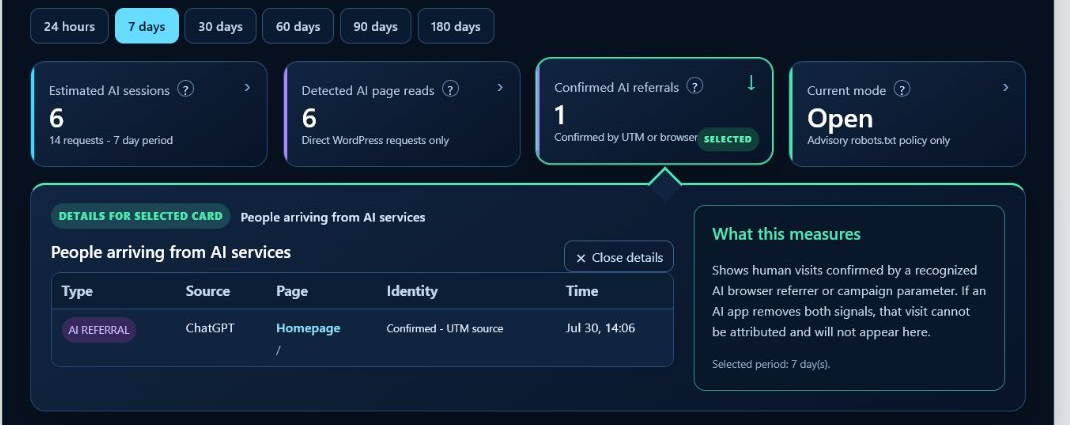
- AI requests, estimated AI sessions, content reads, and AI referrals for 24 hours or 7, 30, 60, 90, and 180 days.
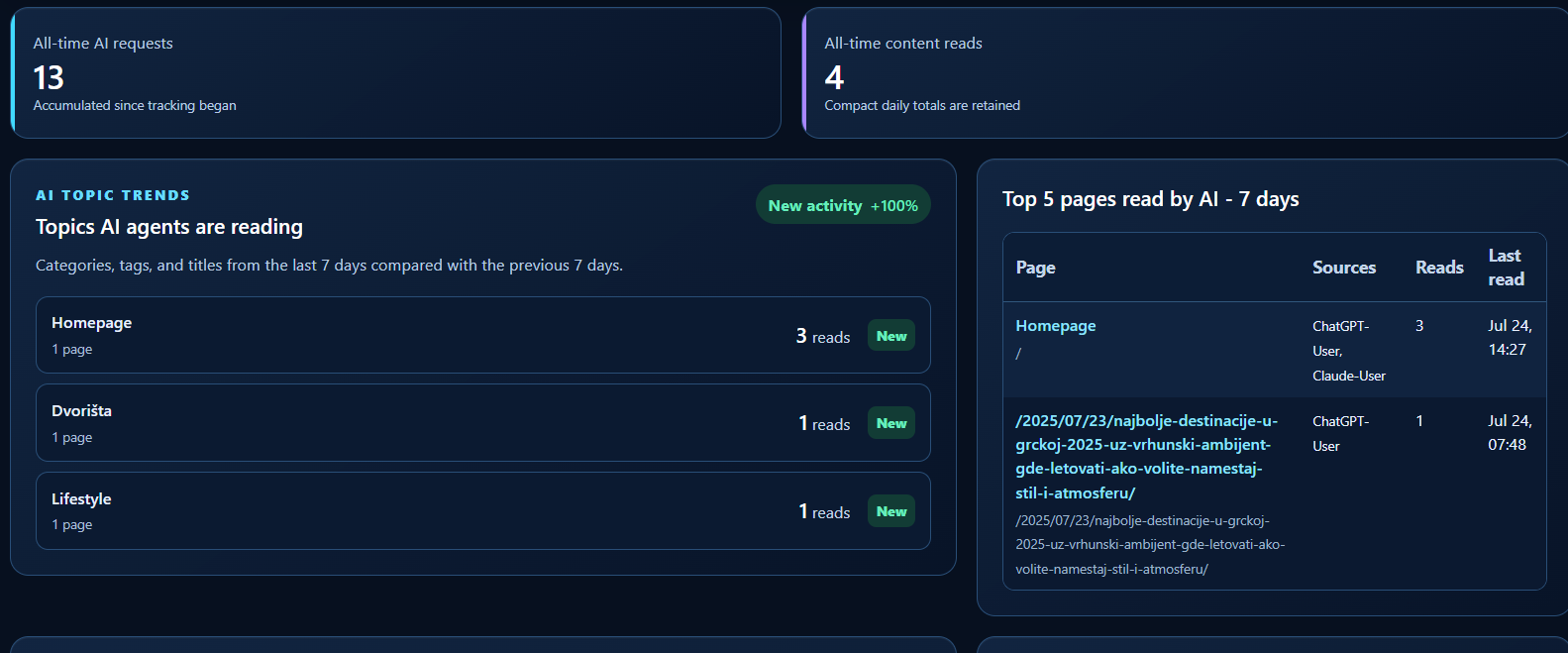
- All-time request and content-read totals stored as compact daily aggregates.
- Top five content pages with WordPress titles, source agents, reads, and last activity.
- Topic trends derived from WordPress categories, tags, and titles.
- Recent activity with content and infrastructure events clearly separated.
- Open, Balanced, Protected, and Custom crawler-policy modes.
- Optional HTTP 403 enforcement. Without enforcement, blocking choices add advisory rules to WordPress virtual robots.txt.
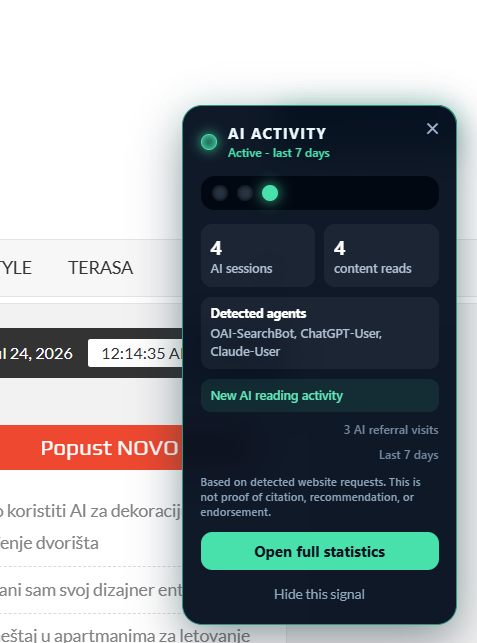
- Optional public or administrator-only AI Signal corner widget.
- Activity status based only on content reads: active within 7 days, recent within 30 days, or no recent activity.
- Privacy-friendly local storage. Raw IP addresses are not stored.
- Configurable detailed-data retention, permanent reset controls, and CSV exports for periods up to 365 days.
The plugin does not use an AI API and does not send activity data to the plugin author or an external analytics service.
Report availability depends on the configured detailed-data retention period. New installations retain detailed activity for 180 days by default, and administrators can choose between 7 and 365 days.
Measurement limits
Crawler identity is currently detected from the request User-Agent header. User-Agent strings can be imitated, so the plugin labels identity as detected and unverified. A detected request is not proof that an AI provider cited, recommended, approved, endorsed, or rated the website or its content.
AI sessions are estimates. Requests from the same detected agent and privacy-safe fingerprint within a 30-minute time bucket are grouped together.
Confirmed AI referral visits require a recognized campaign parameter (including ChatGPT Search’s utm_source=chatgpt.com) or browser referrer. Some AI services remove both signals, so referral totals can be lower than actual visits. Visits by logged-in WordPress users are excluded to avoid counting site-owner activity.
Privacy
The plugin stores detected request metadata locally: time, event type, provider, agent label, purpose category, request path without query parameters, referrer host when supplied, response status, privacy-safe crawler fingerprint, shortened crawler User-Agent, request classification, WordPress content ID, identity label, and policy action. Human AI-referral events do not store a browser fingerprint or User-Agent.
Raw IP addresses are not stored. No telemetry or activity data are transmitted to the plugin author. Site owners remain responsible for assessing their own legal obligations and updating privacy notices where required.
Screenshots
Installation
- Upload the plugin ZIP through Plugins > Add New > Upload Plugin, or install it from the WordPress.org directory after publication.
- Activate the plugin.
- Open AKSA AI in the WordPress administration menu.
- Keep Open mode while testing unless you intentionally want to publish crawler restrictions.
- Choose whether the corner signal is hidden, administrator-only, or public.
FAQ
-
Does this prove that ChatGPT or Claude recommends my website?
-
No. It records requests whose User-Agent matches a supported AI crawler or user agent. Access is not proof of a citation, recommendation, approval, endorsement, or quality assessment.
-
What is a content read?
-
A crawler GET request for a content page after robots.txt, sitemap, REST API, administration, feed, HEAD, and common static-asset requests are excluded.
-
What is an AI session?
-
An estimate grouping the same detected agent and privacy-safe visitor fingerprint within a 30-minute time bucket.
-
Does the plugin store IP addresses?
-
No raw IP address is stored. When available, the server address is immediately transformed into a site-specific HMAC hash used only for estimated sessions. CSV exports exclude this fingerprint.
-
Where are the data stored?
-
In tables inside the website’s own WordPress database. Activity is not sent to the plugin author or an external analytics account.
-
What is the difference between robots.txt and HTTP 403?
-
robots.txt publishes an advisory request that compliant crawlers may follow. HTTP 403 enforcement actively refuses a matching request. The enforcement option is off by default.
-
Will deactivation remove my statistics?
-
No. Deactivation keeps settings and data. During uninstall, data are deleted only when the administrator previously enabled the explicit uninstall-deletion setting.
Reviews
There are no reviews for this plugin.
Contributors & Developers
“AKSA AI Monitor – AI Crawler Analytics & Bot Control” is open source software. The following people have contributed to this plugin.
Contributors
Translate “AKSA AI Monitor – AI Crawler Analytics & Bot Control” into your language.
Interested in development?
Browse the code, check out the SVN repository, or subscribe to the development log by RSS.
Changelog
1.0.4
- Aligned PHP classes, functions, constants, hooks, options, database tables, asset handles, CSS selectors, and JavaScript identifiers with the AKSA AI Monitor slug.
- Renamed internal files to use the unique
aksa_ai_monitorprefix.
1.0.3
- Renamed the plugin to AKSA AI Monitor and aligned the plugin slug and text domain.
- Made 30, 60, 90, and 180-day dashboard reports available in the plugin.
- Added selectable CSV export periods up to 365 days.
- Applied the selected period consistently to activity, topic, page, and agent reports.
- Removed unavailable-feature labels from the plugin interface.
- Corrected the WordPress.org contributor username.
1.0.2
- Improved output escaping, input sanitization, and translator context.
- Prepared SQL wildcard patterns using WordPress database placeholders.
- Documented intentional writes to plugin-owned activity tables.
- Improved WordPress.org Plugin Check compatibility.
1.0.1
- Hardened custom-table SQL queries with WordPress identifier placeholders.
- Clarified intentional direct database operations used by local analytics.
- Improved uninstall and data-reset query safety.
1.0.0
- First public AKSA AI Monitor release.
- Added local AI crawler detection, content-read reports, estimated sessions, and confirmed AI referral reporting.
- Added crawler policy controls, CSV export, privacy controls, topic trends, and an optional public activity signal.