

Description
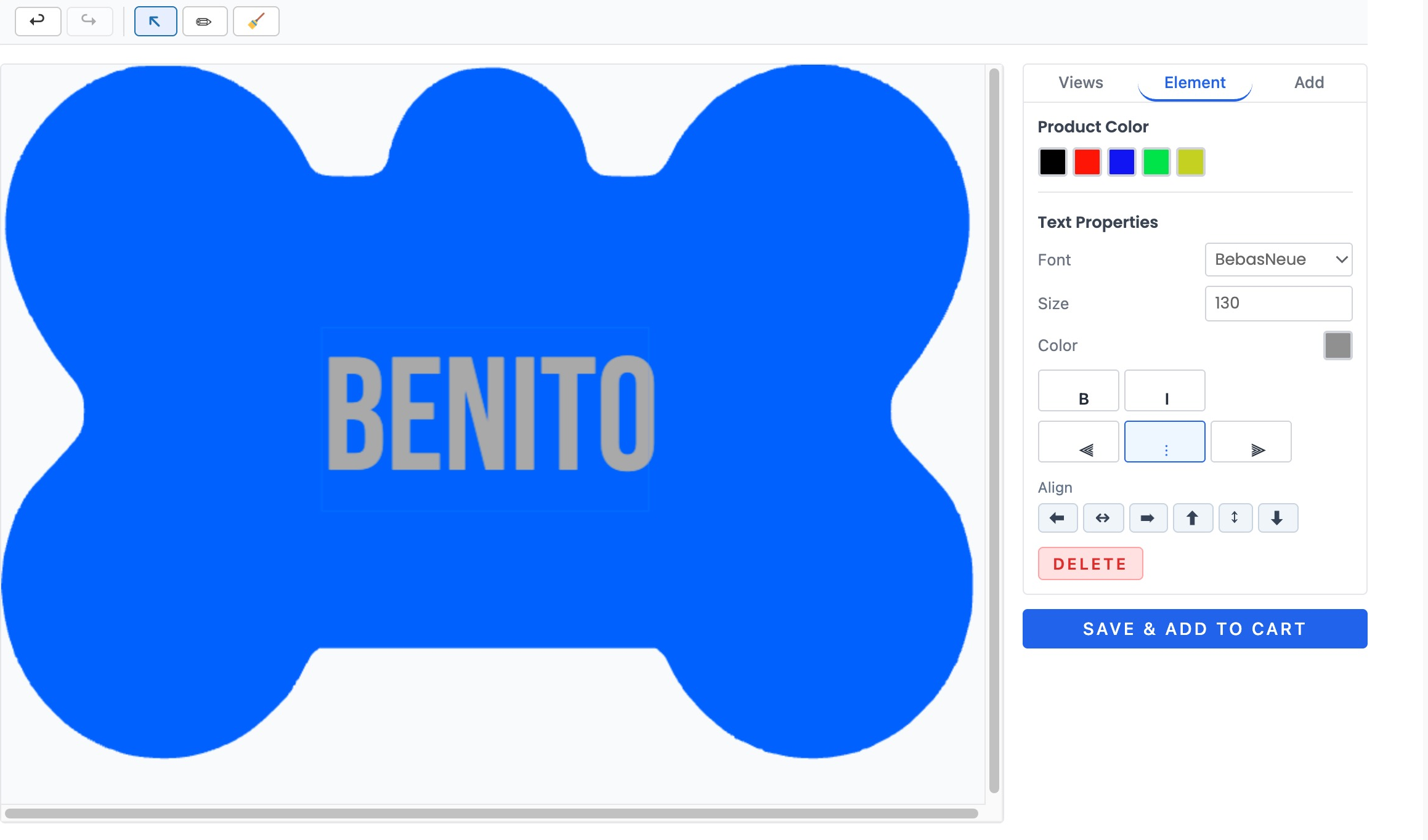
Snelgraveren Product Designer adds a modern, secure product designer to your WooCommerce store. Customers add text, photos, clip art, and SVG artwork onto your products, see a live price, and their design flows straight into your order and production workflow.
Built from the ground up as a secure alternative to legacy product designers, with server-side price calculation, strict file validation, and SVG sanitization on every upload.
Designer
- Drag-and-drop canvas editor (Fabric.js) with multiple product views
- Text, photos, SVG artwork, and curated clip art collections
- Single-stroke engraving fonts for laser/CNC tool paths
- Design zones with boundaries and per-zone permissions
- Live design surcharge preview while the customer edits
- Image resolution warnings before a blurry design reaches production
- Vector-only mode for engraving products (blocks raster photo uploads)
- Works with classic themes (shortcode, auto-render) and block themes (Gutenberg block)
- Mobile-friendly modal designer
Store owner tools
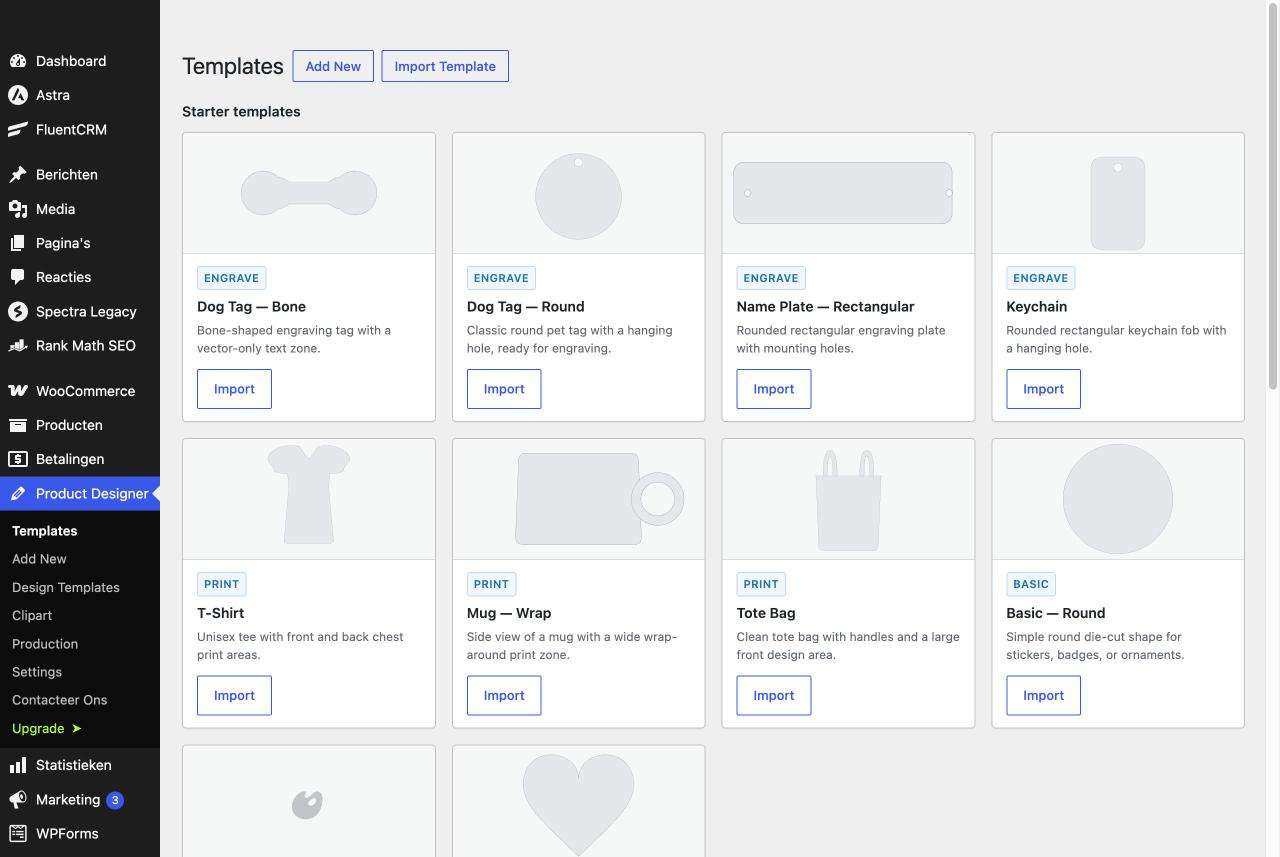
- Ready-made starter templates: import one click from the built-in gallery
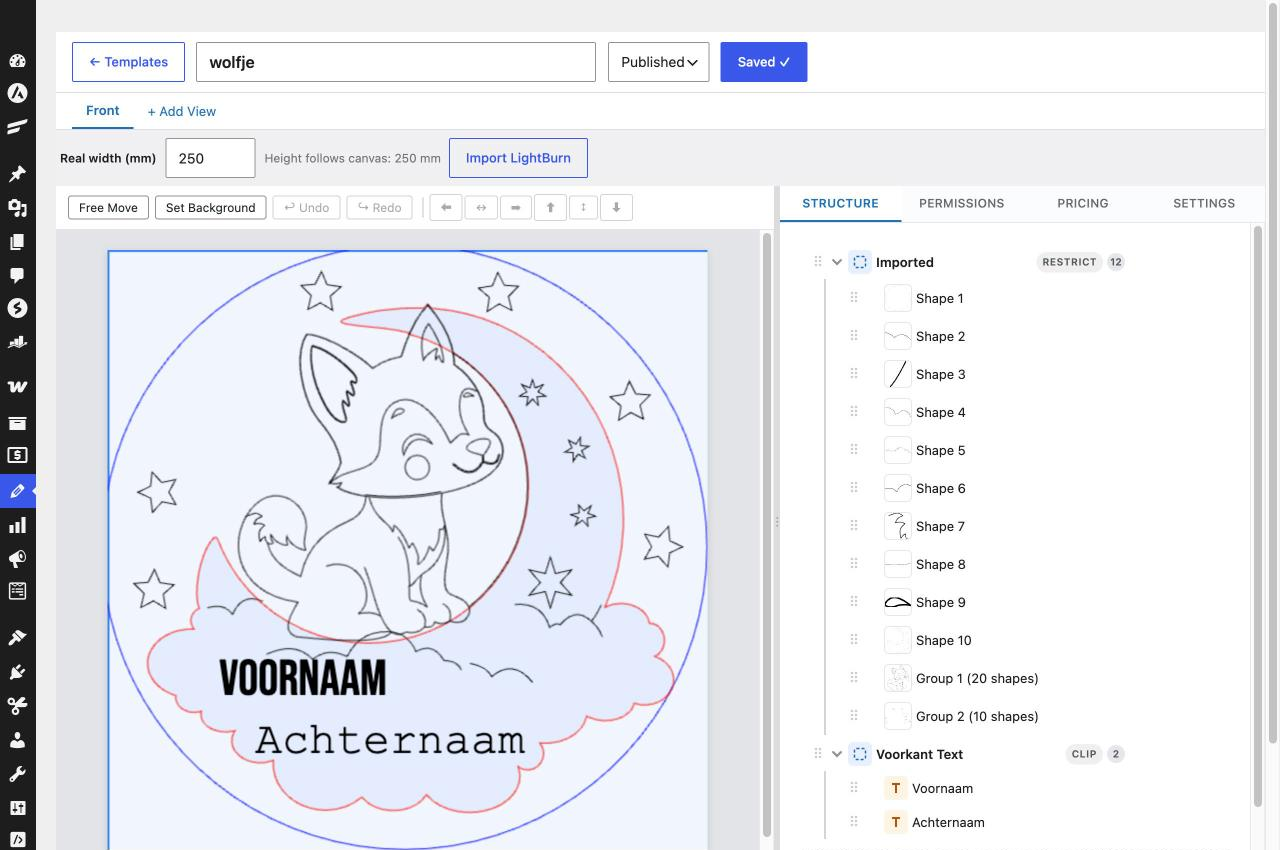
- Template builder with views, zones, layers, permissions, and pricing rules
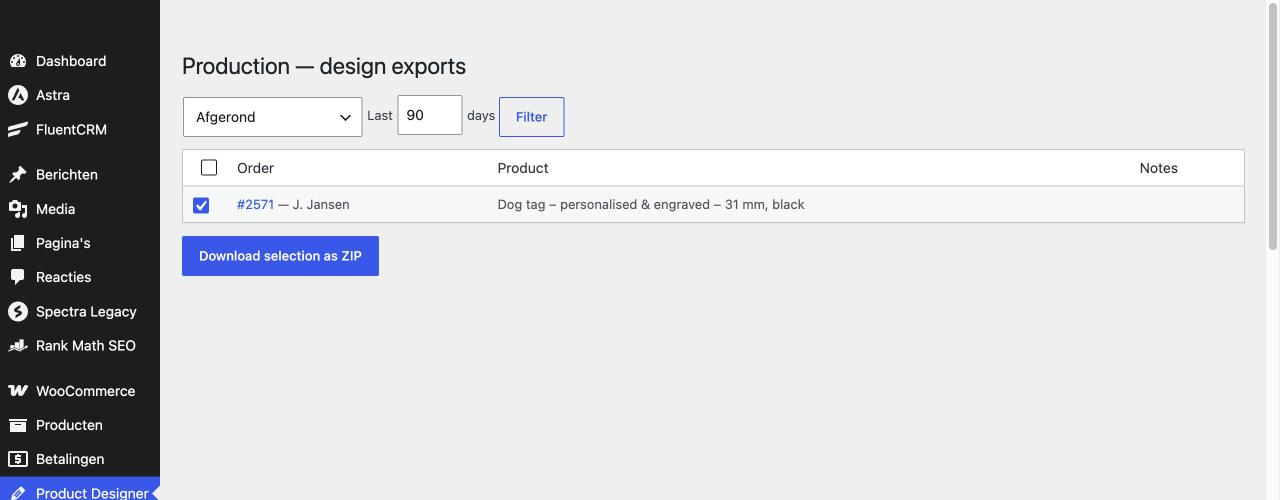
- Production dashboard: all orders with designs, bulk ZIP export for a production run
- Automatic design exports (PDF, PNG, SVG) when an order reaches a chosen status
- Design statistics: saved vs. ordered designs and conversion
- “My designs” tab on the customer account page
- Automatic cleanup of abandoned guest designs (configurable retention)
- System status checks with e-mail alerts when something needs attention
Security first
- All prices calculated server-side — client values are never trusted
- Every SVG sanitized, every upload MIME-validated
- Design links use unguessable random identifiers
- Rate-limited uploads
Free vs Pro
The free plugin is a complete, working product designer. Pro adds the tools that turn it into a full production and pricing workflow.
Free:
- Drag-and-drop designer (text, photos, SVG)
- One template
- Ready-made starter templates
- PNG export
- Shortcode + Gutenberg block
- “My designs” in the customer account
- Mobile designer
- Server-side pricing and SVG sanitization
Pro adds:
- Unlimited templates
- Multiple product views (front, back, …)
- Custom font uploads
- Clip art collections
- Pricing rules (surcharge per element or per tier)
- Per-element and per-zone permissions
- SVG-shape design zones and safe areas
- Product colors and color palettes
- PDF and SVG production export
- Automatic export on order status
- Upload restrictions (vector-only engraving)
- LightBurn (.lbrn2) import
Learn more and compare plans on the product page linked from this listing.
Development
The full source code (including the un-minified JavaScript sources for the compiled files in dist/) and build tooling are publicly available at:
https://github.com/temmink/snelgraveren-product-designer
Build steps: npm install && npm run build (Vite) compiles the designer and admin bundles into dist/; composer install --no-dev installs the PHP dependencies. See the repository README for details.
External Services
This plugin uses the Freemius SDK for license validation, plugin update delivery, and optional usage analytics.
No data is sent anywhere before you act. On activation, Freemius shows an opt-in screen with two choices:
- “Skip” — nothing is sent. The plugin works fully offline; only your Pro license key (if you have one) is validated against Freemius’ servers when you activate a license.
- “Allow & Continue” — you opt in to license validation, update delivery, and anonymized usage analytics. Only then does the plugin share: your site URL, WordPress and PHP versions, the list of active plugins and theme, and the admin e-mail address, with Freemius (freemius.com), a licensing and analytics service used by many WordPress and WooCommerce plugins.
You can review or withdraw this consent at any time from the plugin’s account/opt-in prompts. This service is used for licensing and update delivery — no customer, design, or order data is ever sent to Freemius.
Freemius Privacy Policy: https://freemius.com/privacy/
Freemius Terms of Service: https://freemius.com/terms/
No other external services are used. Design exports (PDF/PNG/SVG) are rendered entirely on your own server — nothing about your customers’ designs, uploads, or orders is ever sent off-site.
Screenshots
Blocks
This plugin provides 1 block.
- Snelgraveren Product Designer Shows the product designer on a customizable product page. Place it anywhere in the product template or description.
Installation
- Upload the plugin ZIP via Plugins Add New Upload Plugin, or unzip into
wp-content/plugins/. - Activate the plugin (WooCommerce must be installed and active).
- Open Product Designer Templates and import a starter template, or build your own.
- Edit a product, enable the designer, and pick a template.
- Block theme? Place the “Snelgraveren Product Designer” block in your Single Product template or product description.
FAQ
-
Does it work with block themes?
-
Yes. Classic themes render the designer automatically on the product page (or via the
[sgpd_designer]shortcode). Block themes use the Snelgraveren Product Designer block in the Site Editor or product description. -
Where are the production files?
-
Exports (PDF, PNG, SVG) are generated locally on your server — nothing is sent to external services. Download them per order or in bulk from the Production dashboard.
-
What does the free version include?
-
The free version includes the full designer with unlimited templates and PNG export. Pro unlocks multiple product views, PDF/SVG production export, automatic exports on order status, pricing rules, custom fonts, clip art management, color palettes, and more.
Reviews
There are no reviews for this plugin.
Contributors & Developers
“Snelgraveren Product Designer for WooCommerce” is open source software. The following people have contributed to this plugin.
Contributors
Translate “Snelgraveren Product Designer for WooCommerce” into your language.
Interested in development?
Browse the code, check out the SVN repository, or subscribe to the development log by RSS.
Changelog
1.7.8
- Fix: starter templates with an SVG-shaped design zone (dog tags, keychain, name plate, T-shirt, round, heart) now import with the zone exactly aligned to the product background. Previously the zone outline was shifted to the top-left corner and the background could appear oversized. Existing templates are not affected.
1.7.7
- Security: hardened the template export/import — embedded asset paths are now confined to the uploads directory (realpath check), so a crafted stored URL cannot read files outside uploads.
- Security: the public font proxy now only serves the designer’s curated Google-font set, keeping its cache bounded, and inline translation data is JSON-escaped for the script context.
- Change: the designer shortcode is now
[sgpd_designer]only (distinctive prefix). Any leftover[productdesigner]/[productforge]tags fall through to the product-page auto-render, so the designer keeps showing.
1.7.6
- Security: a design attached to the cart now requires a valid submission nonce when one is present, and returning to a product page with a design link only shows that design’s preview to its owner.
- Change: internal code namespace made more distinctive and the legacy [productforge] shortcode alias removed — use [productdesigner] (or [sgpd_designer]). Existing content using [productforge] should be switched to [productdesigner].
- Improvement: the font dropdown is now sorted alphabetically in both the builder and the customer designer.
1.7.5
- New: the designer’s save button now saves the design AND adds the product to the cart in one action (“Save & add to cart”). The separate WooCommerce add-to-cart button is hidden while the designer is shown, for one clear action.
- Fix: the “Save & add to cart” button now actually adds the product to the cart (the add-to-cart request parameter was missing on the programmatic form submit).
1.7.3
- Fix: a text field now hugs its content — after typing a name the selection box no longer stays full-width, so moving the text feels natural.
1.7.2
- New: pre-placed template artwork (SVG) is now locked in the customer designer — customers can no longer move, resize, rotate or delete the design’s artwork; only text stays editable. Customer-added clipart remains movable.
- New: the designer can now be embedded with the
[productdesigner]shortcode. The old[productforge]shortcode keeps working.
1.7.1
- New: templates can be exported as a self-contained JSON file (Templates list Export) and imported on another site (Import Template button). All views, zones, boundaries and layers travel along; referenced uploads are embedded in the file and every SVG is re-sanitized on import. Custom fonts do not travel — the import warns per missing font.
1.7.0
- Fix: LightBurn import — shapes with curved segments could land a few pixels off relative to each other (bounding boxes now include exact bezier extrema), so cut layers that coincide in LightBurn coincide in the builder again.
- New: shapes grouped in LightBurn now import as a single multi-path layer per group (colours per cut layer preserved; editable text stays a separate layer).
- New: boundary “From layers” can expand a merged group and select individual shapes inside it, each with its own thumbnail and the parent layer’s name.
- New: imported layers get recognizable names (“Group 1 (12 shapes)”, “Shape 3”) and the layer tree shows real thumbnails instead of generic type icons.
- Fix: the visibility (eye) toggle in the layer tree now actually hides layers and zones on the builder canvas.
- Fix: saving a boundary with decimal coordinates was blocked by browser validation, and the merged-boundary preview rendered blank.
- Fix: zone behavior “Clip at boundary” now works (elements move freely but are cut off at the outline); it previously did nothing.
- Improved: zone behavior “Restrict” now keeps elements inside the actual SVG contour instead of its rectangular bounding box.
- Fix: customers could not select or edit template text in the designer — template artwork loaded on top of the text and swallowed the clicks.
1.6.2
- Fix (critical): the design surcharge could be added to the cart price more than once in the same request (WooCommerce recalculates totals multiple times), overcharging the customer. The surcharge is now applied exactly once per product.
- Fix (critical): regenerating a production export no longer deletes the previous export before the new one exists — a failed regeneration used to permanently destroy the valid export file.
- Fix: the surcharge is rounded to 2 decimals exactly like the live price preview, so the shown and charged amounts always match.
- Fix: the Fabric object-type whitelist now also runs when design templates are created or updated through the regular admin endpoints (previously import-only).
- Fix: when returning to a product with a saved design, only the main gallery image is replaced by the design thumbnail (galleries with multiple photos no longer show the same thumbnail repeatedly).
- Fix: hardening in the REST API — invalid pagination values can no longer crash the templates list, an invalid design status is rejected instead of echoed back, and a failed design-template insert reports an error instead of a bogus success.
1.6.1
- Fix (Pro): the LightBurn import could add its layers to a previously selected view if you switched views (or added one) after the page rendered but before picking the file. The import now always targets the view that is selected at the moment the file is chosen.
1.6.0
- New (Pro): in the Template Builder’s Boundary form, an SVG-shape boundary can now be built from the view’s imported SVG layers — pick one or more layers (“From layers”) instead of uploading a separate SVG file.
- Fix: the designer product page is no longer full-page cached. A shared page cache (e.g. LiteSpeed) could freeze one visitor’s session nonce for everyone (breaking customer saves) and serve one customer’s design to another, or fall back to the default product image. The page now opts out of caching whenever the designer renders.
- Fix: the plugin’s rewrite-rule self-heal now flushes on shutdown instead of mid-init, so a version update can no longer drop WooCommerce’s shop category rewrite rules (which 404’d category pages after an update).
1.5.0
- New (Pro): “Use as Boundary” in the Template Builder. Select one or more vector (SVG) layers on the canvas — such as an imported LightBurn outline — and turn them into a single design boundary (safe area / clip zone) in one click. The merged shape is stored inline and rendered in both the builder and the customer designer; the original layers are kept (non-destructive). Editable afterwards via the Boundary form.
1.4.0
- New (Pro): Import LightBurn projects (.lbrn2) directly in the Template Builder. Every shape and text becomes an individual, editable object on the canvas; cut-layer colours are preserved so exported SVGs round-trip back into LightBurn, and the physical size (mm) is kept for true-scale exports. Supports grouped shapes, shared geometry, bezier and closed-polygon paths, and maps text to the nearest available web font (with a vector fallback when no font matches).
1.3.5
- Fix: a design whose font family is stored without Google Fonts’ canonical spacing (e.g. “BebasNeue” instead of “Bebas Neue”) never loaded on the product page, so the canvas — and therefore the export — fell back to a different-width font and centred text drifted out of the middle. The designer now loads Google fonts under the exact family name the design uses via the built-in font proxy (which normalises the name server-side), so the on-screen text and the export both use the real font and sit correctly. This is the real fix for off-centre exports that 1.3.4 could not address (the font never loaded at all, so there was nothing to wait for). Re-open and save an affected design once to regenerate its export.
1.3.4
- Fix: centered text could be off-centre in the PNG/SVG export while looking correct in the editor. The offscreen render used to lay text out before its web font had loaded, measuring it with a fallback font of a different width; it now waits for the font and re-measures each text object before exporting, so text sits exactly where the design shows it. Re-open and save an affected design once to regenerate its export.
1.3.3
- Fix: re-opening a saved design and saving it again (e.g. to regenerate the vector export) could, in a load-timing race, store an empty canvas and wipe the design. The save now takes the active view from the live canvas, never overwrites a saved view with an empty (0-object) canvas, and no longer snapshots an incompletely-loaded canvas over a good one.
1.3.2
- Add: SVG exports now convert text to vector outlines by default, so the design opens correctly (and stays centred) in any program without needing the original font installed. Shapes and clip art were already vectors; text is the last piece.
- Add: an extra “SVG + fonts” export button on the order screen produces an SVG that keeps the text editable, with the fonts embedded in the file.
- Add: a font proxy endpoint that serves the Google fonts used in a design as TTF, so the designer can outline/embed them in the browser.
1.3.1
- Fix: the admin React apps (template builder, design templates, clip art manager) did not load their scripts after the menu was renamed to “Product Designer”, because the asset-enqueue check compared against a hardcoded page-hook string. The plugin now reads the actual hook names back from WordPress, so the builder loads regardless of the menu title.
1.3.0
- Add: SVG export now produces a real, editable vector (text as
<text>, shapes and clip art as<path>) instead of a raster image wrapped in an SVG. The designer stores the browser-renderedcanvas.toSVG()output alongside the existing high-res PNG. Designs saved before this update keep working: their SVG export uses a correctly-scaled raster fallback until the design is re-opened and re-saved once. - Add: optional real-world physical size per view (“Real width (mm)” in the template builder). When set, SVG and PDF exports come out at true physical scale (real mm units) instead of the previous 96-DPI pixel assumption; the height follows the canvas aspect ratio so the export is never distorted. Leaving it empty keeps the previous behaviour.
- Fix: the raster-fallback SVG export now carries correct width/height/viewBox, so it opens at the design’s real dimensions instead of collapsing to the 300×150 default SVG viewport.
1.2.1
- Change: the Plugin URI now points to the public source repository (https://github.com/temmink/snelgraveren-product-designer) instead of a placeholder URL.
1.2.0
- Change: renamed all globally-namespaced identifiers (constants, options, transients, the Freemius helper function/global, the cron hook, the
edit_pf_templatescapability, script/style handles, JS globals, and admin menu slugs) from thepf/PF_/productforgeprefix tosgpd/SGPD_, per wp.org review feedback thatpfis too short/generic. A one-time migration copies every existingpf_*option/transient to itssgpd_*name and clears the old cron schedule on upgrade — no settings are lost. DB tables, thepf/v1REST namespace,pf-CSS classes, thepf-designer-rootDOM id, and thepf_design_hashcart/order-meta keys are intentionally unchanged (breaking to rename, not a real collision risk). The[productforge]shortcode keeps working;[sgpd_designer]is now available as an alias. See CLAUDE.md “Prefix Rename” for the full old new mapping. - Add: “External Services” section disclosing the optional Freemius licensing/analytics integration and what it shares if you opt in.
- Fix: cart design-hash attachment (
pf_design_hash) now validates that the requester actually owns the design (matching customer/session id) before attaching it to the cart, instead of only checking the hash format — closes a gap where a guessed or leaked design hash could be attached to someone else’s cart. A nonce is also checked as defense-in-depth (not authoritative, since LiteSpeed page-caching can serve a stale nonce to a legitimate customer). - Fix: SQL prepare-statement hardening across
includes/Database/— remaining unprepared queries are either wrapped in$wpdb->prepare()or documented with aphpcs:ignorewhere only internal table/column names (no user input) are interpolated.
1.1.0
- Change: plugin renamed to “Snelgraveren Product Designer for WooCommerce” (slug:
snelgraveren-product-designer). The[productforge]shortcode,pf/v1REST namespace,pf-CSS classes, andpf_*option names are unchanged for backward compatibility with existing installs. - Change: the Gutenberg block is now
snelgraveren/product-designer(wasproductforge/designer). - Fix: the public template REST endpoint no longer strips views, colors, pricing, permissions, or SVG zone boundaries for free-tier users — per wp.org guideline 5, the free plugin does not artificially limit functionality server-side.
- Fix: the public design-templates REST endpoints now only ever return published templates to non-admin requests, ignoring any client-supplied status filter.
- Fix: removed inline
<style>/<script>blocks from admin-rendered HTML in favor ofwp_add_inline_style/wp_add_inline_script. - Fix: file uploads (customer uploads, clip art, fonts) now go through
wp_handle_upload()instead of a rawmove_uploaded_file()call. - Fix: boolean settings now use
rest_sanitize_booleanas theirsanitize_callback. - Fix: removed the manual
load_plugin_textdomain()call — wp.org loads translations for hosted plugins automatically. - Maintenance: translation files (
languages/) are no longer bundled in the distributed ZIP; they remain in the plugin’s Subversion/GitHub repository.
1.0.4
- Change: premium functionality (PDF/SVG export, auto-export, pricing engine, clip art / font / palette management) is no longer bundled in the free version — it now ships only with Pro.
- Change: removed the template and view count limits from the free version; Pro features are presented as upgrades instead.
- Maintenance: slimmed the plugin package (pruned unused PDF fonts, removed unused libraries).
1.0.3
- Maintenance: WordPress.org Plugin Check compliance — filesystem API usage, output escaping, i18n comments; cache files moved to uploads; removed obsolete update-guard.
1.0.2
- Maintenance: updated the Freemius SDK to 2.13.4.
1.0.1
- New: Gutenberg block
productforge/designerfor block themes and the Site Editor. - New: Starter template gallery — 10 ready-made templates (engraving, print, and basic sets) importable in one click.
- New: WooCommerce is now declared as a required plugin, with a graceful notice instead of a fatal error when it is missing.
- Fix: zone overlays are no longer counted as billable elements in design surcharges.
1.0.0
- Initial release: drag-and-drop designer, template builder, design zones, engraving fonts, clip art, pricing rules, local PDF/PNG/SVG exports, production dashboard, design statistics, account page designs, guest design cleanup, and system health checks.