

Description
AI Content Bridge generates complete, publish-ready content from a short brief — a full article or page, SEO metadata, an optional featured image and relevant video embeds — and publishes it to your site. You don’t need any AI API keys of your own: generation runs on the AI Content Bridge service.
It includes 24 purpose-built content types across marketing, commerce, business and learning & development, a built-in SEO score on every piece, an editable, search-grounded outline step for keyword-led pages, and reusable writing-style profiles so your content stays on-brand.
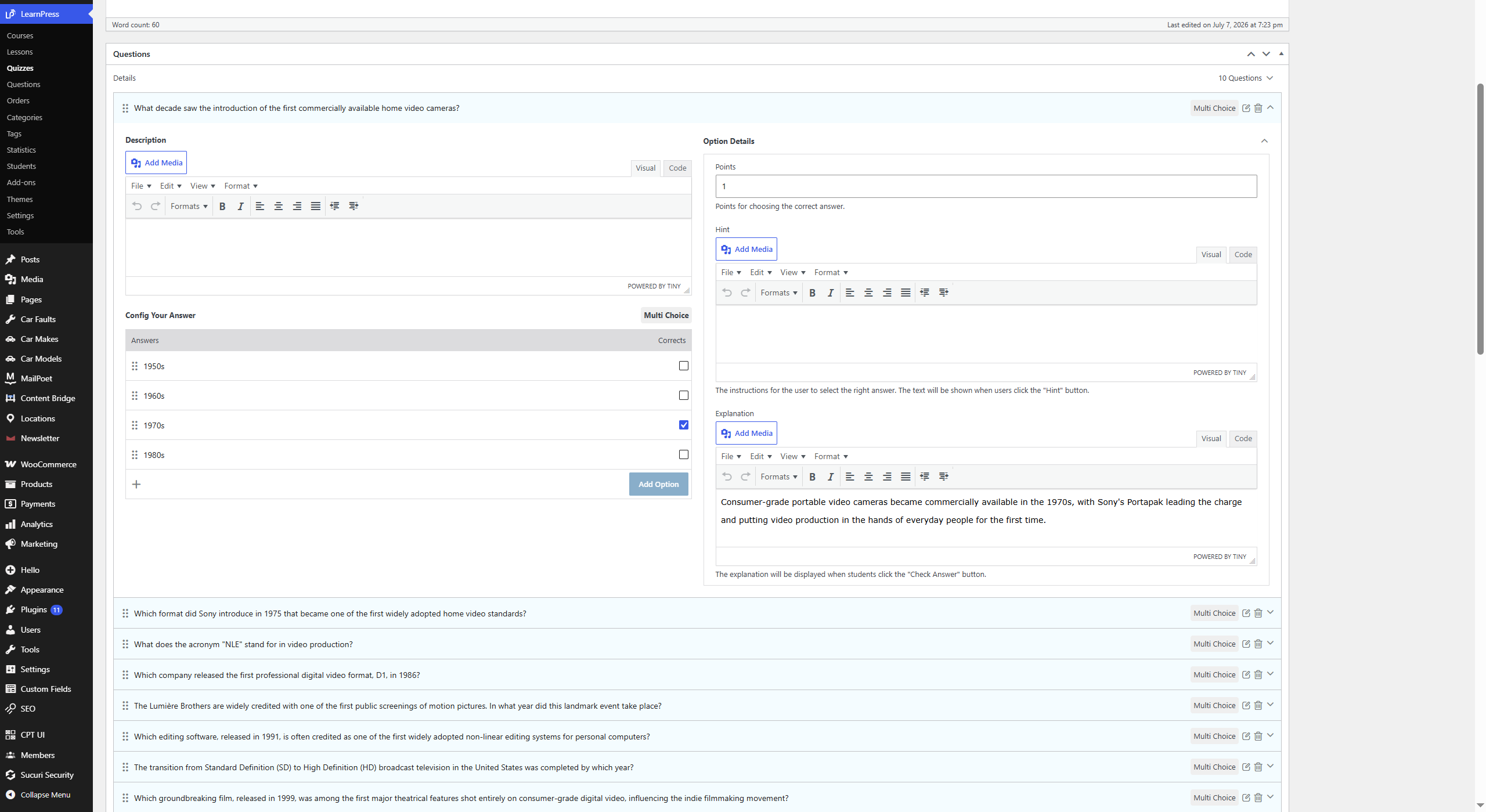
It works with the plugins you already run: Yoast, Rank Math and SEOPress for SEO metadata; WooCommerce for products; LearnPress and LifterLMS for lessons and courses — including knowledge-check quizzes built and linked automatically, so a training module ships ready to test; MailPoet and Newsletter for email; and The Events Calendar for events. Each is detected automatically — there’s nothing to connect.
A free plan is available, with paid plans unlocking more content types, features and credits.
External services
This plugin relies on the AI Content Bridge service to generate content, and that service uses several third-party APIs to do so. When you generate a piece of content, the plugin sends data from your site to the AI Content Bridge service, which then calls the providers below as needed. No content is generated, and no data is sent, unless you start a generation (or the plugin validates your licence key).
AI Content Bridge service (the service this plugin connects to)
Used to validate your licence, manage your credits, and orchestrate generation. Data sent: your licence key, your site’s domain, and the inputs you provide for a piece of content (such as the title, keyword and brief fields). Sent whenever you generate content or your licence is validated.
Terms: https://aicontentbridge.com/terms — Privacy: https://aicontentbridge.com/privacy
Anthropic (Claude API)
Used by the service to generate the article text and SEO metadata. Data sent: the prompt built from your content inputs. Sent on every generation.
Terms: https://www.anthropic.com/legal/commercial-terms — Privacy: https://www.anthropic.com/legal/privacy
OpenAI API
Used by the service to generate a featured image. Data sent: an image prompt derived from your title and chosen style. Sent only when you choose to include an image.
Terms: https://openai.com/policies/terms-of-use — Privacy: https://openai.com/policies/privacy-policy
Serper.dev
Used by the service to fetch search-results data so keyword-led content can be grounded in what currently ranks. Data sent: your primary keyword. Sent only for keyword-led content types when search grounding is enabled.
Terms: https://serper.dev/terms — Privacy: https://serper.dev/privacy
YouTube Data API (Google)
Used by the service to find relevant videos to embed in your content. Data sent: a search query derived from your topic. Sent only when you choose to include video embeds.
YouTube API Services Terms: https://developers.google.com/youtube/terms/api-services-terms-of-service — Google Privacy: https://policies.google.com/privacy
Development
Source code. The admin interface is a React application. The compiled bundle at build/index.js is generated from the human-readable source shipped in this plugin’s /src directory. To rebuild it:
npm cinpm run build(uses@wordpress/scripts)
The output is written to /build. src/index.js is the entry point; every admin component lives under src/components/.
Bundled libraries.
- Parsedown 1.7.x — Markdown parser by Emanuil Rusev, https://github.com/erusev/parsedown (MIT licence, header preserved in
Parsedown.php). The bundled copy is renamedAICOBR_Parsedownto avoid conflicts with other copies of the library. - Fraunces, DM Sans, DM Mono, Syne and Instrument Serif fonts — self-hosted in
/fonts, each licensed under the SIL Open Font License 1.1 (licence texts in/fonts/OFL-*.txt). No fonts are loaded from third-party servers.
Screenshots
![[The content type picker]](https://ps.w.org/ai-content-bridge/assets/screenshot-1.png?rev=3612575)
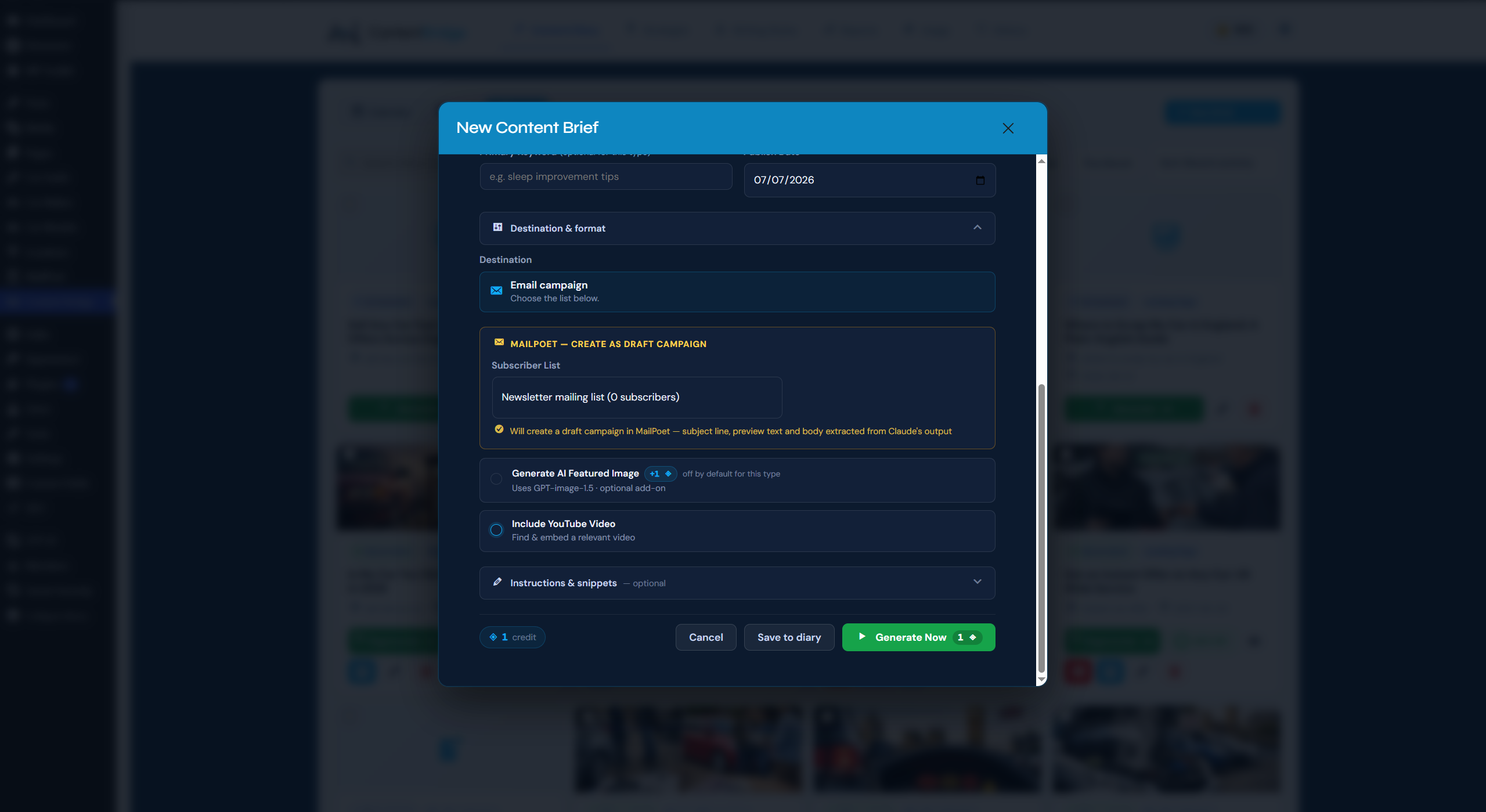
![[The generation form for a content type]](https://ps.w.org/ai-content-bridge/assets/screenshot-2.png?rev=3612575)
![[The editable SEO-grounded outline review]](https://ps.w.org/ai-content-bridge/assets/screenshot-3.png?rev=3612575)
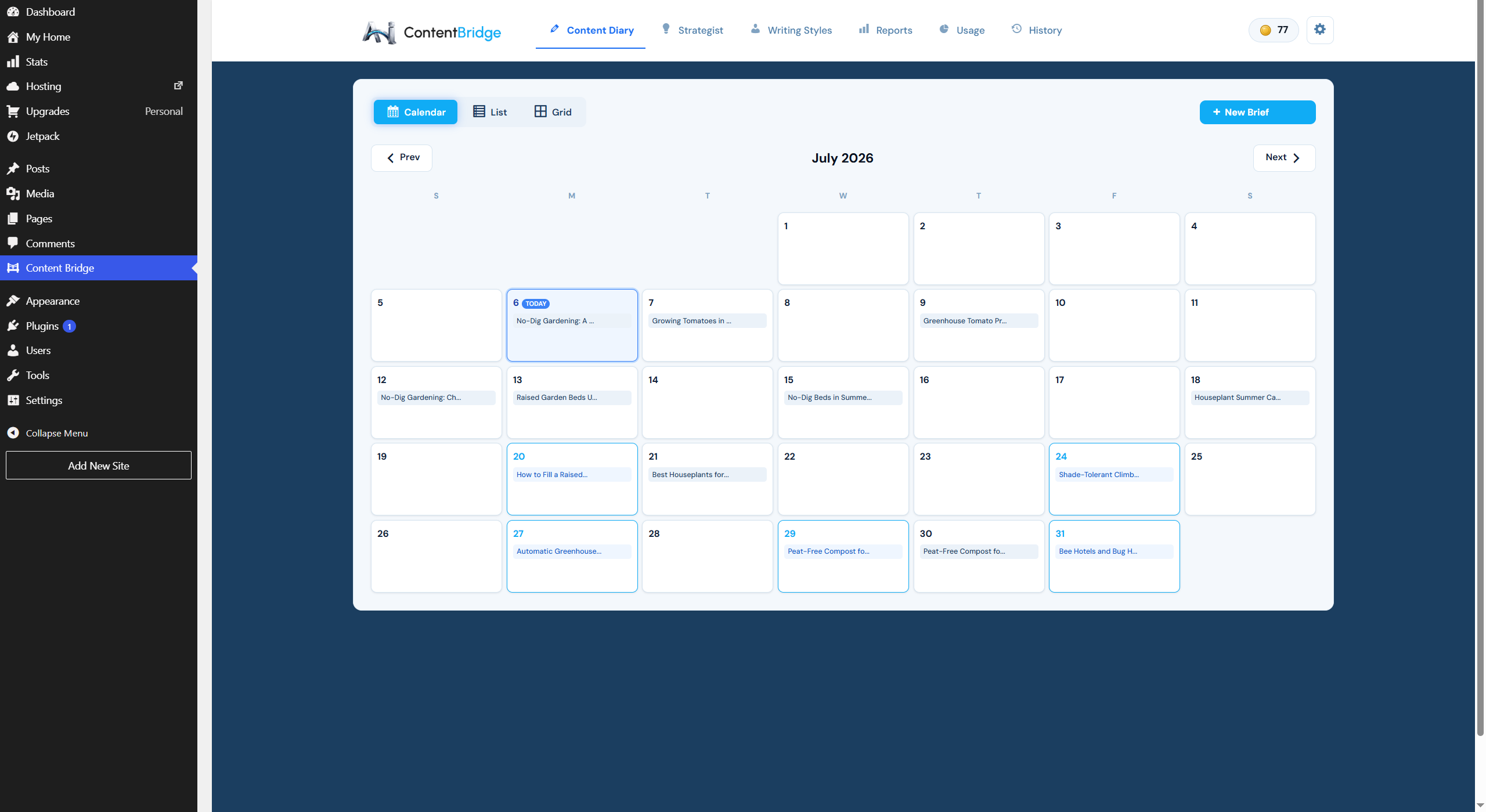
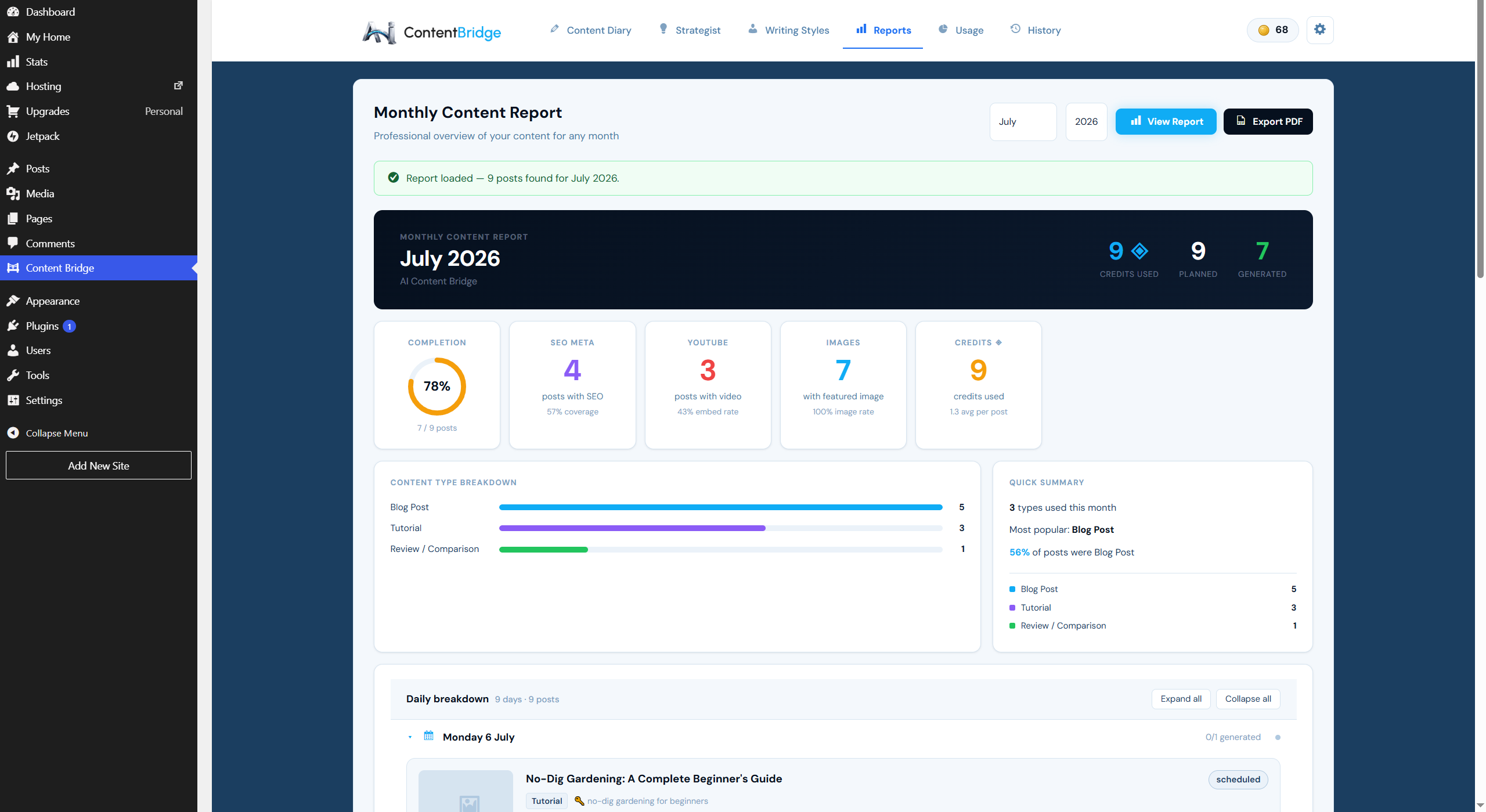
![[The Content Diary with SEO scores]](https://ps.w.org/ai-content-bridge/assets/screenshot-4.png?rev=3612575)
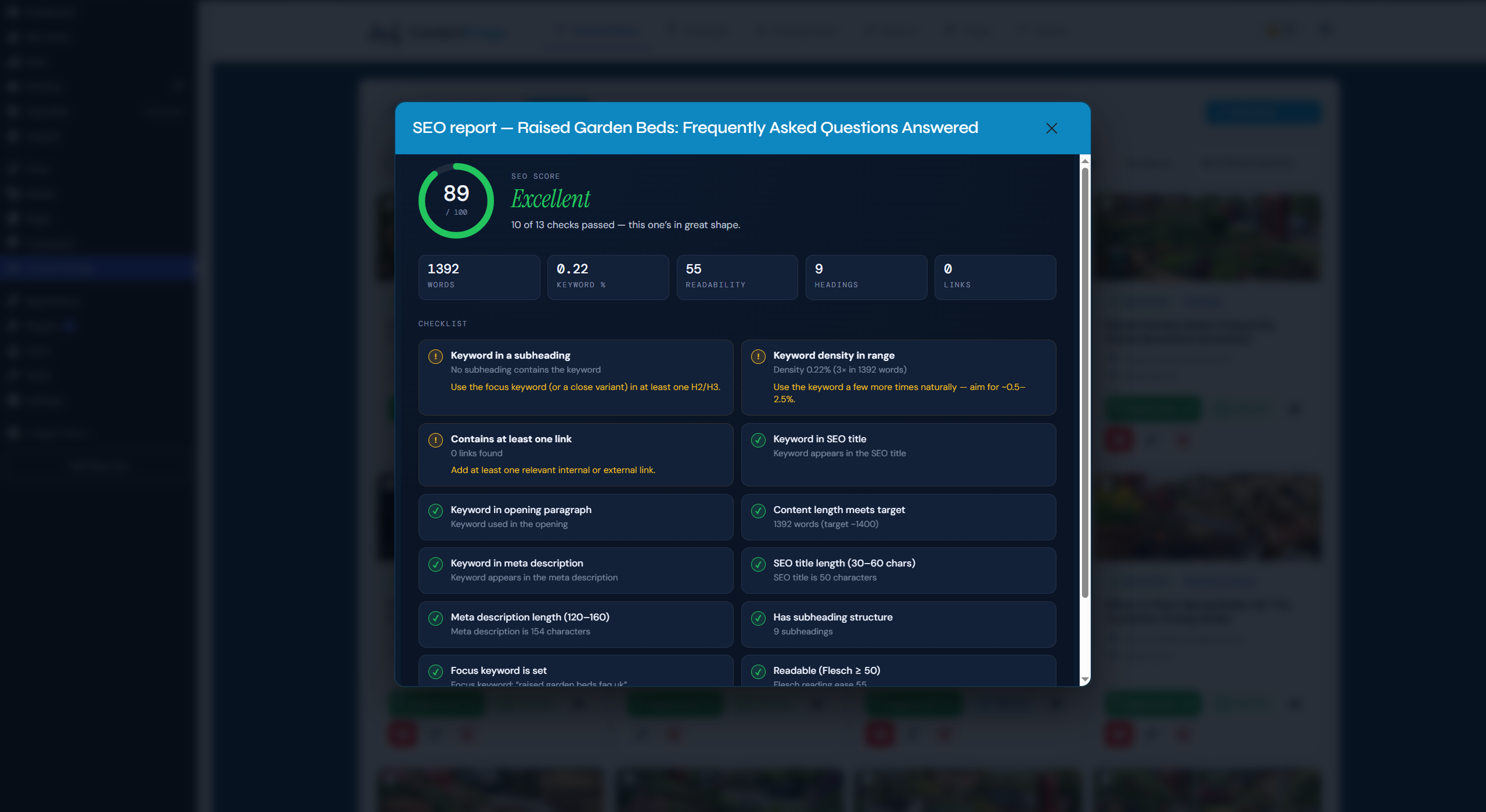
![[A generated article with its SEO report]](https://ps.w.org/ai-content-bridge/assets/screenshot-5.png?rev=3612575)
Installation
- Upload the plugin to your site and activate it, or install it from the WordPress plugin directory.
- Go to the AI Content Bridge settings in your WordPress admin.
- Enter your licence key and save. Your licence locks to this site’s domain on first use.
- Open AI Content Bridge, choose a content type, fill in the brief, and generate.
Pretty permalinks must be enabled and your site’s REST API reachable so generated content can be published back to your site.
FAQ
-
Do I need my own AI API keys?
-
No. Generation runs on the AI Content Bridge service; you don’t supply or pay for any AI provider keys.
-
Is there a free version?
-
Yes. The free plan includes the Blog Post type with an AI image and SEO metadata. Paid plans add more content types, features and credits.
-
What happens if a generation fails?
-
Credits are deducted just before generation and refunded automatically if it fails, so a failed run doesn’t cost you credits.
-
Why didn’t my content publish?
-
The most common cause is the WordPress REST API being blocked by a security plugin, or pretty permalinks being disabled. See the documentation’s Troubleshooting page.
-
Is my licence tied to one site?
-
A licence locks to the first domain it’s used on. To move it to another site, contact support.
Reviews
There are no reviews for this plugin.
Contributors & Developers
“AI Content Bridge” is open source software. The following people have contributed to this plugin.
Contributors
Translate “AI Content Bridge” into your language.
Interested in development?
Browse the code, check out the SVN repository, or subscribe to the development log by RSS.
Changelog
2.8.4
- Fixed: target keywords in the Content Strategist now save immediately when added or removed — previously changes could be lost on refresh unless a plan was run.
2.8.3
- Fixed: bulk delete in the Content Diary now deletes entries permanently, not just from the current view.
- Fixed: entries with multiple generated images no longer show two image buttons — just the gallery counter.
- Fixed: restores the correct admin interface build — version 2.8.2 was packaged with an outdated interface bundle, which could cause the dashboard logo not to display and reverted some recent interface improvements.
2.8.2
- Fixed: bulk delete persistence and a duplicate image button in the Content Diary (re-released as 2.8.3 due to a packaging error).
2.8.1
- New: ACF field targeting now works for standard posts and pages as well as custom post types.
- Changed: every feature implemented locally in the plugin is now available on all plans with no tier conditions — plan tiers apply only to the external generation service. This includes the ACF field selector, the YouTube embed option and Writing Style Profiles.
- Changed: removed the attribution line previously appended to free-plan content.
- Changed: all fonts (admin and front-end) are now self-hosted inside the plugin — no requests to Google Fonts.
- Changed: options, classes, functions, script handles and post meta now use the distinct
aicobr_prefix; existing data is migrated automatically and legacy option values are retained for one release as a rollback safety net. - Changed: the REST namespace is now
aicobr/v1; the previousai-content/v1namespace remains registered as a working alias for the transition. - Hardened: REST routes that modify the Content Diary or spend credits now require the
manage_optionscapability by default (filterable viaaicobr_rest_capability). - Changed: the bundled Parsedown library is renamed
AICOBR_Parsedownso it can never conflict with another plugin’s or theme’s copy. - Removed: unnecessary WordPress core admin includes.
2.8.0
- Hardened: your content records — SEO reports, featured images and newsletter drafts — are now protected against a rare save-timing issue that could briefly blank them immediately after generation. New server-written fields are protected automatically going forward.
2.7.0
- New: AI Content Strategist — turn your business context and target keywords into a reviewable, dated multi-month content plan that populates your Content Diary as scheduled drafts.
- New: Content Diary grid view and a sort dropdown (recent activity, date added, scheduled date, status, title).
- Improved: per-content-type length profiles for more natural, better-fitting article lengths.
- Improved: large content libraries stay fast — Content Diary entries now load as you scroll, in both list and grid.
- Improved: the credit balance now refreshes instantly after each generation, with much lighter background usage.
- Fixed: featured-image generation tuned for quality and cost (gpt-image-1.5).
- Hardened: generation pipeline resilience so a single failed job can never interrupt others.
2.6
- New: SEO Intelligence — a built-in SEO score on every generation and an editable, search-grounded outline review for keyword-led content types.
- [Add further 2.6 notes as needed.]
2.x
- [Earlier release notes.]